+1Kontinente:EU

2. Diagnose
2.1. Männchen
2.2. Falter
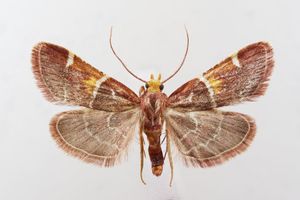
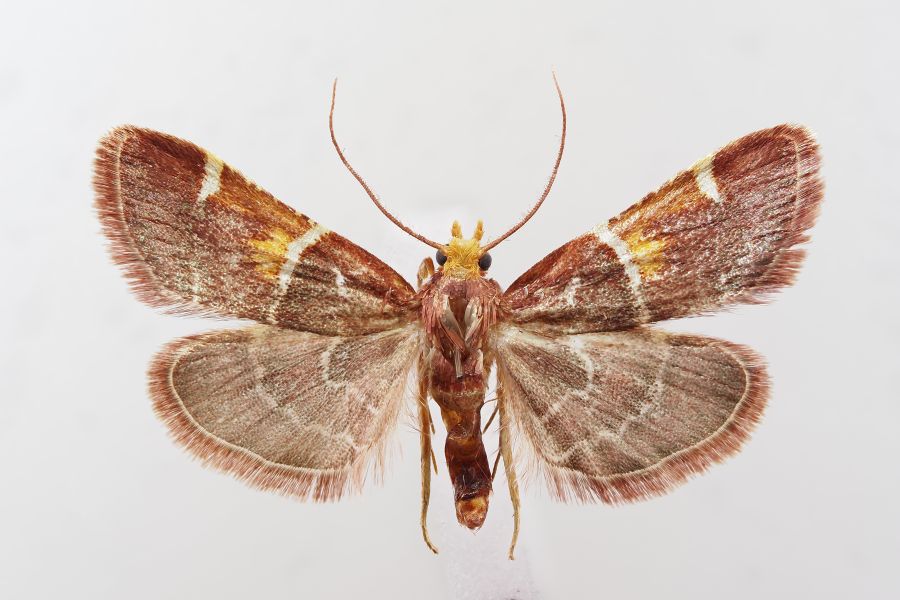
Überraschenderweise lassen sich die Falter der neu beschriebenen Art schon nach äußeren Merkmalen relativ sicher von anderen Arten der Pyralis regalis-Gruppe trennen. Huemer et al. (2026: 167) erklären: "Pyralis papaleonei sp. nov. is distinguished from all congeners by its narrow white forewing markings, featuring an almost uniformly slender white median band extending across the entire wing (Figs 2, 3). In all other species of the group (Figs 4, 5), except for specimens of P. kacheticalis from Cyprus, the white pattern elements are distinctly broader, and in some cases abruptly narrowed medially or terminating in the middle of the wing. Also characteristic are the nearly uniform pale greyish-purple hindwings, which are divided into three sections by two white lines; the basal section is only slightly darker than the outer sections. In contrast, in P. kacheticalis (Fig. 4) and P. sagarrai particularly the median and also the outer sections of the hindwings are much lighter than the remaining areas, while the basal section is conspicuously darkened and clearly demarcated. The hindwings of P. regalis (Fig. 5) and P. cardinalis, which are likewise slightly darker overall, are densely suffused with a light purplish tinge of variable intensity, especially the marginal area. Moreover, the white pattern on the forewings of all these three species is broader. Finally, P. princeps and P. joannisi are easily distinguished from the new species by features such as forewing with pointed apex and with a much darker ground colour, extensive purple suffusion along the fore- and hindwing margins, and conspicuously broad and short white streaks of the forewing (see Wikström et al. 2020)."
4. Weitere Informationen
4.1. Etymologie (Namenserklärung)
Huemer et al. (2026: 72-73) begründen ihre überraschende Namenswahl: "The new species is dedicated to the head of the Catholic Church, Pope Leo XIV. The Pontiff is a strong advocate of climate and environmental protection, and we hope that his voice may serve as an example for humanity. Furthermore, due to its distinctive coloration and overall appearance, the new species belongs to a group of Pyralidae whose species names refer to high secular or ecclesiastical offices, including Pyralis regalis, Pyralis imperialis (= P. kacheticalis), Pyralis princeps, and Pyralis cardinalis. In der [Pressemitteilung des Tiroler Landesmuseums vom 29. April 2026] wird die Namenswahl noch etwas vertieft beleuchtet. "Taxonomie als „erster Beruf“ des Menschen" ist jedenfalls bedenkenswert.
4.2. Taxonomie
Dass sich beim Barcoding scheinbar unverwechselbarer Arten manchmal Überraschungen ergeben, hat sich im letzten Jahrzehnten auch im Pyralis regalis-Komplex gezeigt, was zur Beschreibung von Pyralis cardinalis und zur Aufwertung von Pyralis sagarrai zur bona species führte (Wikström et al. 2020). Doch auch danach gab es innerhalb der Gruppe und innerhalb einzelner Arten noch immer eine große Barcode-Variabilität, so dass mit der Beschreibung weiterer Arten zu rechnen war und weiter zu rechnen ist. Huemer et al. (2026: 72) erklären zum Barcode der neuen Art: "BIN: BOLD:AAY9338. The minimum distance to the nearest neighbour, P. kacheticalis populations from Greece (Samos), Ukraine, Armenia and Iraq is 5.78% (BIN: BOLD:ABA9291), whereas the minimum distance to P. regalis is 9.4% (BIN: BOLD:AAP5668)." Huemer et al. (2025) hatten die Art noch als "Pyralis kacheticalis" von Kreta gemeldet.
4.3. Faunistik
Die neue Art ist ziemlich sicher ein Endemit von Kreta, der dort an die etwas höheren Lagen gebunden ist. Huemer et al. (2026: 72-73) schreiben dazu: "Only known from few localities in the White mountains in western Crete." Und weiter in ihrer Diskussion: "The discovery of a new endemic Lepidoptera species on Crete fits seamlessly into the series of species descriptions that have been published from the island in the last few decades. Indeed, 40% of the currently documented 76 endemic species of the island have been described since the turn of the millennium (Huemer et al. 2025). Nevertheless, the new species is surprising—especially considering that in the nearest regions of Greece (Peloponnese) and Cyprus two other members of the species group, respectively, P. regalis and P. kacheticalis, are present. This may partly explain why P. papaleonei sp. nov. has so far been overlooked and was initially misidentified in BOLD as P. kacheticalis. Furthermore, the species appears to occur mainly in the less intensively sampled mountain regions of Crete, and has therefore been collected by only a few entomologists." Immerhin stammt die Art aus einer Gebirgsregion, aus der noch eine ganze Reihe weiterer Endemiten unter den Schmetterlingen beschrieben wurden: Herrichia vilhelmseniella Karsholt & Lvovsky, 2018 (Oecophoridae), Teleiodes albiluculella Huemer & Karsholt, 2001 (Gelechiidae), Peribatodes omalensis Rajaei, Skou & Hausmann, 2019 (Geometridae), und Cryphia omalosi Fibiger & Svendsen, 1998 (Noctuidae). Weitere Arten warten noch auf ihre Beschreibung.
4.4. Typenmaterial
Huemer et al. (2026: 67) listen: "Holotype. Greece • ♂; Crete, Omalos, Mikes House; 1075 m; 35°20’04”N, 23°53'03"E; 18 June 2025; leg. Huemer; TLMF. Paratypes. Greece • 8 ♂; same data as holotype; gen. slide PYR 390 P. Huemer; TLMF • 11 ♂, same data, 20 June 2025; DNA Barcodes TLMF Lep 46643, 46444, 46645, 46646; TLMF • 2 ♂; Crete, Lakki, 4.2 km SSW; 920–930 m; 35°22’00”N, 23°54'52"E; 19 June 2025; leg. Huemer; TLMF • 9 ♂, 2 ♀; Crete, Omalos plateau, 1 km Kalergi; 1225 m; 35.3202°N, 23.9215°E; 15–20 June 2014; leg. C. Hviid, O. Karsholt & F. Vilhelmsen; ZMUC • 7 ♂; Crete, Omalos plateau; 1040 m; 35.3443°N, 24.9048°E; 14–20 June 2014; leg. C. Hviid, O. Karsholt & F. Vilhelmsen; ZMUC • 1 ♂, 1 ♀; Crete, 1.7 km S Topolia; 1040 m; 35.2442°N, 23.8054°E; 14–19 June 2014; leg. C. Hviid, O. Karsholt & F. Vilhelmsen; gen. slide Kaila 6311; ZMUC • 1 ♀; Crete, 10.5 km W Omalos plateau; 760 m; 35.3489°N, 23.8154°E; 18 June 2014; leg. C. Hviid, O. Karsholt & F. Vilhelmsen; ZMUC • 1 ♂; Crete, Fassatal; 270 m; 35°24’N, 23°53'E; 11 October 1972; leg. H. Malicky; TLMF • 1 ♂; Crete, Omalos-Hotel; 1041 m [“1000 m”]; 35.34429 N; 23.9046 E; 05 July 2010; DNA Barcode BC ZSM Lep 46538; leg. W. Ruckdeschel; ZSM."
(Autor: Erwin Rennwald)
4.5. Literatur
- Huemer, P., Berggren, K., Aarvik, L., Rennwald, E., Hausmann, A., Segerer, A., Staffoni, G., Aspaas, A.M., Trichas, A. & P.D.N. Hebert (2025): Extensive DNA Barcoding of Lepidoptera of Crete (Greece) Reveals Significant Taxonomic and Faunistic Gaps and Supports the First Comprehensive Checklist of the Island’s Fauna. — Insects 2025, 16, 438: 1-21. https://doi.org/10.3390/insects16050438. [zum open access-Artikel mit PDF-Download auf mdpi.com]
- Erstbeschreibung: Huemer, P., Kaila, L. & A.H. Segerer (2026): Pyralis papaleonei sp. nov. from Crete (Greece) (Lepidoptera, Pyralidae). — Nota Lepidopterologica, 49: 63–74. [zum open access-Artikel auf nl.pensoft.net]
- Wikström, B., Huemer, P., Mutanen, M., Tyllinen, J. & L. Kaila (2020): Pyralis cardinalis, a charismatic new species related to P. regalis [Denis & Schiffermüller], 1775, first recognized in Finland (Lepidoptera, Pyralidae). — Nota Lepidopterologica, 43: 337–364. [zum open-access-Artikel und PDF download auf pensoft.net]