+5Kontinente:ASAF


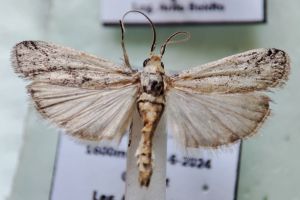

2. Diagnose
2.1. Männchen

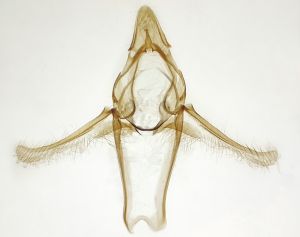
2.2. Genitalien
2.2.1. Männchen

4. Weitere Informationen
4.1. Andere Kombinationen
- Myrlaea pulverulentella Ragonot, 1888 [Originalkombination]
- Morosaphycita pulverulentella (Ragonot, 1888) [von Leraut (2022) bis Speidel (2026) kurzfristig verwendete Kombination]
- Pempeliopteryx pulverulentella (Ragonot, 1888) [von Leraut (2014) bis Leraut (2022) übliche Kombination]
4.2. Synonyme
- Faveria tchourouma (Amsel, 1961) [synonymisiert durch Slamka (2019)]
4.3. Taxonomie
Leraut (2014) stellte die Art in die von ihm aufgestellte Gattung Pempeliopteryx. Sein Sohn Leraut (2022) kombinierte sie neu zu Morosaphycita pulverulentella. Speidel (2026) sieht in Morosaphycita ein Synonym zu Melathrix, drei Arten, die zuvor in Pempeliopteryx gestanden hatten, werden in diese wieder restaurierte Gattung rückgeführt: "Morosaphycita Horak, 1997 and Lugubraphycita Leraut, 2021 are junior synonyms of Melathrix Ragonot, 1893 (syn. nov.). Neurotomia Chrétien, 1911 is reinstated as a synonym of Melathrix (syn. rev.), while Pempeliopteryx Leraut, 2014 is provisionally restored as a separate genus (stat. rev.). The genus Melathrix, as herein defined, is primarily based on the structure of the corema on the abdominal sternite 8 (culcita)." Die provisorische Akzeptanz von Pempeliopteryx wird begründet mit: "Die Coremata sind sehr ähnlich denjenigen der typischen Melathrix-Arten, allerdings ist der vordere Fortsatz viel kürzer und breiter (siehe Abb. 1G). Die Valven sind terminal löffelartig erweitert."
4.4. Faunistik
Gemäß der Erstbeschreibung von Ragonot (1888: 23) wurde die Art aus "Palestine" beschrieben - der locus typicus liegt also entweder in Israel oder in den Palästinensischen Autonomiegebieten. Slamka (2019: 116) meldet zusammenfassend zur Verbreitung: "Tunisia (Bou Hedma, ex coll. Dumont, coll. NHMW), Egypt, Palestine, Iran." Er hält ein Vorkommen auf Zypern für möglich. Die Angabe aus dem Iran bezieht sich auf den locus typicus des Synonyms Faveria tchourouma: Tchouroum, 1000 m.
(Autor: Erwin Rennwald)
4.5. Typenmaterial
Amsel (1961: 382) beschrieb Oligochroa tchourouma nach einem einzigen Falter: „GU. 3704. Monotypus: 1 ♂ Tchouroum 1000 m, 1937.“
4.6. Literatur
- Beschreibung als Oligochroa tchourouma: Amsel, H. G. (1961): Die Microlepidopteren der Brandt'schen Iran-Ausbeute. 5. Teil. — Arkiv för Zoologi N. S. 13 (17): 323-445, pl. I-IX.
- Leraut, G.H.C. (2019): Contribution à la connaissance des Pyralidae Phycitinae de Madagascar, des Comores et des Mascareignes (III) – Révision et inventaire des espèces présentes à Madagascar et dans les Mascareignes. Supplément à la Faune de Madagascar. — Revue Française d’Entomologie Générale, Autun, 1 (2): 38–198. [Sekundärzitat nach globiz.pyraloidea.org]
- Leraut, G.H.C. (2021): A global comprehensive checklist of the Phycitinae (Lep.: Pyraloidea, Pyralidae). — Revue Française d’Entomologie Générale, Autun, 2 (5–6, Supplement): 1–371, tables. [Sekundärzitat nach globiz.pyraloidea.org]
- Leraut, G.H.C. (2022): Addendum et corrigendum au Spécies général des Phycitinae (Lepidoptera, Pyraloidea) (I). — Revue Française d’Entomologie Générale, Autun, 4 (9): 275–282. [Sekundärzitat nach globiz.pyraloidea.org]
- Leraut, P. (2014): Moths of Europe. Volume 4. Pyralids 2. - 441 S.; Verrières-le-Buisson (N.A.P Editions).
- Mabille, P. [Prés.] (1890): Séance du 11 juin 1890. — Bulletin des séances et bulletin bibliographique de la Société entomologique de France 1890: CIV-CXVI.
- Erstbeschreibung: Ragonot, E.-L. (1888): Nouveaux genres et espèces de Phycitidae & Galleriidae: 1-52. Paris (Imprimerie Grandremy et Henon).
- Slamka, F. (2019): Pyraloidea (Lepidoptera) of Europe. Volume 4. Phycitinae - Part 1. Identification - Distribution - Habitat - Biology. - 432 S., 175 Taf. mit Genitalabb., 31 Farbtaf. mit mehr als 900 Bildern zu 207 Arten; Bratislava (Eigenverlag František Slamka).