+13Kontinente:EUAS


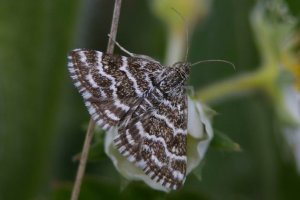
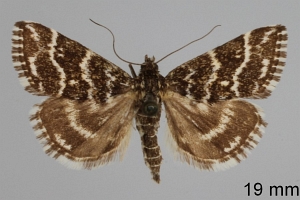
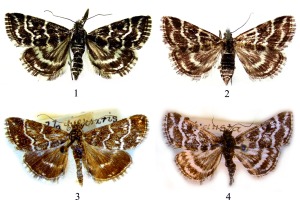
1. Lebendfotos
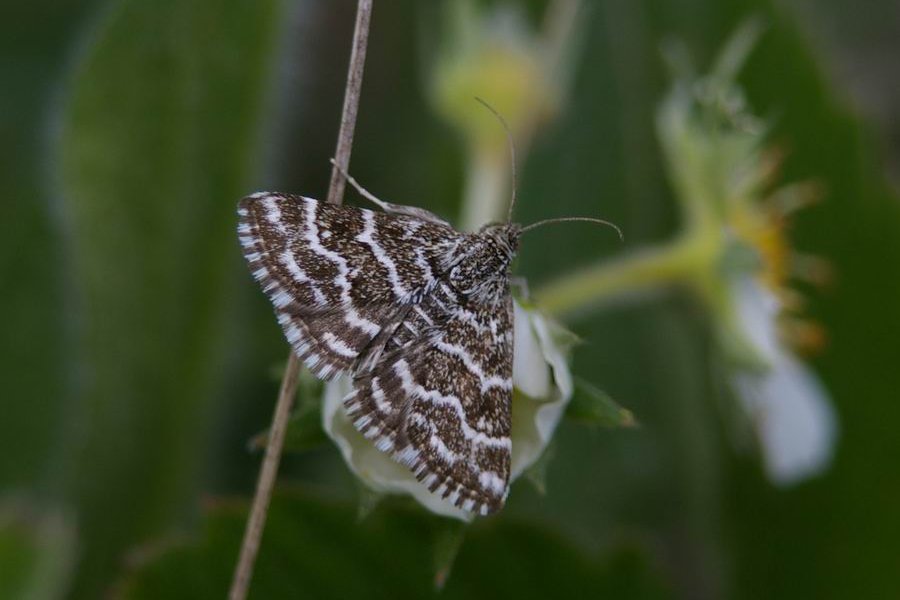
1.1. Falter
2. Diagnose
2.1. Männchen

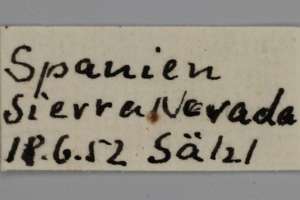
2.2. Geschlecht nicht bestimmt

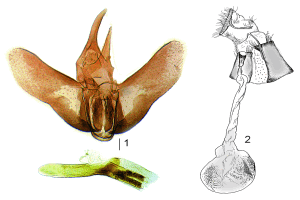
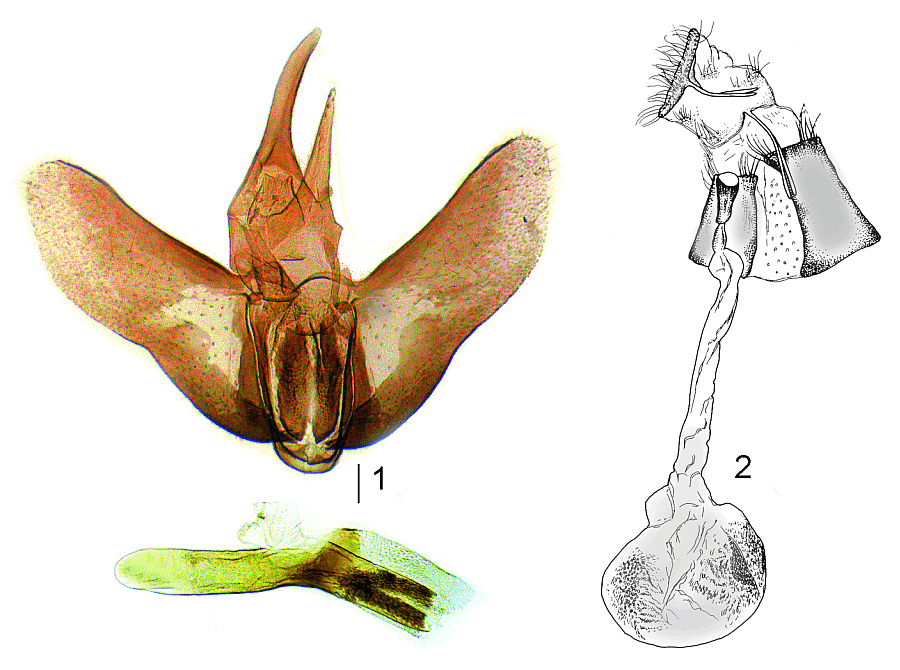
2.3. Genitalien
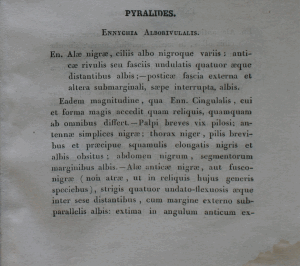
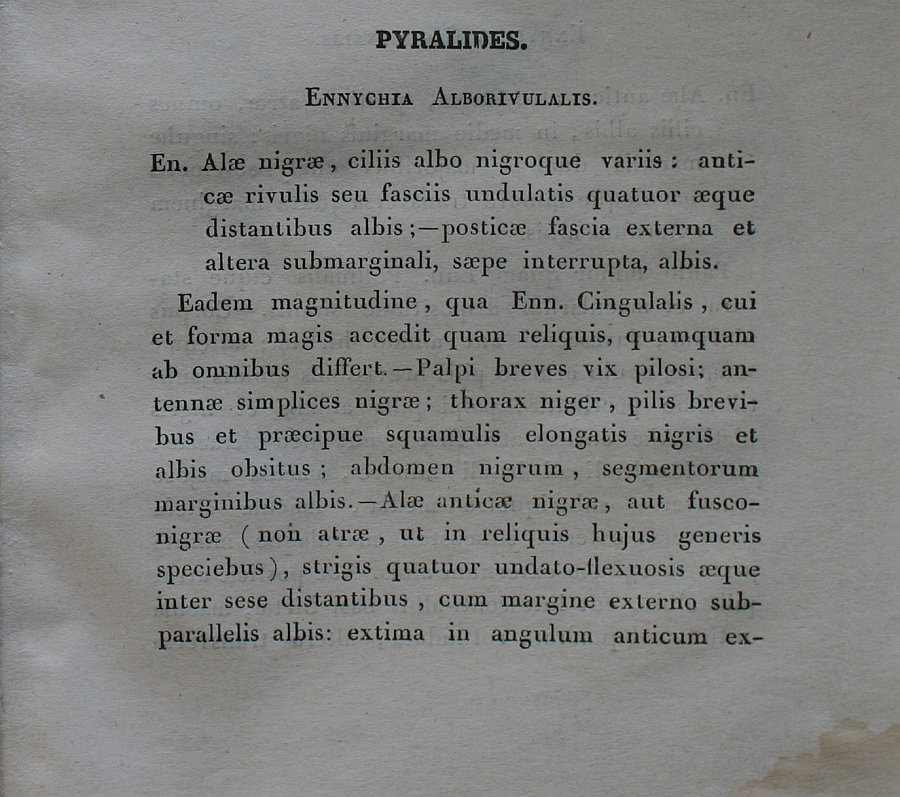
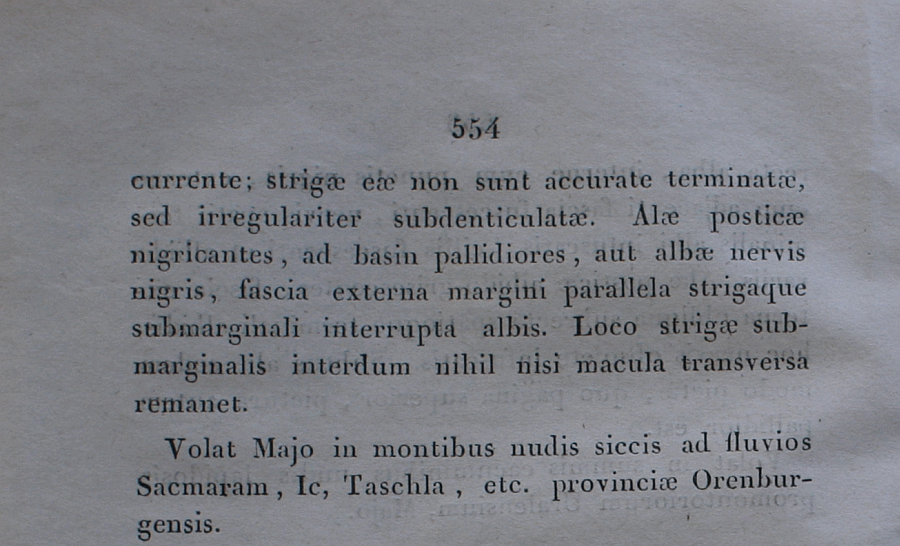
2.4. Erstbeschreibung
3. Biologie
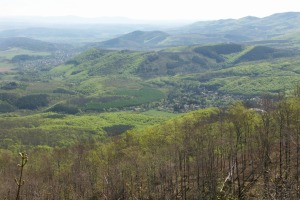
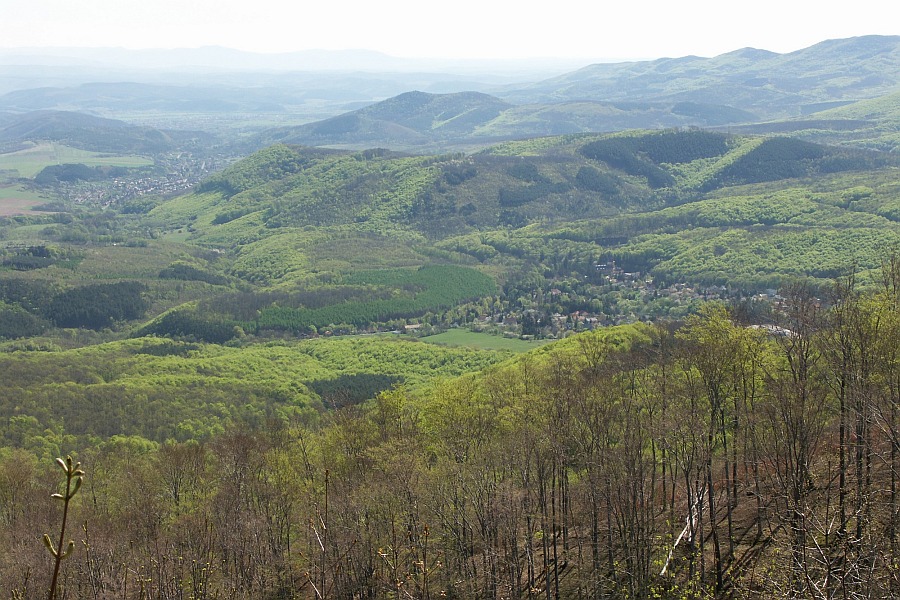
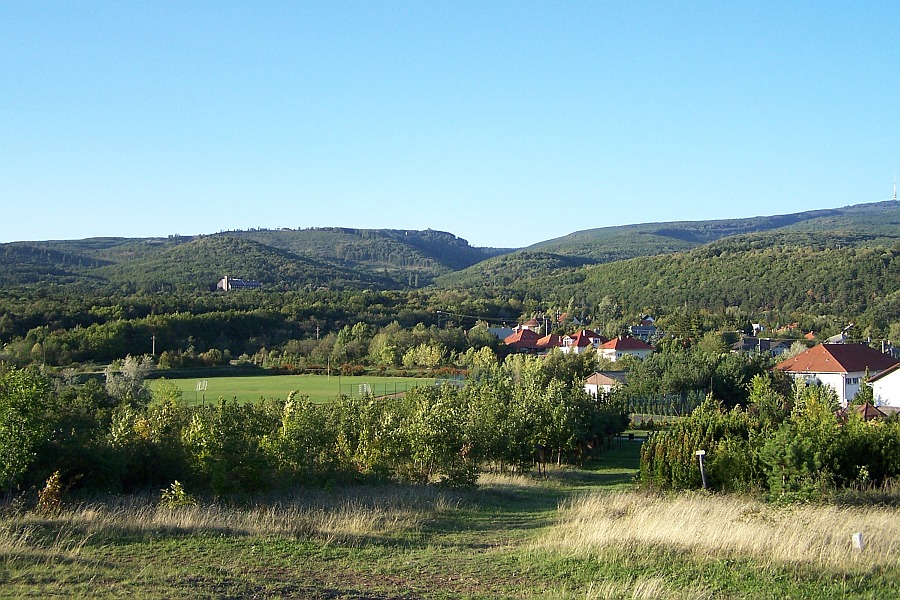
3.1. Habitat
3.2. Nahrung der Raupe
Noch unbekannt! Es ist natürlich zu erwarten, dass auch diese Art als Raupe an Brassicaceae lebt, aber dazu scheint es noch nicht einmal einen Zuchtversuch gegeben zu haben, geschweige denn einen Freilandfund.
(Autor: Erwin Rennwald)
4. Weitere Informationen
4.1. Andere Kombinationen
- Ennychia alborivulalis Eversmann, 1844 [Originalkombination]
- Reskovitsia alborivulalis (Eversmann, 1844) [so bei Karsholt & Razowski (1996)]
4.2. Synonyme
- Evergestis canalesialis Hampson, 1913
4.3. Faunistik
Von Karsholt & Razowski (1996) und der Fauna Europaea (Fauna Europaea Web Service. Last update 23 December 2010. Version 2.3. [nicht mehr online verfügbar]) wurde die Art vor allem aus Südosteuropa, aber auch aus Spanien angeführt. Siehe auch Fazekas (2013). Im Osten ist die Art auch aus dem Südural nachgewiesen, außerhalb Europas auch im Süden Sibiriens. Plant & Jakšić (2020: 75) erklären das stark zersplitterte Areal in Südeuropa: "This highly localised distribution in the European region can be explained by isolation of populations within separate glacial refuges followed by inter- and post-glacial expansion to the present distribution area."
Plant & Jakšić (2020) publizierten "A contribution to the knowledge of the Balkan Lepidoptera: Evergestis alborivulalis (Eversmann, 1843) Crambidae: A new species for Serbia." Sie zeigen ein attraktives Freilandfoto eines Falters beim Blütenbesuch und erklären: "Whilst examining Lepidoptera in the Jadovnik Mountains of western Serbia on 8 June 2015 one of us (PJ) encountered an attractive moth at a flower of Dianthus (Plate 1). He identified the moth, tentatively, as Evergestis alborivulalis and this name was subsequently confirmed, from the photograph, by CWP who added that is appeared to be a female (although the tip of the abdomen is not visible, Dr Jelica Novaković kindly named the flower upon which it was feeding as Dianthus carthusianorum L." Dieser erste Fundort in Serbien passt in das bekannte Raster, dass die Art montane Lagen besiedelt: "The present record is no exception, being made at 1276 metres asl near Kašanj village, in the Prijepolje district at coordinates 43°19’36"n; 19°46 44"E." Der Eintrag für Serbien wurde im Lepiforum zunächst übersehen. Dann meldete Colin W. Plant (e-Mail 11. August 2026 an E. Rennwald): I also found “E. alborivulalis” at a new site in Serbia, (Tzaribrod region, Vidlic Mountain, Vistni kamen near Baceva, 736m, 11.viii.2024). Please add this species to the map for Serbia." Die beiden Fundorte liegen in unterschiedlichen Gebirgen, mehrere hundert Kilometer entfernt voneinander.
Plant & Jakšić (2020) machten sich die Mühe, die Nachweise aus den einzelnen Balkanländern detailliert zusammenzustellen: "A closer examination of the original sources of the Balkan records is revealing. Matthew (1881) noted it for European Turkey at Gallipoli, in 1878. It was recorded new to Bosnia-Herzegovina in 1914 by Schawerda (1916), who also mentioned Turkey [“Türkei. Ural. Hawelka legit.”] – though at that date the political boundary of Turkey was different and incorporated the whole southern part of present-day Bulgaria. Bosnia-Herzegovina is also listed by Fazekas (2013). For Bulgaria, records were summarised by Plant (2016); the earliest appears to be that from Varna in 1861 or 1862 (Lederer, 1863) – repeated in Ganev (1988) and there are later records from Burgas in 1911 (also repeated by Ganev in 1988), at 1000 metres in the Stara Planina without date (reported by Drenowski in 1925) and Strandzha Mountains, also undated, given in Ganev (1988). There are only two modern records– from Krumovgrad, 380 metres) in 2010 (Zlatkov & Ganeva leg.) and the Eastern Rhodopes in 2014 (Beshkov leg.). Plant & Jakšić (2018) also included Greece, based on reports in Sumpich & Skyva (2014) and Zilli & Pavesi (2015). Thus, whilst the moth is spread widely across the Balkans the distribution is highly disjunct and the moth perhaps numerically rare. The majority of reports appear to be historical. With certainty, the present record represents an addition to the Serbian fauna."
Die Art ist weit verbreitet, aber offensichtlich durchweg sehr rar und wahrscheinlich hochgradig gefährdet. In den meisten der angeführten Arbeiten ist jeweils nur vom Fund eines einzelnen Exemplars die Rede - und die Mehrzahl der Funde ist alt. So etwa meldete Matthew (1881) die Art für 1878 von Gallipoli (jetzt Gelibolu) im europäischen Teil der Türkei.
(Autor: Erwin Rennwald)
4.4. Literatur
- Erstbeschreibung: Eversmann, E. (1843): Quædam lepidopterorum species novæ, in montibus Uralensibus et Altaicis habitantes, nunc descriptæ et depictæ. — Bulletin de la Société Impériale des Naturalistes de Moscou 16 (3): 535-555, pl. VII-X.
- Fazekas, I. (2013): Disjunct distribution of Evergestis alborivulalis (Eversmann, 1843) in the Palaearctic (Lepidoptera: Crambidae, Evergestinae). — Natura Somogyiensis 23: 211-220 [PDF auf microlepidoptera.hu].
- Ganev, J., (1988): Katalog der Unterfamilien Pyraustinae, Euclastinae, Acentropinae und Nachtrag zur Untersuchung der Pyraloidea in Bulgarien (Lepidoptera). — Stapfia, 16: 85-113.
- Goater, B., Nuss, M. & Speidel, W. (2005): Pyraloidea I (Crambidae: Acentropinae, Evergestinae, Heliothelinae, Schoenobiinae, Scopariinae). - In: Huemer, P. & Karsholt, O. (Hrsg.): Microlepidoptera of Europe 4: 1-304.
- Lederer, J. (1863): Verzeichnis der von Herrn Johann und Frau Ludmilla Haberhauer 1861 und 1862 bei Varna in Bulgarien und Sliven in Rumelien gesammelten Lepidopteren. — Wiener Entomologische Monatsschrift, 7: 17-27; 40-47, t. 1; Figs 1-13. [S. 42, Digitalisat auf biodiversitylibrary.org]
- Matthew, G.F. (1881): List of Lepidoptera observed in the neighbourhood of Gallipoli, Turkey, in 1878. Entomologist’s Monthly Magazine, 18: 10-13; 29-32; 92-100. [S. 100, Digitalisat auf biodiversitylibrary.org]
- Plant, C.W. (2016): An annotated, systematic, synonymic and distributional checklist of the Pyraloidea of Bulgaria. — Neue Entomologische Nachrichten, 72: 1-351.
- Plant, C. & P. Jakšić (2018): A provisional checklist and bibliography of the Pyraloidea of the Balkan Peninsula (Lepidoptera: Pyralidae & Crambidae). — Atalanta 49(1-4): 219-263. [pdf auf researchgate.net]
- Plant, C. W. & P. Jakšić (2020): A contribution to the knowledge of the Balkan Lepidoptera: Evergestis alborivulalis (Eversmann, 1843) Crambidae: A new species for Serbia. — The Entomologist's Record and Journal of Variation 132: 74-76. [zum PDF-Download auf researchgate.net]
- Schawerda, K. (1916): Neunter Nachtrag zur Lepidopterenfauna Bosniens und der Herzegowina. — Verhandlungen der kaiserlich-königlichen zoologisch-botanischen Gesellschaft in Wien 66 (3-5): 227-256. [PDF auf zobodat.at]
- Šumpich, J. & J. Skyva (2014): Faunistic records of new and poorly known Microlepidoptera (Insecta) from Europe. — Annalen des Naturhistorischen Museums Wien, Serie B 116: 5-12. [PDF auf entomologicalservice.com] [PDF auf zobodat.at]
- Zilli, A. & F. Pavesi (2015): New or little known Pyraloids from Italy (Lepidoptera: Pyraloidea). — Phegea, 43 (3): 81-96. [zum PDF-download auf researchgate.net]