+27Kontinente:EUAS


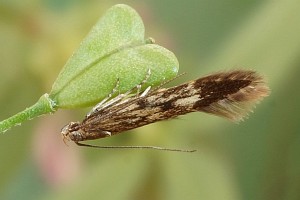
1. Lebendfotos
1.1. Falter




2. Diagnose
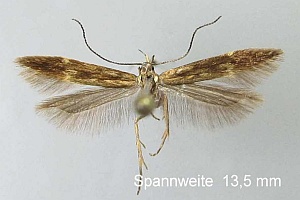
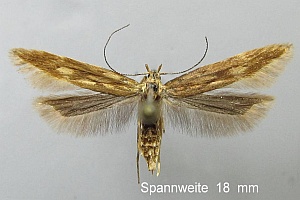
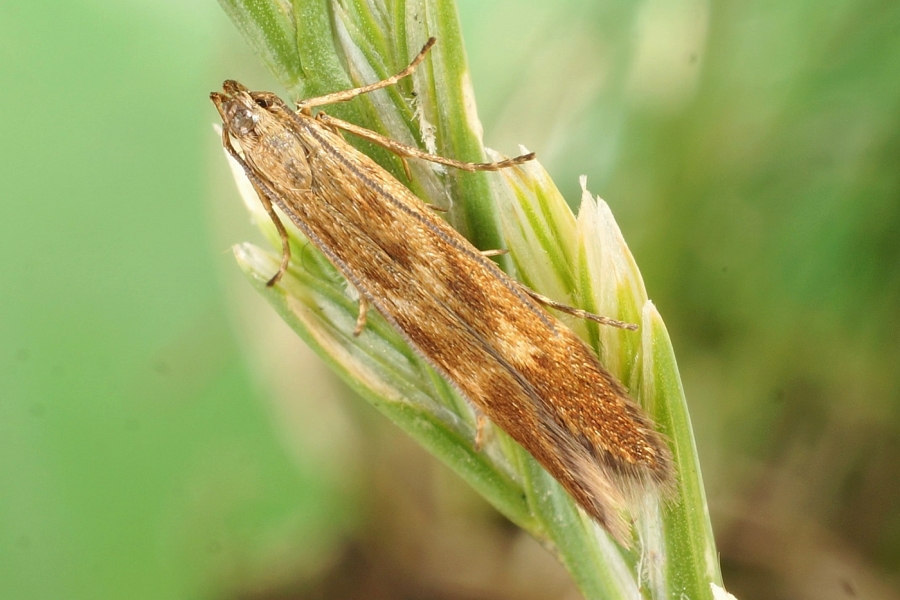
Diese Art variiert in der Größe (meine Sammlungsbelege haben eine Spannweite von 11 mm bis 19 mm), aber auch die Ausprägung der hellen und dunklen Zeichnungselemente ist nicht konstant. (Friedmar Graf)
2.1. Männchen


2.2. Weibchen

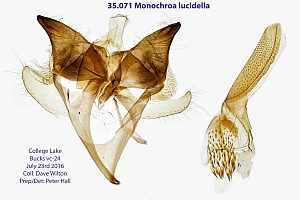
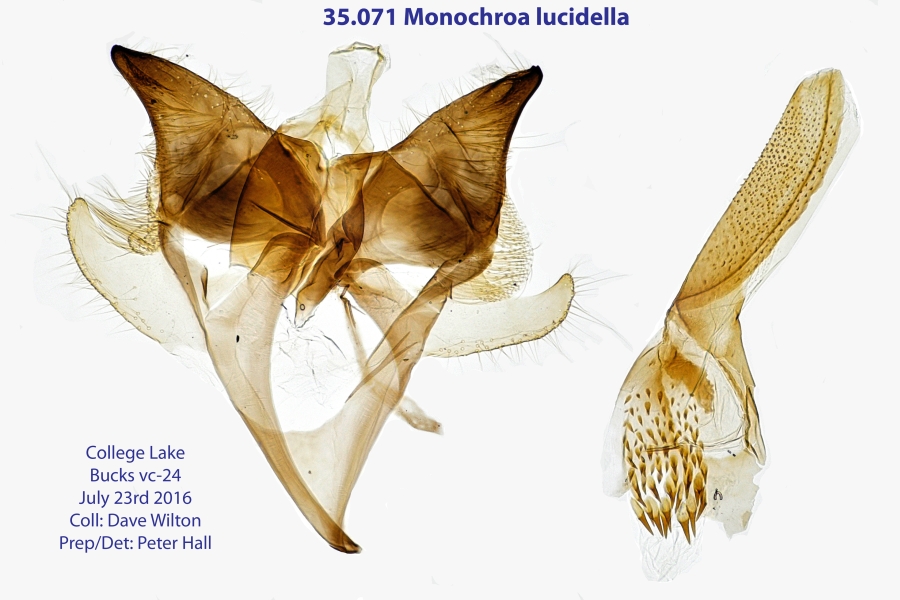
2.3. Genitalien
2.3.1. Männchen
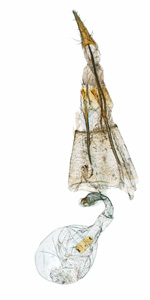
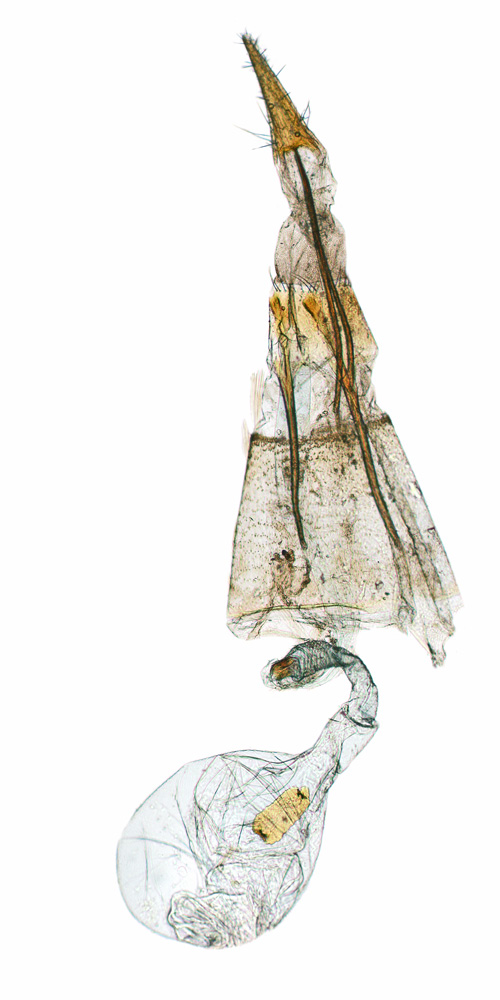
2.3.2. Weibchen
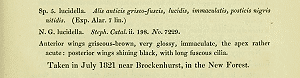
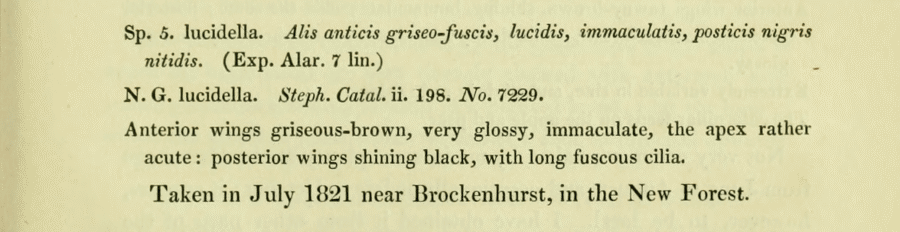
2.4. Erstbeschreibung
3. Biologie
3.1. Lebensraum
Monochroa lucidella findet man um Gewässer, Gräben oder feuchte Stellen. Den Falter kann man an trüben Tagen aufscheuchen, er kommt aber auch ans Licht. [Friedmar Graf]
3.2. Nahrung der Raupe
- [Cyperaceae:] Eleocharis palustris (Gewöhnliche Sumpfbinse)
Die Raupe war in Binsen (Juncus und verwandte Gattungen) vermutet worden, gefunden wurde sie dann aber in Sumpfbinsen der Gattung Eleocharis. Gregersen & Karsholt (2022: 314) erklären: "Host-plant. Eleocharis palustris. A record from Schoenoplectus lacustris (as Scirpus lacustris (Walsingham 1898: 205) was due to confusion with Eleocharis palustris (Walsingham 1906: 232). The larva mines the stem commencing near the top and descending before maturity to the base of the stem, usually below the level of the water, not entering the root; it pupates with the head upwards, slightly above the surface of the water (Gregersen & Palm 2011: 13). The affected stems become discoloured, yellowish and the plants are lower than the not affected ones (see also Walsingham 1908: 205 and Thurnall 1906: 211)."
(Autor: Erwin Rennwald)
4. Weitere Informationen
4.1. Andere Kombinationen
- Cleodora lucidella Stephens, 1834 [Originalkombination]
4.2. Synonyme
- Xystophora scordiscella Rebel, 1904
- Catabrachmia unipunctella Amsel, 1935
4.3. Unterarten
- Monochroa lucidella immaculella Huemer, 1996
4.4. Faunistik
Die Art wurde in der Schweiz erst relativ spät registriert. Erst Bryner & Kopp (2023: 49) können berichten: "Twann (BE), St.Petersinsel, 430 mü.M., 577/212, 16.6.2021, zwei Weibchen (GP 2021-033) bei Lichtfang in einer Riedwiese im zeitweise überflutetem Uferbereich des Bielersees (leg. R. Bryner)."
(Autor: Erwin Rennwald)
4.5. Literatur
- Bryner, R. & A. Kopp (2023): Aktualisierung der Checkliste der Schmetterlinge (Lepidoptera) der Schweiz. — Entomo Helvetica 16: 39-60.
- Emmmet, A.M. & Langmaid, J.R. (Hrsg.) (2002): The Moths and Butterflies of Great Britain and Ireland. Vol. 4 (Part 2).
- Gregersen, K. & O. Karsholt (2022): The Gelechiidae of North-West Europe. — 939 pp., Oslo, Norway (Norwegian Entomological Society).
- Erstbeschreibung der ssp. immaculatella: Huemer, P. (1996): Monochroa lucidella immaculatella ssp. n. aus den Verlandungszonen des Kalterer Sees in Südtirol (Italien) (Lepidoptera: Gelechiidae). — Zeitschrift der Arbeitsgemeinschaft Österreichischer Entomologen 48 (1-2): 23-28. [PDF auf researchgate.net].
- Huemer, P. & S. Erlebach (2003): Typenkatalog der Schmetterlinge (Lepidoptera) der Tiroler Landesmuseums Ferdinandeum. — Veröffentlichungen des Tiroler Landesmuseums Ferdinandeum 83: 95-152 [PDF auf zobodat.at].
- SCHÜTZE (1931): 43
- Erstbeschreibung: Stephens, J. F. (1834): Illustrations of British Entomology; or, a Synopsis of Indigenous Insects: Containing their Generic and Specific Distinctions; with an Account of their Metamorphoses, Times of Appearance, Localities, Food, and Economy, as Far as Practicable. Haustellata 4: 1-434 + pl. 33-41.
- Thurnall, (1906): Aristotelia lucidella, Stph. — The Entomologist's monthly magazine, 42: 211.[Digitalisat auf biodiversitylibrary.org]
- Walsingham (1898): Description of the larva of Aristotelia lucidella. — The Entomologist's monthly magazine, 34: 205.[Digitalisat auf biodiversitylibrary.org]
- Walsingham (1906): Aristotelia lucidella, Stph.: a correction. — The Entomologist's monthly magazine, 42: 232.[Digitalisat auf biodiversitylibrary.org]