+18Kontinente:ASNAMAOC


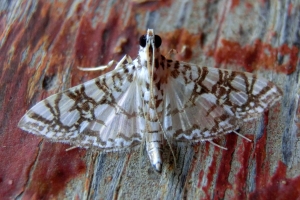
1. Lebendfotos
1.1. Falter


2. Biologie
2.1. Nahrung der Raupe
- [Apocynaceae: Apocynoideae:] Nerium sp. (Oleander)
Was die Raupen in ihrer natürlichen Heimat fressen, ist unbekannt. Es besteht aber der Verdacht, dass sie mit eingetopftem Oleander (Nerium sp.) nach Nordamerika eingeschleppt wurden. Jedenfalls wurden danach in Nordamerika Fraßschäden von Raupen an zwei Oleander-Büschen im Garten gefunden, und die Raupenbeschreibung von Solis (2008) beruht auf einem genau dort gefundenen Tier: "The damage of two of four long- established oleanders was extensive (Fig. 5, pp. 95), with many tips dead from stem boring (Fig. 6, pp. 95 ), extensive frass around the base, and many pupal skins in the debris around the base of the plants and in debris clusters at the blossom heads. One quarter mile south of the previous location, several larvae were collected from unopened oleander flower buds. At the second location. they were acting as bud borers, with no sign of leaf skelet on izin g or st em boring. Adults were reared from both locations."
Da sich die meisten Tiere dort aber in der Nähe von Sternjasmin (Trachelospermum sp.) aufhielten und jene Pflanze ebenfalls zu den Apocynoideae gehört, ist zu erwarten, dass doch ein breiteres Spektrum dieser Pflanzen-Unterfamilie genutzt werden kann.
(Autor: Erwin Rennwald)
3. Weitere Informationen
3.1. Andere Kombinationen
- Asopia onychinalis Guenée, 1854 [Originalkombination]
- Glyphodes onychinalis (Guenée, 1854) [bis Maes (2022) übliche Kombination]
3.2. Synonyme
- Zebronia braurealis Walker, 1859 [Synonym nach Maes (2022)]
3.3. Taxonomie
Shaffer & Munroe (2007: 48) überführten die asiatische "Diastictis putrisalis Viette, 1958" in eine neue Gattung, die sie "Chabulina nannten. Sie notierten dazu: "This genus, as is easily seen from the wing pattern and from the configuration of the male genitalia, is a member of the complex of genera centering on Glyphodes Guenée, which differs in its much larger size, in the complex and irregular vaulting of the tegumen, among many other features. Within this complex it is closest to an unnamed genus which will contain Asopia onychinalis Guenée, 1854, which shares the same unusual shape of the uncus, but which has the scaling of the labial palpus much shorter, the second segment having a narrowly rhomboidal profile. Other related genera are Glyphodella Shaffer & Munroe (described above), Synclera Lederer, 1863, and Chabula Moore, [1866], all of which have substantial differences in the shape of the uncus. The type-species is the only member of the genus whose structure has been well investigated, but we also place here Hydrocampa tenera Butler, 1883, from Sulawesi, which becomes Chabulina tenera (Butler, 1883), new comb, as well as an unnamed species or subspecies from the mainland of Africa which has been misidentified in collections as "Glyphodes" tenera, but which in fact is closer to putrisalis."
Maes (2022) griff die Aussagen für Afrika auf und legte sein weiteres Vorgehen - nämlich z.B. die Durchführung der Neukombination von A. onychidalis zu Chabulina onychinalis - in einer langen, von vielen Unsicherheiten geprägten Einführung dar: "The species onychinalis was originally described by Guenée (1854) in the genus Asopia Treitschke, 1828 from India, Coromandel (Oriental Region). Asopia became a junior objective synonym of Pyralis Linnaeus, 1758 (Pyraloidea: Pyralidae: Pyralinae) (Fletcher & Nye, 1984). Hampson (1896, 1899) listed the species onychinalis under the genus Bocchoris Moore, 1885 with synonyms Zebronia braurealis Walker, 1859 (type locality: Ceylon) and Lepyrodes astomalis Felder & Rogenhofer, 1875 (type locality: Knysna, South Africa). Hampson also mentioned the distribution from West Africa over Asia to Australia." Und dann folgt der aus meiner Sicht wichtigste Satz der gesamten Arbeit: "The generic placement of this species is not clear at the moment." Dann folgt die Beschreibung des taxonomischen Chaos: "Munroe (1956, 1967) mentioned that the types of the genera Bocchoris, Chabula, Didymostoma and Aediodina are all generically distinct not only from Diastictis but also from each other. In his 1956 article Munroe only studied Diastictis and did not elaborate on the other above listed genera. He mentioned also that Bocchoris as listed by Hampson (1896, 1899) is a very heterogenous group. The synonymy of Bocchoris is discussed in detail by Rose & Kirti (1986). Krūger (2020) placed the species onychinalis with its synonyms astomalis and braurealis under the genus Bocchoris Moore [1885]1884-7."
Die Frage war also, wie mit diesen unklaren Gattungsanschlüssen umzugehen ist. Sie einfach zu ignorieren, war für Maes (2022) nicht der richtige Weg, und so entschloss er sich, die Gattung "Chabulina" zu akzeptieren und sie auf die bisherige "Glyphodes onychinalis und verwandte Taxa anzuwenden. Und wieder einmal ist der erste Satz wichtig, da er andeutet, dass da noch viele weitere Verschiebungen folgen könnten: "The validity of the genera mentioned above is not the subject of this paper and is left for another study. The species onychinalis was placed by Shaffer (1996) under Glyphodes. This placement is followed in recent databases: Beccaloni et al. 2003. The Global Lepidoptera Names Index (LepIndex), De Prins J. & De Prins W. 2003-2022. Afromoths.net, and Nuss et al. 2003–2022. Global Information System on Pyraloidea. On the other hand, Shaffer & Munroe (2007) created the genus Chabulina for the species Diastictis putrisalis Viette, 1958, a species, at least externally, very similar in wing pattern to onychinalis. Apart from the type species, they included in the description of that genus the following species: Chabulina tenera (Butler, 1883) from Sulawesi and an unnamed species from Africa misidentified as “tenera” but closer to “putrisalis”. Based on the above, and after the dissection of various species currently listed under the different genera listed above, the author can only conclude that Bocchoris and Glyphodes as listed under the above three databases are heterogenous and contain non-related species of very different genera. In order to create a starting point for the revision of these genera and to clarify the identity of these species, this paper focuses in a first instance on the correct identification of onychinalis and astomalis, and extend the results of Shaffer & Munroe (2007) to include a wider range of species in the genus Chabulina."
Wichtiger als der Gattungsname war für Maes (2022) die Feststellung, dass Chabulina astomalis nicht, wie bisher gehandhabt, ein Synonym von Chabulina onychinalis ist, sondern eine eigenständige Art !
(Autor: Erwin Rennwald)
3.4. Faunistik
Asopia onychinalis Guenée, 1854 wurde von Indien (Côte de Coromandel) beschrieben, das Synonym Zebronia braurealis Walker, 1859 von Sri Lanka (Ceylon).
Nach [Global Biodiversity Information Facility] kommt die Art in USA, Taiwan, Neuseeland, Australien, Indien, Japan, Hongkong, Südkorea, Südafrika, Thailand, Botswana, Papua-Neuguinea, Malaysia, Indonesien, Mexiko, Sri Lanka, Uganda, China, Madagaskar, Namibia, Swasiland, Republik Kongo, Gambia, Kambodscha, Pakistan, Serbia? und Singapur vor.
Das ist nach Abtrennung der Chabulina astomalis als eigenständige Art jetzt sehr einzuschränken. Maes (2022: 89) nennt nur noch "India and South East Asia, Australia" und für die abgetrennte Art C. astomalis: "The species is restricted to the African continent. At present no specimens have been collected from the African islands Madagascar, Comores." Was mit den Meldungen aus den USA und Mexiko ist, wird dort nicht diskutiert. Seizmair (2023: 235) meldet für die Arabische Halbinsel: "Chabulina astomalis (Felder & Rogenhofer, 1875) is reported as new to the entomofauna of the Arabian Peninsula. The records of the closely related Chabulina onychinalis (Guenée, 1854) for the Arabian Peninsula are discussed and put into question." Konkret weist er die Art nach mit Daten: "Oman, Dhofar, 4 km W Dalkuth, 01-XI-2021, 1♂, slide no. 22GP014, leg. et coll. M. Seizmair." Und er bemerkt dann dazu: "The specimen from Oman, Province Dhofar listed in this paper has been figured for the first time and erroneously attributed to C. onychinalis in Seizmair [13]. The valid species name was made available by Maes, who removed C. astomalis from synonymy with C. onychinalis [12]. C. onychinalis has been recently reported for the Ain region in Dhofar by Gillet [26]. However, the record is considered as doubtful. The adult figured in this paper is bare from the forewing postmedial double line structure characteristic of C. onychinalis and C. astomalis. The wing maculation of the specimen appears characteristic of the S. traducalis group. The presence of C. onychnialis in Oman is thus in need of further verification. From Yemen and Saudi Arabia, exclusively historical records have been known, which need re-validation [27] [28]."
Eine Antwort auf die Frage zur USA findet sich bei Solis (2008: 79-80). Demnach wurde die Art dort erstmals im Jahr 2000 registriert, und zwar, weil die Raupen mit ihrem Fraß Schäden an Oleander (Nerium sp.) in Newport Beach (California) anrichteten. Die Art ist mittlerweile in Kalifornien verbreitet. Nachdem die Art auch noch bei Shropshire & Tallamy (2025) gelistet und auf [mothphotographersgroup.msstate.edu], wo die Arbeit von Maes (2022) ausdrücklich zitiert und die Art jetzt als "Chabulina onychinalis" geführt wird, scheint es sich bei der dortigen Einschleppung tatsächlich um das ostasiatisch-australisch und nicht um das afrikanisch verbreitete Taxon zu handeln.
(Autoren: Erwin Rennwald & Michel Kettner)
3.5. Literatur
- Erstbeschreibung: Guenée, M. A. (1854): Deltoïdes et Pyralites. — In: Boisduval, J. B. A. D. & M. A. Guenée (1854): Histoire Naturelle des Insectes. Species Général des Lépidoptères 8. 1-448. Paris (Roret). [S. 205, Digitalisat auf biodiversitylibrary.org]
- Maes, K.V.N. (2022): Studies on African Crambidae II: On the identity of Asopia onychinalis Guenée, 1954, its synonyms, generic placement and related species (Pyraloidea: Crambidae: Spilomelinae). — Metamorhosis, 33: 85–91. DOI: https://dx.doi.org/10.4314/met.v33i1.11. [zum open access-Artikel mit PDF-Download]
- Seizmair, M. (2023): Contribution to the Knowledge of the Afrotropical Spilomelinae (Lepidoptera, Crambidae): A New Species from Saudi Arabia, New Combinations and Distributional Updates. — Advances in Entomology, 11: 223-238. [zum Artikel mit PDF-Download auf scirp.org]
- Shaffer, J.C. & E. Munroe (2007): Crambidae of Aldabra Atoll (Lepidoptera: Pyraloidea). — Tropical Lepidoptera, 14 (1-2): 1-110. [PDF auf journals.flvc.org]
- Shropshire, K.J. & D.W. Tallamy (2025): Lepidoptera of North America, north of Mexico: an annotated list containing geographic ranges and host-plant records. — ZooKeys, 1261: 101-113; Suppl. 1. [zum open-access-Artikel auf zookeys.pensoft.net] bzw. [zum Supplement 1 auf zookeys.pensoft.net]
- Solis, W.A. (2008): New sightings of Glyphodes onychinalis (Guenée) (Pyraloidea: Crambidae: Spilomelinae), a recent arrival to the United States with a description of the larva reared on oleander (Nerium sp.) in California. — News of the Lepidopterists' Society, 50(3, 4): 79-80. [PDF auf images.peabody.yale.edu]
3.6. Informationen auf anderen Websites (externe Links)
- [Australian Lepidoptera Butterflyhouse]
- [Moth Photographers Group]
- [Butterflies and Moths of North America]
- [BOLD] [Achtung: noch inkl. C. astomalis]
- [Global Biodiversity Information Facility] [Achtung: noch inkl. C. astomalis]