+12Kontinente:ASAF


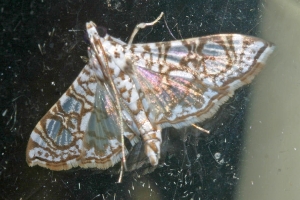
1. Lebendfotos
1.1. Falter


2. Weitere Informationen
2.1. Andere Kombinationen
- Lepyrodes astomalis Felder & Rogenhofer, 1875 [Originalkombination]
2.2. Synonyme
- Nausinoe gueyraudi Guillermet, 2004 [synonymisiert durch Maes (2022)]
2.3. Taxonomie
Shaffer & Munroe (2007: 48) überführten die asiatische "Diastictis putrisalis Viette, 1958" in eine neue Gattung, die sie "Chabulina nannten. Sie notierten dazu: "This genus, as is easily seen from the wing pattern and from the configuration of the male genitalia, is a member of the complex of genera centering on Glyphodes Guenée, which differs in its much larger size, in the complex and irregular vaulting of the tegumen, among many other features. Within this complex it is closest to an unnamed genus which will contain Asopia onychinalis Guenée, 1854, which shares the same unusual shape of the uncus, but which has the scaling of the labial palpus much shorter, the second segment having a narrowly rhomboidal profile. Other related genera are Glyphodella Shaffer & Munroe (described above), Synclera Lederer, 1863, and Chabula Moore, [1866], all of which have substantial differences in the shape of the uncus. The type-species is the only member of the genus whose structure has been well investigated, but we also place here Hydrocampa tenera Butler, 1883, from Sulawesi, which becomes Chabulina tenera (Butler, 1883), new comb, as well as an unnamed species or subspecies from the mainland of Africa which has been misidentified in collections as "Glyphodes" tenera, but which in fact is closer to putrisalis."
Maes (2022) griff die Aussagen für Afrika auf und legte sein weiteres Vorgehen - nämlich z.B. die Durchführung der Neukombination von A. onychidalis zu Chabulina onychinalis. Wichtiger als der Gattungsname war für Maes (2022) die Feststellung, dass die afrikanische Chabulina astomalis nicht, wie bisher gehandhabt, ein Synonym von Chabulina onychinalis ist, sondern eine eigenständige Art !
2.4. Faunistik
Asopia onychinalis Guenée, 1854 wurde von Indien (Côte de Coromandel) beschrieben, das Synonym Zebronia braurealis Walker, 1859 von Sri Lanka (Ceylon). Die jetzt abgetrennte Chabulina astomalis hat ihre Typenlokalität in Knysna (Südafrika), das neue Synonym Nausinoe gueyraudi wurde von Réunion beschrieben.
Maes (2022) schrieb zur Verbreitung von C. astomalis: "The species is restricted to the African continent. At present no specimens have been collected from the African islands Madagascar, Comores."
Seizmair (2023: 235) meldet für die Arabische Halbinsel: "Chabulina astomalis (Felder & Rogenhofer, 1875) is reported as new to the entomofauna of the Arabian Peninsula. The records of the closely related Chabulina onychinalis (Guenée, 1854) for the Arabian Peninsula are discussed and put into question." Konkret weist er die Art nach mit Daten: "Oman, Dhofar, 4 km W Dalkuth, 01-XI-2021, 1♂, slide no. 22GP014, leg. et coll. M. Seizmair." Und er bemerkt dann dazu: "The specimen from Oman, Province Dhofar listed in this paper has been figured for the first time and erroneously attributed to C. onychinalis in Seizmair [13]. The valid species name was made available by Maes, who removed C. astomalis from synonymy with C. onychinalis [12]. C. onychinalis has been recently reported for the Ain region in Dhofar by Gillet [26]. However, the record is considered as doubtful. The adult figured in this paper is bare from the forewing postmedial double line structure characteristic of C. onychinalis and C. astomalis. The wing maculation of the specimen appears characteristic of the S. traducalis group. The presence of C. onychnialis in Oman is thus in need of further verification. From Yemen and Saudi Arabia, exclusively historical records have been known, which need re-validation [27] [28]."
(Autor: Erwin Rennwald)
2.5. Literatur
- Erstbeschreibung: Felder C., Felder R. & Rogenhofer A. F. (1865-1875): Reise der österreichischen Fregatte Novara um die Erde in den Jahren 1857, 1858, 1859 unter den Befehlen des Commodore B. von Wüllerstorf-Urbair. Zoologischer Theil. Zweiter Band. Abtheilung 2, Heft 4, Lepidoptera. Atlas der Heterocera. Vol. 2, 140 pl. [Taf. 135, fig. 2, Digitalisat auf biodiversitylibrary.org]
- Guenée, M. A. (1854): Deltoïdes et Pyralites. — In: Boisduval, J. B. A. D. & M. A. Guenée (1854): Histoire Naturelle des Insectes. Species Général des Lépidoptères 8. 1-448. Paris (Roret). [S. 205, Digitalisat auf biodiversitylibrary.org]
- Maes, K.V.N. (2022): Studies on African Crambidae II: On the identity of Asopia onychinalis Guenée, 1954, its synonyms, generic placement and related species (Pyraloidea: Crambidae: Spilomelinae). — Metamorhosis, 33: 85–91. DOI: https://dx.doi.org/10.4314/met.v33i1.11. [zum open access-Artikel mit PDF-Download]
- Seizmair, M. (2023): Contribution to the Knowledge of the Afrotropical Spilomelinae (Lepidoptera, Crambidae): A New Species from Saudi Arabia, New Combinations and Distributional Updates. — Advances in Entomology, 11: 223-238. [zum Artikel mit PDF-Download auf scirp.org]
- Shaffer, J.C. & E. Munroe (2007): Crambidae of Aldabra Atoll (Lepidoptera: Pyraloidea). — Tropical Lepidoptera, 14 (1-2): 1-110. [PDF auf journals.flvc.org]