+3Kontinente:SA


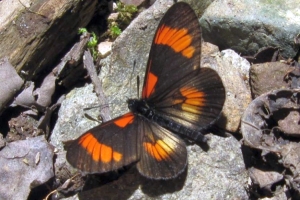
1. Lebendfotos
1.1. Falter

2. Weitere Informationen
2.1. Andere Kombinationen
- Altinote hilaris (Jordan, 1910) [bis Zhang et al. (2021) übliche Kombination]
2.2. Synonyme
- Actinote desmiala Jordan, 1913 [jetzt Unterart]
- Acraea culoti Oberthür, 1916
- Altinote brownorum Potts, 1943
2.3. Unterarten
- Actinote hilaris desmiala Jordan, 1913 [Unterart nach funet.fi]
2.4. Taxonomie
Die meisten Arten der späteren Gattungen Actinote und Altinote wurden zunächst in der Kombination mit Acraea beschrieben. Die meisten der späteren Altinote-Arten waren erst einmal mit Actinote kombiniert. Die Verwirrung in der Benennung war damit perfekt. Doch nach Zhang et al. (2021: 46-47) ist es anhand der Barcode-Abstände besser, Altinote allenfalls als Untergattung von Actinote zu akzeptieren. Sie begründen: "In agreement with previous studies (Silva-Brandao et al. 2008; Carvalho et al. 2020), we find that genera Actinote Hübner, [1819] (type species Papilio thalia Linnaeus, 1758), Abananote Potts, 1943 (type species Acraea abana Hewitson, 1868) and Altinote Potts, 1943 (type species Heliconius neleus Latreille, [1813]) are closely related and some of them are not monophyletic as currently circumscribed (Fig. 49). The type species of Abananote and Altinote are quite closely related: e.g. their COI barcodes differ by 6.4% (42 bp) [...], and therefore are congeneric. The Actinote clade is separated from them by a prominent gap (Carvalho et al. 2020), and the barcodes of A. thalia and A. neleus differ by 8.5% (56 bp), which would suggest their attribution to different subgenera. However, species phylogeny is at odds with intuitive phenotypic assessment (Lamas 2004): there is an additional third clade unexpected from phenotypes (Silva-Brandao et al. 2008; Carvalho et al. 2020). Therefore, until these inconsistencies between phenotypic and genetic classifications of this group are sorted out, we propose placing Abananote Potts, 1943 and Altinote Potts, 1943 as junior subjective synonyms of Actinote Hübner, [1819]. This treatment is consistent with the unified, and more genetically diverse, Old World genus Telchinia Hübner, [1819] (type species Papilio serena Fabricius, 1775) that is sister to Actinote sensu lato (Fig. 49)." Dies scheint mittlerweile überwiegend so akzeptiert zu werden. Es wurden zwar nur wenige der bisherigen Altinote-Arten untersucht, aber immerhin die Typusart. Mit weiteren Änderungen innerhalb der Acraeini ist zu rechnen.
Die Gattung Altinote war von Potts (1943: 31) eingeführt worden, der argumentierte: "All members of the subfamily Acraeinae have heretofore been placed in a single genus, Actinote. Within this genus there is a marked natural division into two well-defined groups. Dr. K. Jordan (in Seitz, Gross-Schmett. ) and others have noted this, but without according the groups a status above the section. It now appears that they merit generic standing. [...] Forewing underneath scaled between costal and subcostal veins in distal portion, not normally bearing bristles; hindwing beneath always with a central row of bristles on disco-cellular fold. Mountainous tropics. Type species: Heliconius neleus Latreille. In general Altinote may be distinguished from Actinote by color pattern and distribution. Actinote contains only species with patterns on both wings, being normally more or less transparent and thinly scaled, yellowish or whitish in tone with dull or rarely dark markings. Altinote normally show patterns on the forewing or underside only, these being bright red, orange, yellow or white against a consistently dark ground often showing irridescence, only a few species exhibiting any hindwing pattern and only one becoming dull; all being rather densely scaled. The Altinote are typically confined to the Andes and its outriders, while the Actinote center in the Amazon basin and are commonest near tidewater, although there is a considerable overlapping."
Die hier besprochene Art wurde von Jordan (1910 : 467) als "Actinote hilaris" eingeführt, nach ihrem Exkurs zu Altinote steht sie jetzt wieder in der Originalkombination.
(Autor: Erwin Rennwald)
2.5. Faunistik
Die Art wurde aus Peru beschrieben. Jordan (1910 : 467) schrieb zu seinem Typenmaterial: "Five ♂♂ and one ♀ from Chanchamayo district and Huancabamba, Peru; type from Rio Toro." Drei Jahre später beschrieb Jordan (1913: 32) dann Actinote desmiala mit Typenfundort Archidona (Ecuador) - das Taxon gilt mittlerweile als Unterart von A. hilaris. Weitere drei Jahre später beschrieb Oberthür (1916: 38) die Art erneut unter dem Namen "Acraea culoti" mit Typenfundort Ambato (Ecuador). Potts (1943: 32) beschrieb "Altinote brownorum mit Typenfundort Yunguilla (Ecuador), die ebenfalls als Synonym von Actinote hilaris gilt.
Nach [Global Biodiversity Information Facility] kommt A. hilaris in Kolumbien, Peru, Ecuador und Bolivien? vor.
(Autoren: Michel Kettner & Erwin Rennwald)
2.6. Literatur
- Erstbeschreibung: Jordan, K. (1910): New forms of the Acraeine genera Planema and Actinote. — Novitates Zoologicae 17 (3): 462-469. [Digitalisat auf archive.org]
- Beschreibung als Actinote desmiala: Jordan, K. (1913): Diagnoses of some American Acraeine. — The Entomologist 46 (597): 32-33. [Digitalisat auf archive.org]
- Beschreibung als Acraea culoti: Oberthür, C. (1916): Étude de Lépidoptérologie comparée. — Études de lépidoptérologie comparée 12 (2): 1-44, pl. CCCC-CDXIII. [p. 38, Digitalisat auf aurchive.org] und [pl. CDVI, Digitalisat auf aurchive.org]
- Beschreibung als Altinote brownorum: Potts, R.W.L. (1943): Systematic notes concerning American Acraeinae (Lepidoptera: Nymphalidae). - The Pan-Pacific Entomologist, 19 (1): 31-32. [Digitalisat auf aurchive.org]
- Zhang, J., Cong, Q., Shen, J., Opler, P.A. &N.V. Grishin (2021): Genomics-guided refinement of butterfly taxonomy. — The Taxonomic Report of the International Lepidoptera Survey, 9 (3): 1-55. [PDF auf lepsurvey.carolinanature.com]