+41Kontinente:EUAS


1. Lebendfotos
1.1. Falter






2. Diagnose
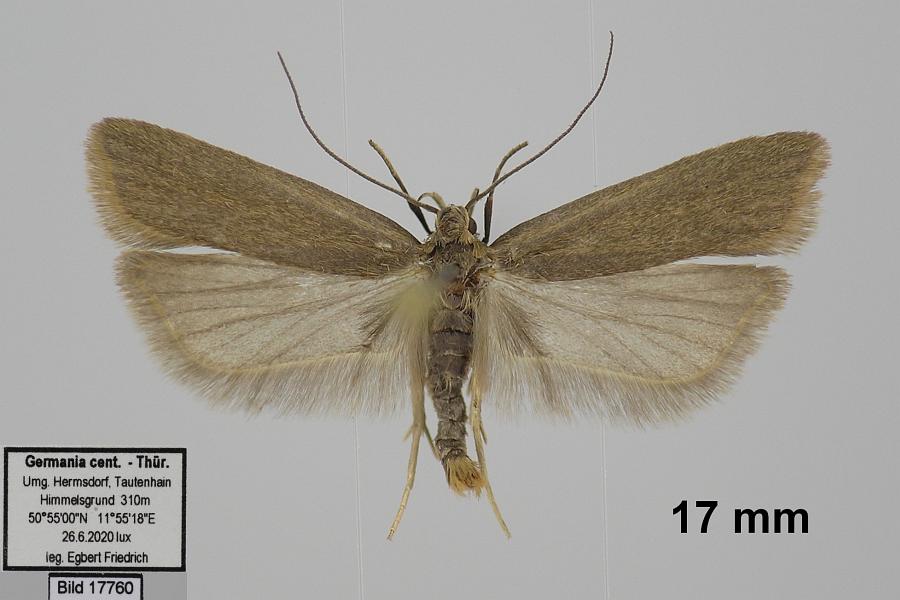
2.1. Männchen
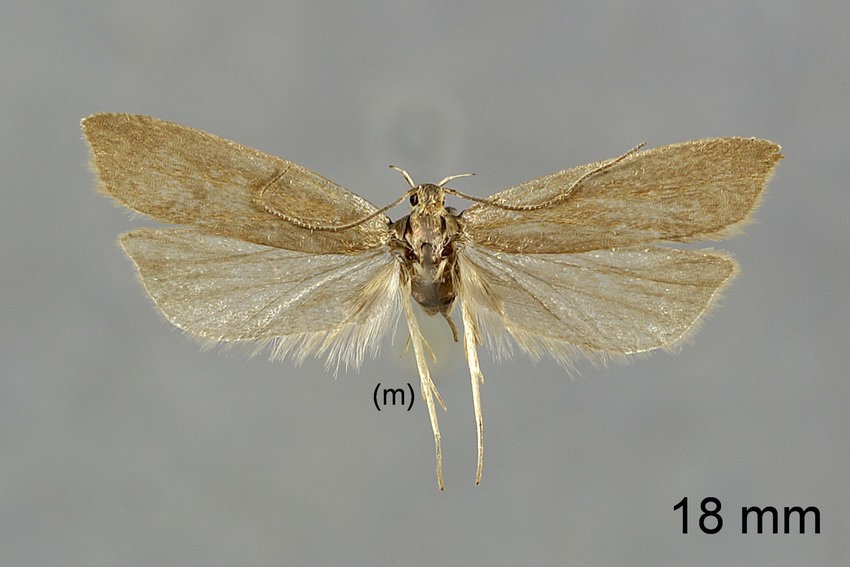

2.2. Geschlecht nicht bestimmt


2.3. Genitalien
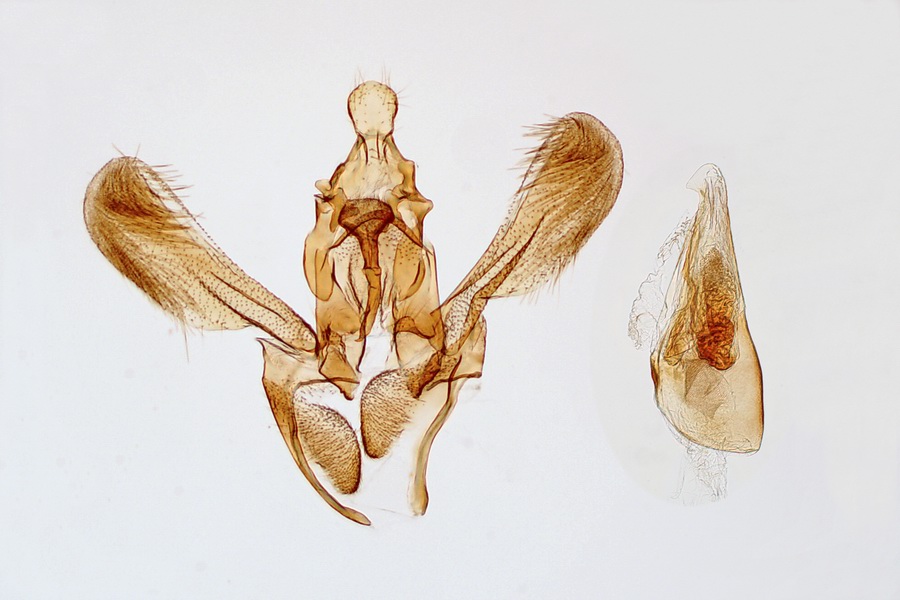
2.3.1. Männchen

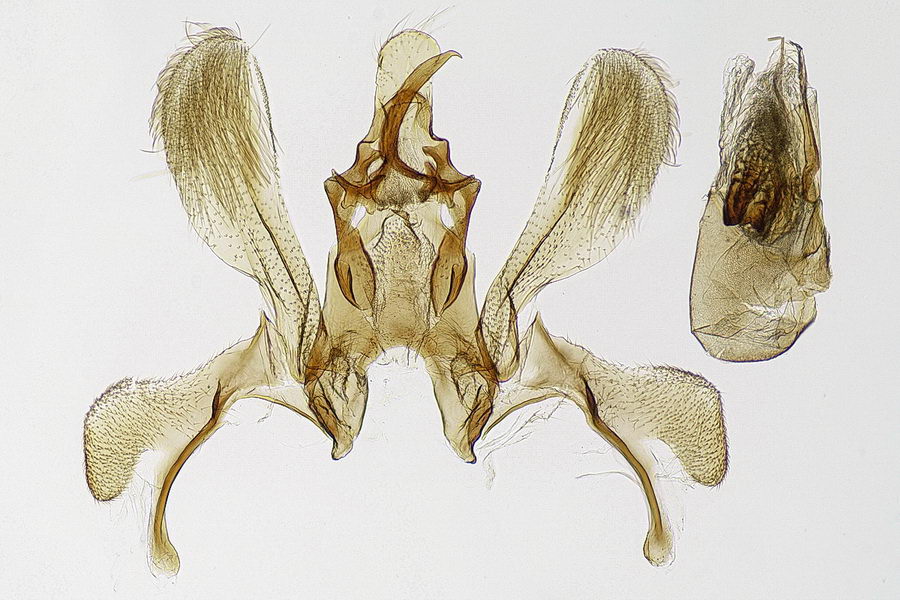
2.3.2. Weibchen

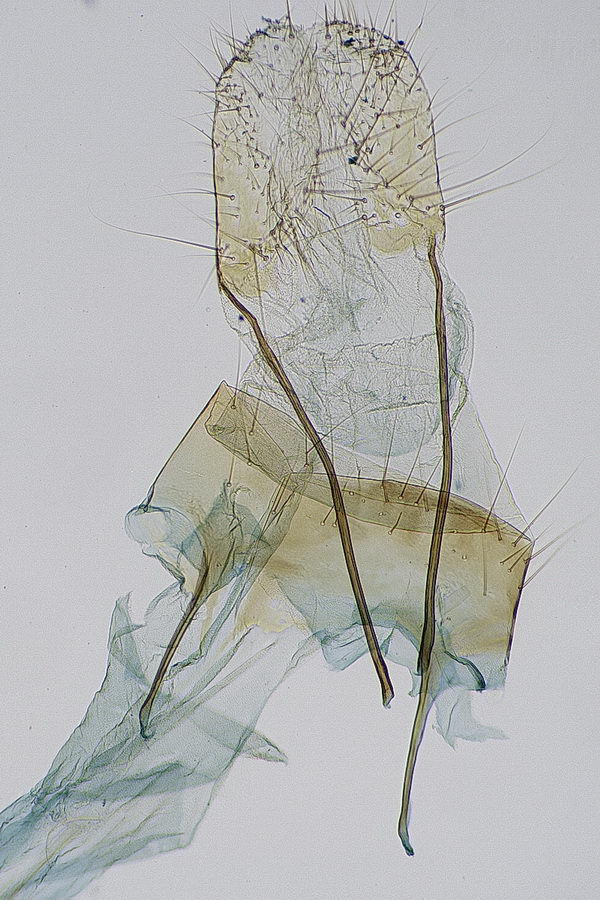
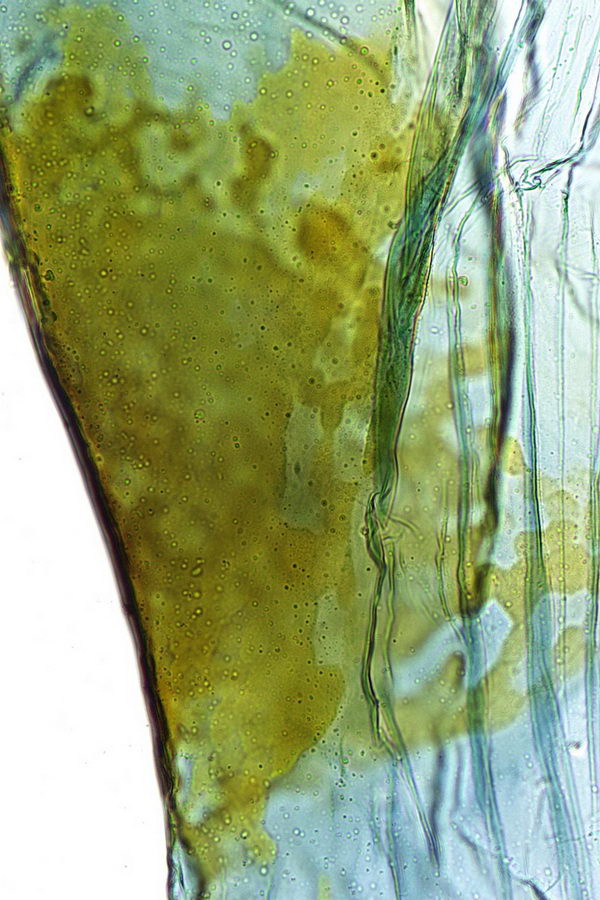
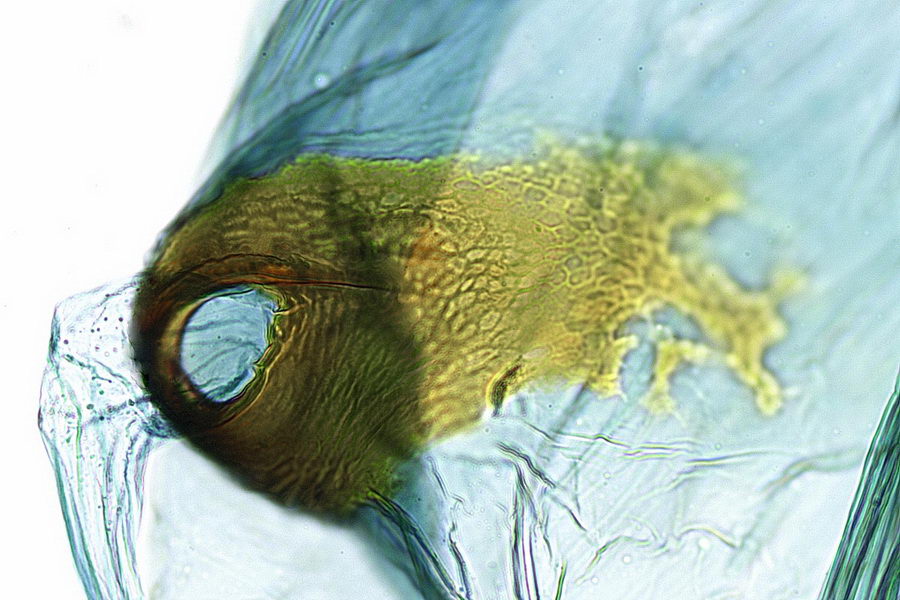
2.4. Erstbeschreibung

3. Biologie
3.1. Nahrung der Raupe
Noch sehr wenig bekannt! Schütze (1931: 14) berichtet: "Raupe im Juni zwischen Moos am Fuße von Waldbäumen, das Moos verzehrend. Ist sehr scheu und verbirgt sich stets wieder im Moose (Sorhagen)."
Huemer & Karsholt (2002: 116) trugen zusammen: "The larva was described by Sorhagen (1902: 56-57) - based on the description and a water-colour made by C. W. L. Grabow, the father in law of O. Staudinger (Sorhagen 1901: 241): rather slim, especially towards end, greenish grey; head brown, prothoracic shield and legs black; abdominal legs concolorous with body; back with four dark warts on each segment, laterally beneath anterior pair another one; larva wrinkled beneath faint, light lateral line, with two rather long bristles above each other, upper (anterior) shorter. It lives until June between moss at the base of trees growing in forests, feeding on the moss; it is very shy, quickly disappearing into the moss. According to Lhomme (1948: 655) Chrétien bred A. cinerella from eggs on Veronica chamaedrys L. (Scrophulariaceae). Chrétien (1900: 202) himself informs that Millière found larvae of A. cinerella in September on Epilobium montanum L. (Onagraceae). It is unclear if the larva of A. cinerella is polyphagous or if some of the host records above refer to other species.
Gregersen & Karsholt (2022: 163) stellen die völlig widersprüchlichen Daten zusammen: "Host-plant. Mosses at the base of trees (Sorhagen op. cit.). Lhomme (1948-1949: 655) referred to rearing from eggs on Veronica chamaedrys by Chrétien and Chrétien himself (1899: 202) referred to larva found in September on Epilobium montanum by Millière. The host-plant and biology are incompletely known. The habitats are open grassland and dry meadows, but the species is also found in gardens and parks."
(Autor: Erwin Rennwald)
4. Weitere Informationen
4.1. Andere Kombinationen
- Phalaena cinerella Clerck, 1759 [Originalkombination]
4.2. Synonyme
- Phalaena murinella Scopoli, 1763
- Tinea ardeliella Hübner, [1817]
- Recurvaria cinerea Haworth, 1828
- Lita spodiella Treitschke, 1833
4.3. Literatur
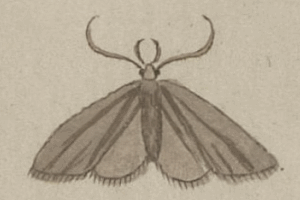
- Erstbeschreibung: Clerck, C. (1759): Icones Insectorum rariorum Cum Nominibus eorum trivialibus, locisqve e C. LINNÆI Arch. R. et Eqv. Aur. Syst. Nat. allegatis. Sectio Prima: [8 unpaginierte Textseiten], pl. 1-16. Holmiae. — Digitalisat der Bibliothèque nationale de France: [pl. 11 mit fig. 6].
- Corley, M. F. V., Fabião, P. L., Nunes, J. & J. Rosete (2024): New and interesting Portuguese Lepidoptera records from 2023 (Insecta: Lepidoptera). — SHILAP Revista de lepidopterología 52 (208): 761-786. [PDF auf shilap.org]
- Gregersen, K. & O. Karsholt (2022): The Gelechiidae of North-West Europe. — 939 pp., Oslo, Norway (Norwegian Entomological Society).
- Huemer, P. & O. Karsholt (2002): A review of the genus Acompsia Hübner, 1825, with description of new species (Gelechiidae). — Nota lepidopterologica, 25 (2/3): 109-151. [PDF auf zobodat.at]
- Lectotypus-Festlegung: Robinson, G. S. & E. Schmidt Nielsen (1983): The Microlepidoptera described by Linnaeus and Clerck. — Systematic Entomology 8: 191-242.
- SCHÜTZE (1931): 14