+5Kontinente:AS


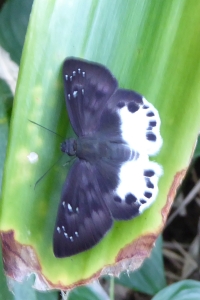
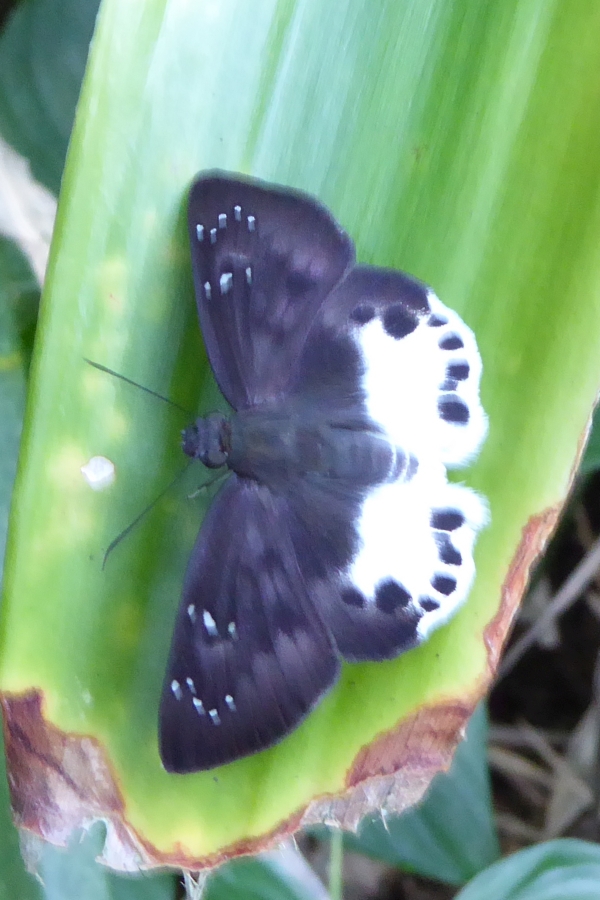
1. Lebendfotos
1.1. Falter
2. Diagnose
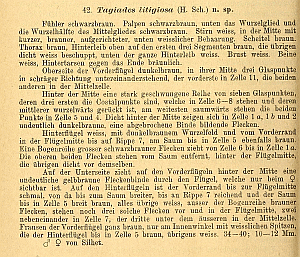
2.1. Erstbeschreibung

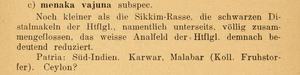
2.2. Beschreibung als Tagiades menaka vajuna

3. Weitere Informationen
3.1. Synonyme
- Tagiades menaka vajuna Fruhstorfer, 1910
- Tagiades vajuna Fruhstorfer, 1910
3.2. Unterarten
- Tagiades litigiosa tubulus (Fruhstorfer, 1910) [Unterart nach funet.fi]
- Tagiades litigiosa andamanica Evans, 1932 [Unterart nach Butterflies of India]
3.3. Taxonomie und Faunistik
Chiba et al. (2026) untersuchten die von Maruyama (1991) festgelegten Lectotypen von sechs ostasiatischen Hesperidae in Form einer Vollgenomanalyse je eines Beins dieser Tiere. Dabei bestätigen sie fast durchweg die Diagnosen. Zu T. litigiosa hatten sie aber noch eine Überraschung zu bieten: Bein und Hinterleib von "Tagiades menaka vajuna Fruhstorfer, 1910" gab es eine Überraschung: Beine und Hinterleib gehörten zu verschiedenen Arten. Das Bein mit dem Vorderkörper gehörte genetisch zu T. litigiosa - nur der Hinterleib mit dem anderen Genital war angeklebt und gehört zu T. menaka! Chiba et al. (2026) rechnen den Hinterleib daher nicht mehr zum Lectotypus des Taxons, das auf diese Weise zum Synonym von T. litigiosa wurde: "We located the lectotype male designated by Maruyama and a corresponding paralectotype female in the collection. The morphology and the data of the specimens agree with the original description, and Maruyama’s designation of the types was confirmed. In the section on Tagiades ultra Evans, 1932, Maruyama (1991) wrote: “In addition, when I examined the type specimen of litigiosa in Berlin, the male genitalia were different from what Evans (1949) illustrated as litigiosus but nearly or exactly the same as T. menaka [(Moore, 1866)]. Therefore, of the remaining three taxa that Evans (1949) treated as subspecies of litigiosus, vajana [sic!] Fruhstorfer, 1910 (distributed from South India to the Malay Peninsula) becomes the nominotypical subspecies, and ceylonica [Evans,1932] from Sri Lanka and andamanicus [Evans, 1932] from Andaman are its subspecies.” This part is only in the Japanese text and not translated in English." Die Folge: "The name litigiosa kept being used for T. litigiosa sensu Evans (1949) for a while (Corbet & Pendelbury 1993; Chou 1994; Zhu 2017), but T. vajuna has gradually become known and used for T. litigiosa sensu Evans (1949) (e.g. Liu et al. 2017). The identity of the “chimaera” lectotype specimen with T. litigiosa wings (Fig. 5 & 6) and T. menaka genitalia (Fig. 17) has puzzled us, but no attempt to comprehensively revise the whole group has been made (cf. Zhang et al., 2022). Genomic DNA extracted from a leg of the lectotype places it among T. litigiosa sensu Evans (1949) and away from T. menaka (Fig. 1). Therefore, we reinstate Tagiades (Damio) litigiosa Möschler, 1878, stat. rest. as a species and for the lack of better evidence because we have not sequenced this taxon, tentatively place Tagiades menaka vajuna Fruhstorfer, 1910 as its junior subjective synonym, although Lepidoptera populations from southwestern India are usually distinct, at least at the subspecies level, from those in Bengal. Furthermore, we hypothesize that the abdomen of a T. menaka male was glued to the body of T. litigiosa lectotype to “repair” this specimen due to the lack of original abdomen, which resulting in a “chimaeric” skipper. The abdomen of the female paralectotype is still missing. To avoid further confusion about this issue and in the interest of nomenclatural stability, we exclude the abdomen from the lectotype of T. litigiosa."
3.4. Typenmaterial
Chiba et al. (2026: 508-509) schreiben zum Lectotypus und zum Paralectotypus: "Labels: Lectotype: pink printed label: “origin”; white faded to beige label: “Coll. Möschl. / India ? Silhet”; blue handwritten label: “India / ? Silhet. / D. 69.”; white faded to beige handwritten label “Litigiosa / Möschl.”; white faded to beige handwritten label “litigiosa Möschl. / Menaka Moore?”; white faded to beige handwritten label “Litigiosa Möschl. /Menaka Moore? / (proparta) / stramineipennis?”; white label: “Genit. unters. / Nr. 5264 / Zool. Mus. Berlin”; pink handwritten label: “Type. / Verhdlg. Zool. / bot. Gesellsch. / 1878. p. 230.”; pink handwritten label: “Genitalia / exam. by Maruyama / 1990 No. 82-1”; pink label: “Lectotype / Tagiades /litigiosa litigiosa / Möschler, 1878 / Maruyama 1990”; white label with Qr-code “http://coll.mfn-berlin.de/u/9085b3”; white label “DNA sample ID: / NVG—18055D10 / c/o Nick. V. Grishin” (MfN). Paralectotype: pink printed label: “origin”; white faded to beige label: “Coll. Möschl. /India ? Silhet”; blue handwritten label: “India / ?Silhet. / D. 69”; white faded to beige handwritten label “Col. Staudinger / r. 9159.”; yellow label “396”; white faded to beige hand written label “Tagiades / atticus F. / teste Elwes”; white faded to beige printed label: “Coll. / Staudinger”; pink handwritten label: “Type. / Verhg. Zool. / bot. Gesellsch. / 1878. p. 230.”; blue handwritten label: “Paralectotype / Tagiades litigiosa / litigiosa Möschler, 1878 / Maruyama 1990”; white label with QR-code “http://coll.mfn-berlin.de/u/9085b5.” (MfN). COI barcode sequence of the lectotype (NVG-18055D10) [...]".
(Autor: Erwin Rennwald)
3.5. Literatur
- Chiba, H., Grishin, N.V., Tsykiyama, H., Lamas, G. & S.-Y. Huang (2026): Taxonomic review of six Asian Hesperiidae (Lepidoptera) species with name-bearing type specimens studied by Maruyama (1991). — Zootaxa, 5862 (3): 507–522.
- Beschreibung als Tagiades menaka vajuna: Fruhstorfer, H. (1910): Neue Hesperiden des Indo-Malayischen Faunengebietes und Besprechung verwandter Formen. — Deutsche Entomologische Zeitschrift Iris 24: (3) 58, (4) 59-74, (5) 75-104, pl. V. — Digitalisat auf biodiversitylibrary.org: [78]
- Maruyama, K. (1991): Butterflies of Borneo. Volume 2, No. 2. Hesperiidae. — Tobishima Corporation, Tokyo, 89 pp. [Sekundärzitat]
- Erstbeschreibung Möschler, H. B. (1879): Neue exotische Hesperidae. — Verhandlungen der kaiserlich-königlichen zoologisch-botanischen Gesellschaft in Wien 28: 203-230.