+5Kontinente:SA


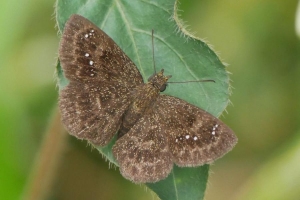
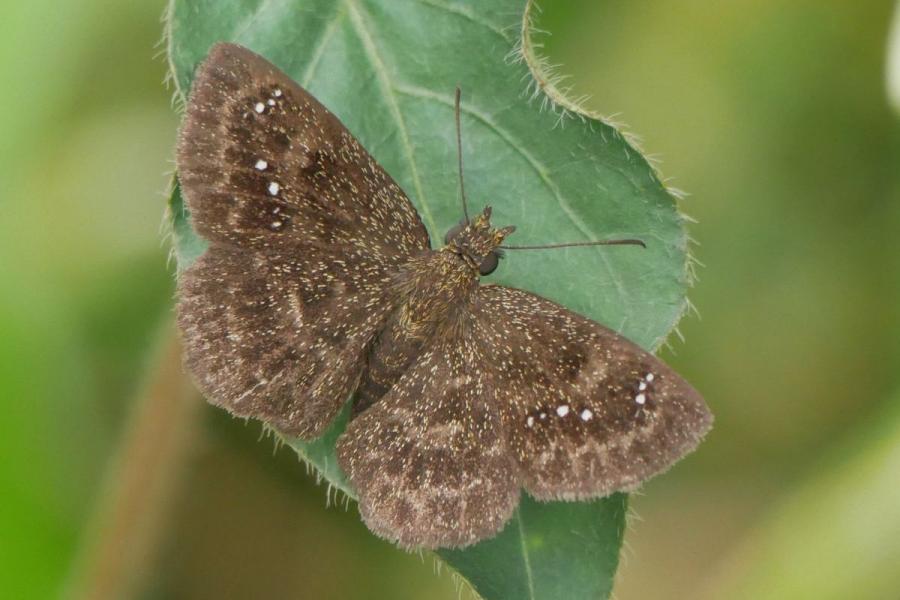
1. Lebendfotos
1.1. Falter
2. Weitere Informationen
2.1. Etymologie (Namenserklärung)
Lemes et al. (2026:: 152) trugen zusammen: "According to Hayward (1938), Staphylus (C.) lizeri was named in honor of his friend and colleague Carlos A. Lizer y Trelles. Although Williams and Bell (1940) did not provide an etymology for Pholisora cruza, they were clearly making reference to Santa Cruz de la Sierra, Santa Cruz, Bolivia, the type locality. Hayward (1940) did not provide an etymology for the name imperspicua."
2.2. Andere Kombinationen
- Pholisora lizeri Hayward, 1938 [Originalkombination]
2.3. Synonyme
- Pholisora cruza Williams & Bell, 1940 [synonymisiert durch Evans (1953)]
- Pholisora imperspicua Hayward, 1940 [synonymisiert durch Lemes et al. (2026)]
- Staphylus imperspicua (Hayward, 1940) [synonymisiert durch Lemes et al. (2026)]
2.4. Unterarten
- Staphylus lizeri album Steinhauser, 1989 [Unterart nach funet.fi]
2.5. Taxonomie und Faunistik
Lemes et al. (2026: 150-155) akzeptieren die Untergliederung der Art in die ssp. lizeri und album. Erstere ist vor allem im nordwestlichen Südamerika (Kolumbien, Ecuador, Peru, Bolivien (Typenlokalität: Caranavi), östliches Brasilien) weit verbreitet, wurde aber auch im Nordosten Brasiliens gefunden, die ssp. album ist hingegen nur aus dem Bundesstaat Minas Gerais im Osten Brasiliens bekannt, also völlig isoliert vom Hauptareal der Art.
Lemes et al. (2026: 150) bemerkten gleich zu Beginn ihrer Besprechung: "Taxonomic history. Hayward (1938) described Pholisora lizeri and Williams and Bell (1940) described Pholisora cruza. Evans (1953) synonymized P. cruza with P. lizeri lizeri, and recognized Staphylus lizeri corumba Williams & Bell, 1940 as a subspecies. Steinhauser (1989) described Staphylus lizeri album. Hayward (1940) described Pholisora imperspicua, which Evans (1953) cited as Staphylus imperspicua for the first time. Most subsequent authors followed Evans (1953) when mentioning these taxa in taxonomic comments, faunistic studies and catalogues."
S. 152 stellen sie dann fest: "The male genitalia of the holotype of Pholisora imperspicua is identical to specimens of S. (C.) lizeri lizeri, and the type locality (Ecuador) also corresponds to recorded specimens of S. (C.) lizeri lizeri. Therefore, aiming to stabilize the taxonomy, Pholisora imperspicua is herein considered a new synonym of S. (C.) l. lizeri." Die Autoren stellten bei der Besprechung von S. nicoleae zudem fest, dass Evans Museumsfalter jener Art als P. imperspicua fehlbestimmt hatte.
(Autor: Erwin Rennwald)
2.6. Typenmaterial
Hayward (1938: 110) beschrieb die Art nach einem einzigen Falter: “Holotype male and genital preparation (N.° 131) in my collection, from Bolivia, Caranaví.”
Hayward (1940: 865) meldete zum Synonym Pholisora imperspicua: “Holotype male and a paratype male from the Rio Topo, Ecuador, 1160 m (Macintyre). Another paratype from Peru. The type in my collection.”
2.7. Literatur
- Erstbeschreibung: Hayward, K. J. (1938): Some Hesperiidae from Yungas of Bolivia (Lep.). — Revista de Entomologia 8 (1-2): 106-111.
- Beschreibung als Pholisora imperspicua: Hayward, K. J. (1940): New species of Neotropical Hesperiidae from Ecuador (Lep.). — Revista de Entomologia 11 (3): 861-877.
- Lemes, J.R.A., Siewert, R.R., Mielke, O.H.H., Casagrande, M.M. & A.D. Warren (2026): Integrative taxonomic revision of Capilla Grishin, 2023, subgenus of Staphylus Godman & Salvin, 1896 (Lepidoptera, Hesperiidae, Pyrginae, Carcharodini), with descriptions of four new species. — Arthropod Systematics & Phylogeny, 84: 123–173. https://doi.org/10.3897/asp.84.e179328. [zum open-access-Artikel mit PDF-Download auf arthropod-systematics.arphahub.com]
- Erstbeschreibung der Unterart Staphylus lizeri album: Steinhauser, S. R. (1989): Taxonomic notes and descriptions of new taxa in the Neotropical Hesperiidae. Part I. Pyrginae. — Bulletin of the Allyn Museum 127: 1-70. [PDF auf floridamuseum.ufl.edu]