+10Kontinente:AS




1. Lebendfotos
1.1. Falter

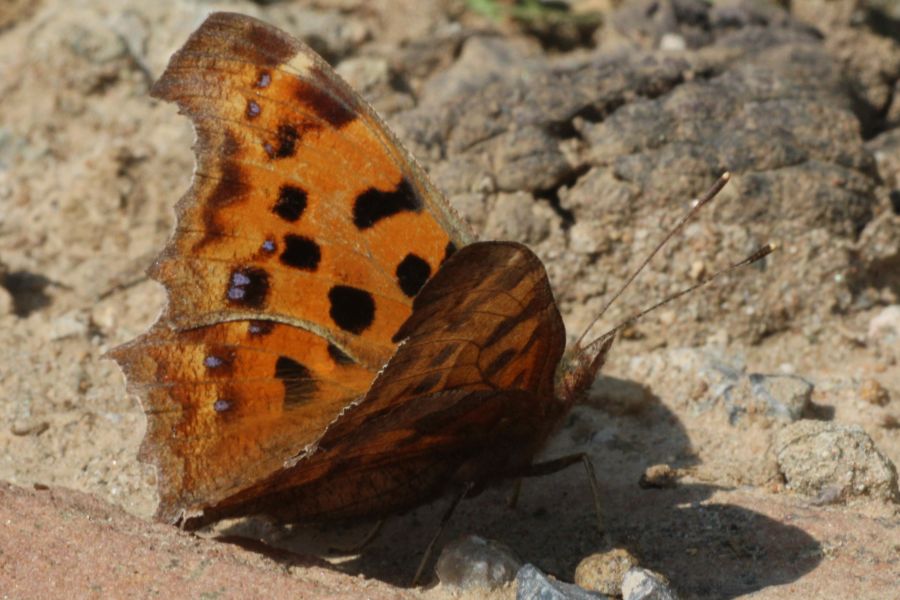
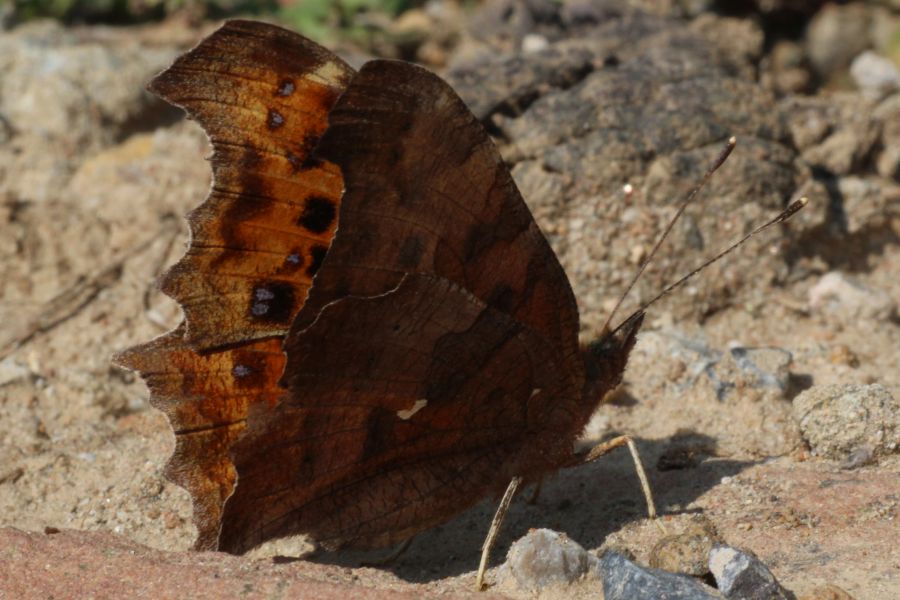
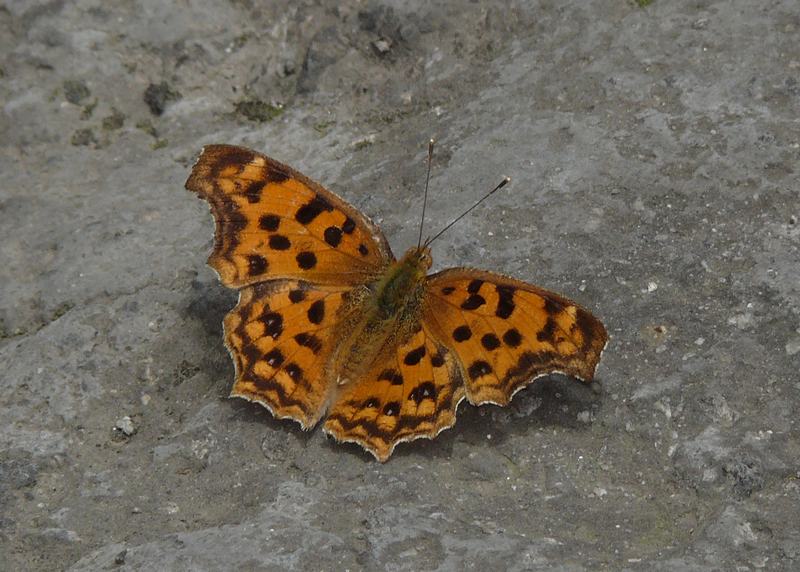

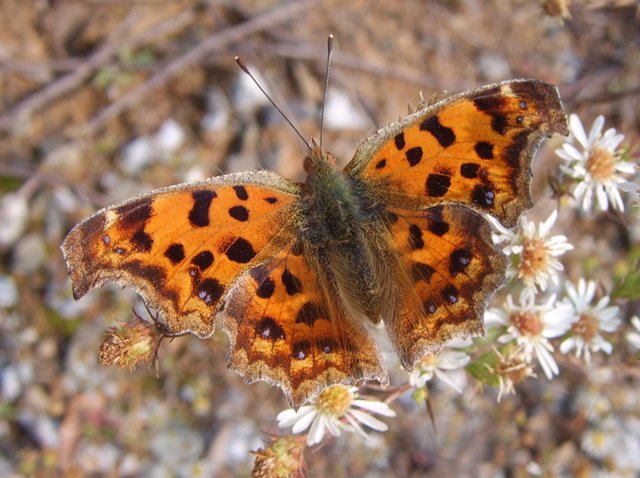


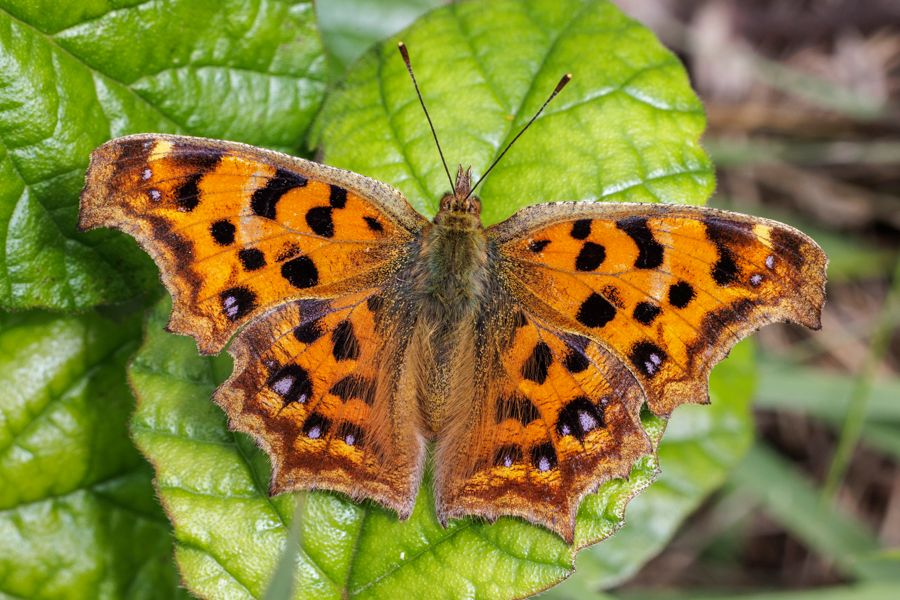
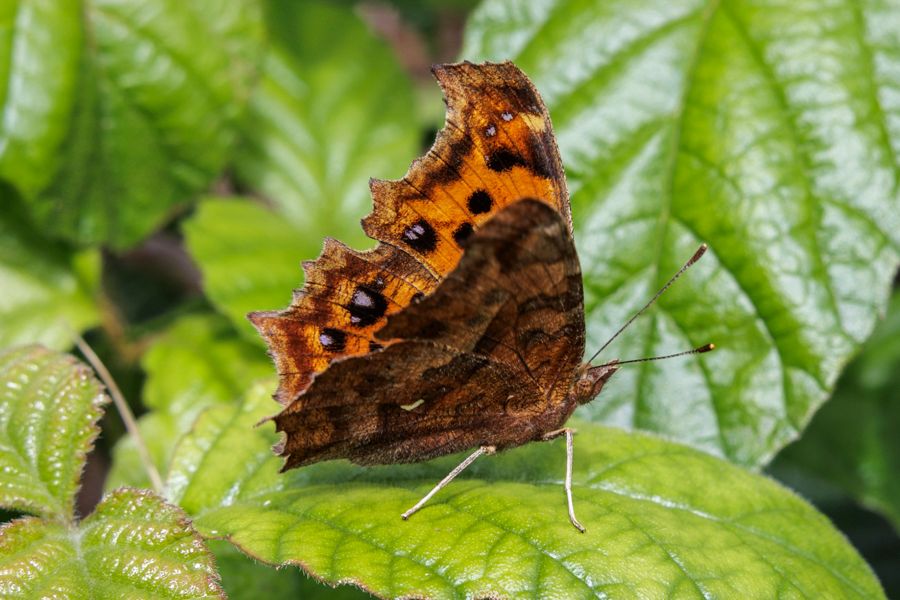
2. Diagnose
2.1. Erstbeschreibung

3. Biologie
3.1. Habitat

4. Weitere Informationen
4.1. Andere Kombinationen
- Papilio c-aureum Linnaeus, 1758 [Originalkombination]
- Nymphalis c-aureum (Linnaeus, 1758) [so bei Zhang et al. (2020)]
4.2. Synonyme
- Papilio angelica Stoll, [1782] [Synonym nach funet.fi]
4.3. Unterarten
- Polygonia c-aureum lunulata (Esaki & Nakahara, 1924) [Unterart nach funet.fi]
4.4. Taxonomie
Zhang et al. (2022: 21-22) plädieren für die Fassung von Polygonia als Untergattung von Nymphalis. Sie argumentieren: "In agreement with others (Opler and Malikul 1992; Layberry et al. 1998; Savela 2020), we propose that Aglais Dalman, 1816 (type species Papilio urticae Linnaeus, 1758) and Polygonia Hübner, [1819] (type species Papilio c-aureum Linnaeus, 1758) are better treated as subgenera of Nymphalis Kluk, 1780 (type species Papilio polychloros Linnaeus, 1758) rather than as distinct genera. These three distinct phylogenetic groups are close to each other genetically with genetic distances between them of the same magnitude as those for taxa considered congeneric in closely related lineages, such as Vanessa [Fabricius], 1807 (type species Papilio atalanta Linnaeus, 1758) (Fig. 13). The times of divergence between Nymphalis and Polygonia and between Nymphalis and Aglais have been estimated as ~7 and ~11 Mya, respectively (Chazot et al. 2019). COI barcode difference between N. polychloros and P. caureum is 6.7% (44 bp), and between N. polychloros and A. urticae is 7.9% (52 bp). This divergence is comparable to that between Vanessa annabella (W. D. Field, 1971) and Vanessa atalanta (Linnaeus, 1758) at 6.2% (41 bp), but smaller than the divergence between V. atalanta and N. polychloros of 9.7% (64 bp). While it is not possible establish a meaningful COI cutoff for the genus-level divergence, these numbers comparatively indicate genetic similarity of these butterflies, and they also loosely correlate with their divergence times. Inspection of the genomic tree (Fig. 13) reveals that the most prominent internal branches (the longest) are indeed those that support Vanessa and its sister clade consisting of Nymphalis, Polygonia and Aglais. The clade of the latter three taxa is compact (Fig. 13), prominent, and genetic divergence within it agrees with the expected divergence within a genus. Therefore, unification of the three genera under a single genus (Nymphalis) would be more consistent with how other genera (e.g. Vanessa) are classified. These showy butterflies are quite diverse in their wing patterns and attracted significant attention, which is likely responsible for their oversplit classification. Also, we confirm the expected sister relationship between Nymphalis antiopa (Linnaeus, 1758) and N. cyanomelas (E. Doubleday, [1848]) (Fig. 13). In summary, in a move towards a more consistent classification, we suggest treating Aglais and Polygonia as subgenera of Nymphalis." Das ist durchaus plausibel, doch der Splitter, der dachach käme, würde diese Einheiten wieder zu Gattungen aufwerten und hätte genauso gute Argumente dafür. Die "Wahrheit" gepachtet hätte keiner von beiden. Im Lepiforum bleiben aus pragmatischen Gründen - nämlich im Sinne der nomenklatorischen Stabilität - Aglais und Polygonia als eigenständige Gattungen erhalten.
(Autor: Erwin Rennwald)
4.5. Faunistik
Nach [Global Biodiversity Information Facility] kommt die Art in Südkorea, Japan, Taiwan, China, Russland, Hongkong, Nordkorea, Laos, Thailand, Armenien?, Mongolei? und Vietnam vor.
Locus typicus gemäß Erstbeschreibung: Asia.
(Autor: Michel Kettner)
4.6. Typenmaterial
Honey & Scoble (2001: 306): “LSL [The Linnean Society of London, Anm. Red. Lepiforum]: 1 ex., without abdomen, labelled “C aureum” [by Linnaeus], “C aureum 778.” [by Smith], here designated as LECTOTYPE.”
4.7. Literatur
- Hiroyoshi, S., Takeda, M., Mitsunaga, T. & G. V. P. Reddy (2019): Quantitative response to photoperiod and weak coupling between seasonal morphs and diapause regulation in the Asian comma butterfly, Polygonia c-aureum (Lepidoptera: Nymphalidae). — European Journal of Entomology 116: 123-132. [PDF auf eje.cz]
- Lectotypus-Festlegung: Honey, M. R. & M. J. Scoble (2001): Linnaeus's butterflies (Lepidoptera: Papilionoidea and Hesperioidea). — Zoological Journal of the Linnean Society 132: 277-399.
- Erstbeschreibung: Linnaeus, C. (1758): Systema naturae per regna tria naturae, secundum classes, ordines, genera, species, cum characteribus, differentiis, synonymis, locis. Tomus I. Editio decima, reformata. 1-824. Holmiae (Laurentius Salvius).
- Zhang, J., Cong, Q., Shen, J., Opler, P.A. & N.V. Grishin (2020): Genomic evidence suggests further changes of butterfly names. — The Taxonomic Report of the International Lepidoptera Survey, 8 (7): 1–40. [zum open-access-Artikel auf digitalcommons.unl.edu]