+12Kontinente:EUAS


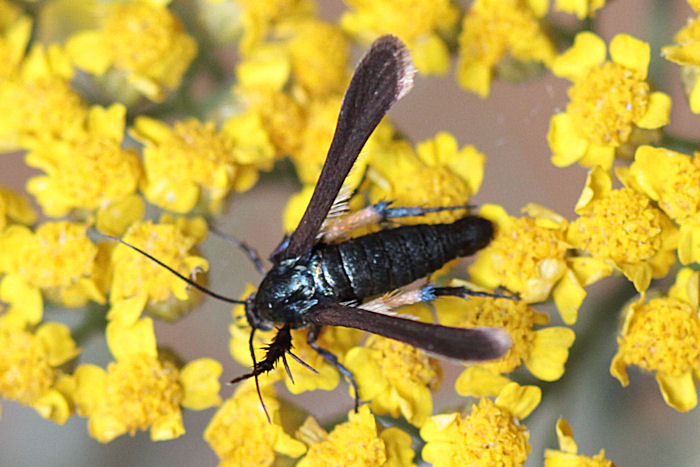
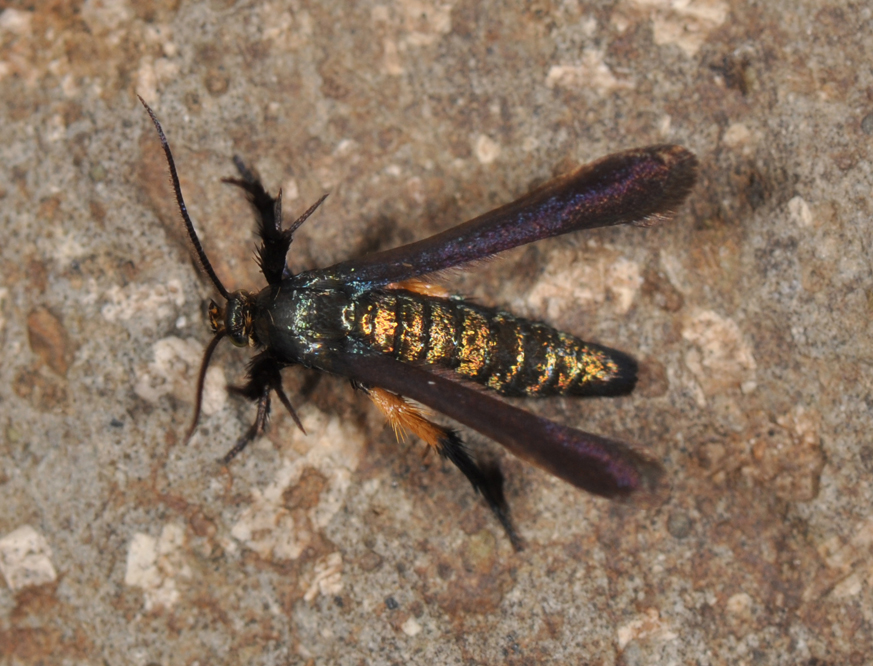
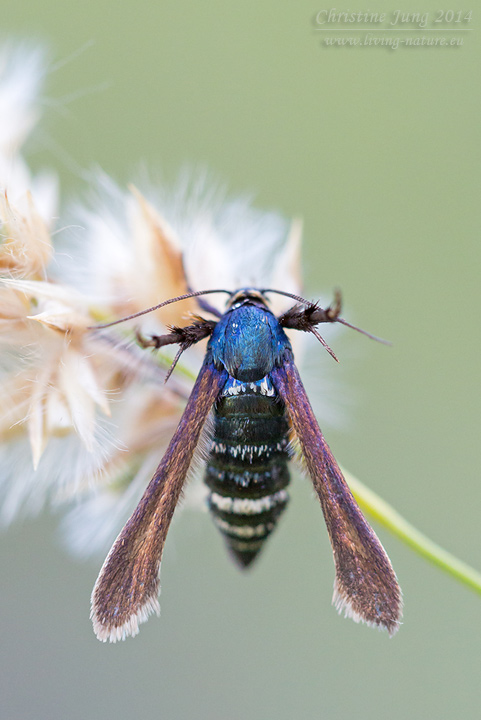
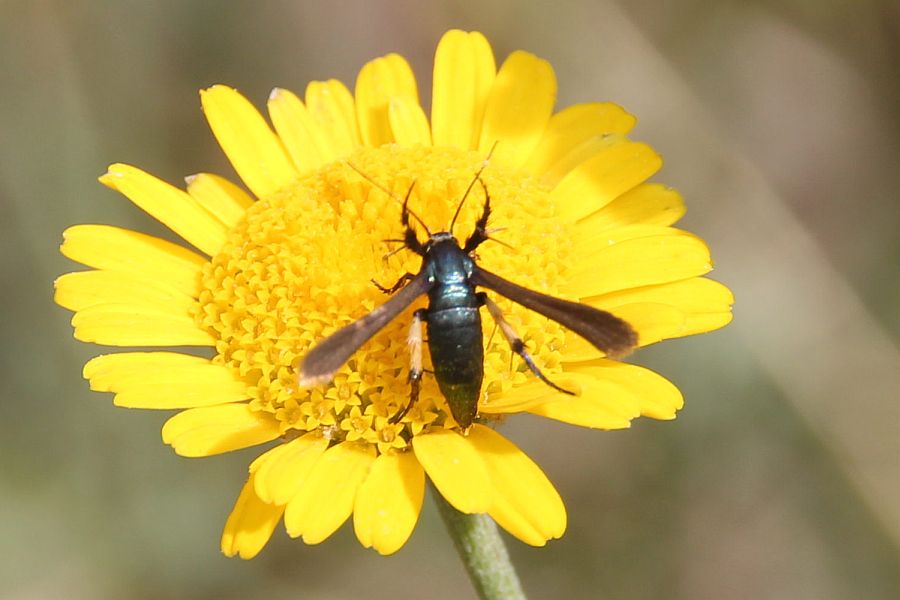
1. Lebendfotos
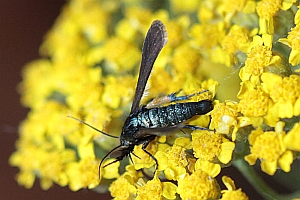
1.1. Falter

2. Diagnose
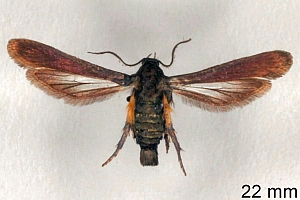
2.1. Geschlecht nicht bestimmt
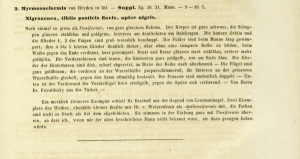
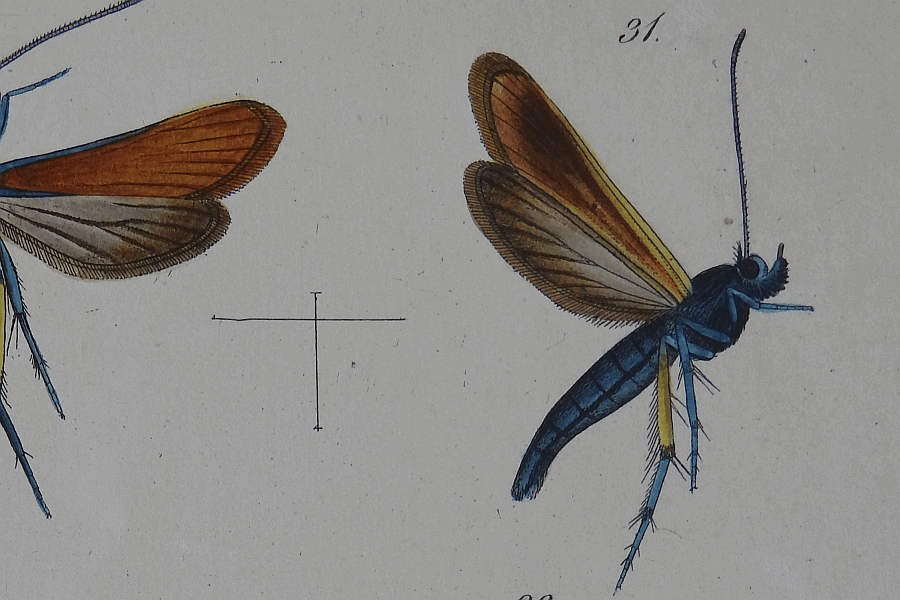
2.2. Erstbeschreibung

3. Biologie
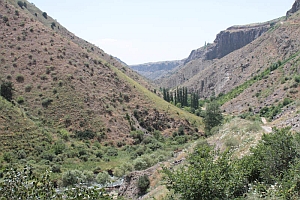
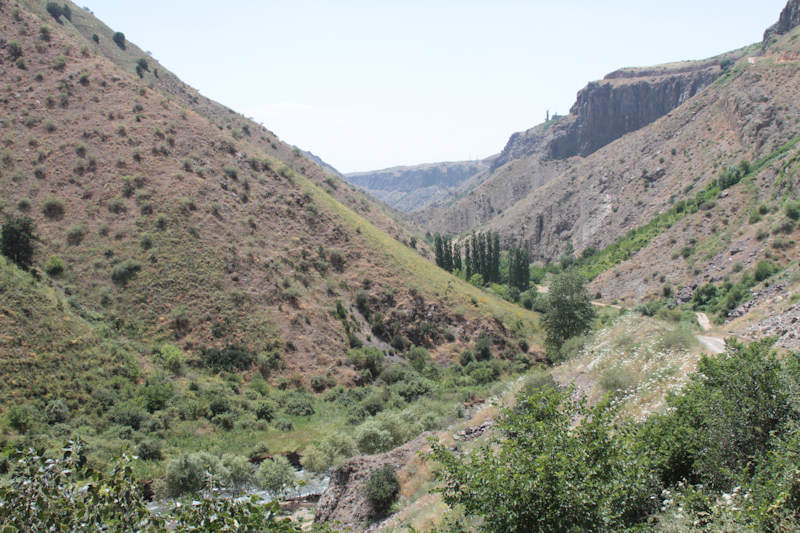
3.1. Habitat


3.2. Nahrung der Raupe
- [Rosaceae:] Potentilla recta (Aufrechtes Fingerkraut)
- [Rosaceae:] Potentilla astracanica [= Potentilla taurica] (Astrachan-Fingerkraut, Taurisches Fingerkraut)
- [Rosaceae:] Potentilla pedata (Behaartes Fingerkraut, Langhaariges Fingerkraut, Rauhaariges Fingerkraut)
Die Raupe von N. myrmosaeformis lebt in den Wurzeln der beiden genannten Fingerkraut-Arten Potentilla recta und P. astracanica. Angaben zu Paliurus spina-cristi sind sehr wahrscheinlich falsch. Durch die Einbeziehung der Negotinthia efetovi als Unterart - Negotinthia myrmosaeformis efetovi kommt von der Krim eine weitere Fingerkraut-Art hinzu: Gorbunov (2019) fand die Raupen seiner Zuchtserie für die Erstbeschreibung jenes Taxons in Wurzeln von Potentilla pedata.
(Autor: Erwin Rennwald)
4. Weitere Informationen
4.1. Etymologie (Namenserklärung)
myrmosaeformis: „Myrmosa, Ameisenbiene.“
ssp. efetovi: Gorbunov (2019: 309) erläuterte seine Namenswahl: "This new species is named after my friend Prof. Dr. Konstantin A. Efetov (the Vernadsky Crimean Federal University, Simferopol, Russia), a researcher of the Lepidoptera of the Crimean Peninsula and a specialist in the family Zygaenidae of the world fauna."
4.2. Andere Kombinationen
- Paranthrena [sic!] myrmosaeformis Herrich-Schäffer, 1846 [Originalkombination]
- Paranthrene myrmosaeformis Herrich-Schäffer, 1846
- Tinthia myrmosaeformis (Herrich-Schäffer, 1846) [so in der Fauna Europaea, last update 23 July 2012, version 2.5 [nicht mehr zugänglich]]
4.3. Synonyme
- Tinthia cingulata (Staudinger, 1870) [Nr. 04021 bei Karsholt & Razowski (1996)]
- Negotinthia cingulata (Staudinger, 1870) [vielleicht Subspecies]
- Negotinthia efetovi Gorbunov, 2019 [jetzt Subspecies]
4.4. Unterarten
- Negotinthia myrmosaeformis efetovi Gorbunov, 2019
- Negotinthia myrmosaeformis cingulata (Staudinger, 1870)
4.5. Taxonomie
Das von Karsholt & Razowski (1996) unter der Nummer 4021 als Art geführte Taxon Tinthia cingulata (Staudinger, 1870) ist nach freundlicher Mitteilung von Daniel Bartsch (E-Mail vom 15. Juni 2008) eine Subspecies von N. myrmosaeformis. Dies wird von verschiedenen Autoren aber sehr unterschiedlich gehandhabt. Gorbunov (2019: 303) muss daher schreiben: "Some of them consider N. cingulata as a synonym [Dalla Torre, Strand, 1925; Popescu-Gorj et al., 1958; Laštùvka, 1990; Laštùvka, Laštùvka, 1995] or a subspecies of N. myrmosaeformis [Laštùvka, Laštùvka, 2001; Pühringer, Kallies, 2004], others as a good species [Cãpușe, 1971, 1973; Špatenka et al., 1993, 1996; de Freina, 1997; Špatenka et al., 1999; Gorbunov, 2001, 2008, 2013]. I have always considered and believe that N. cingulata is separate species, but very closely related to N. myrmosaeformis." Er beschreibt dazu eine weitere Art - Negotinthia efetovi - die er vor allem mit Negotinthia cingulata vergleicht, die er als Art akzeptiert.
Es bleibt dabei: Ob N. cingulata und N. efetovi als Arten akzeptiert werden oder nicht, sehen "Splitter" und "Lumper" unterschiedlich. Laštůvka & Laštůvka (2025: 20) rechnen beide "Arten" in ihrer Europa-Liste weiterhin zu Negotinthia myrmosaeformis und schreiben dazu: "N. efetovi Gorbunov, 2019 from Crimea with more pronounced rings is considered a subspecies here (3c) (cf. Gorbunov 2019a, Gorbunov & Efetov 2024); the position of the taxa cingulata Staudinger, 1870 and efetovi requires further study."
4.6. Faunistik
Ssp. efetovi: Gorbunov (2019) schreibt zu seiner "Negotinthia efetovi": "At present, this new species is known only from two localities in the surroundings of Belogorsk, Crimea only." Gorbunov & Efetov (2024: 148) konnten nach einer umfassenden Suche melden: "In total, we found representatives of the genus in 57 localities in Crimea. Of these, we found N. cingulata in 39 and N. efetovi in 20. At two localities, namely in Simferopol’ (Bitak) and in the vicinity of Zolotoye Pole, Kirovskiy District, both of these species were found syntopically."
(Autor: Erwin Rennwald)
4.7. Typenmaterial
Ssp. efetovi: Gorbunov (2019): "Holotype ♂ (Figs 1–2) with labels: “Russia, Crimea, Belogorsk, / 5 km W of Belogorsk, / 45°03.95´N, 034°30.06´E, / 315 m, 16.V.2018, ex l. / O. Gorbunov leg.” (white); “Host plant: / Potentilla pedata / (Rosaceae) / Moth emerged 02.VI.2018” (white); “SESIIDAE / Pictures №№ / 0177-0178–2018 / Photo by O. Gorbunov” (white); “HOLOTYPUS ♂ / Negotinthia efetovi / O. Gorbunov, 2019 / O. Gorbunov des., 2015” (red) (COGM)." Die 42 Paratypen stammen vom selben Fundort und von einer weiteren Stelle um den gleichen Ort.
4.8. Publikationsjahr der Erstbeschreibung
Wir folgen den Angaben von Heppner (1982).
4.9. Literatur
- Beschreibung als Negotinthia efetovi: Gorbunov, O. (2019): A new species of the genus Negotinthia O. Gorbunov, 2001 (Lepidoptera: Sesiidae) from Crimea, with remarks on the genus. — Russian Entomological Journal 28 (3): 303–311. [PDF auf kmkjournals.com]
- Gorbunov, O. G. & K. A. Efetov (2024): To the distribution of the genus Negotinthia O. Gorbunov, 2001 (Lepidoptera: Sesiidae) in the Crimea. — Ecologica Montenegrina 73: 146-157. [PDF auf biotaxa.prod.amazon.auckland.ac.nz]
- Heppner, J. B. (1982): Dates of selected Lepidoptera literature for the western hemisphere fauna. — Journal of the Lepidopterologists' Society 36 (2): 87-111.
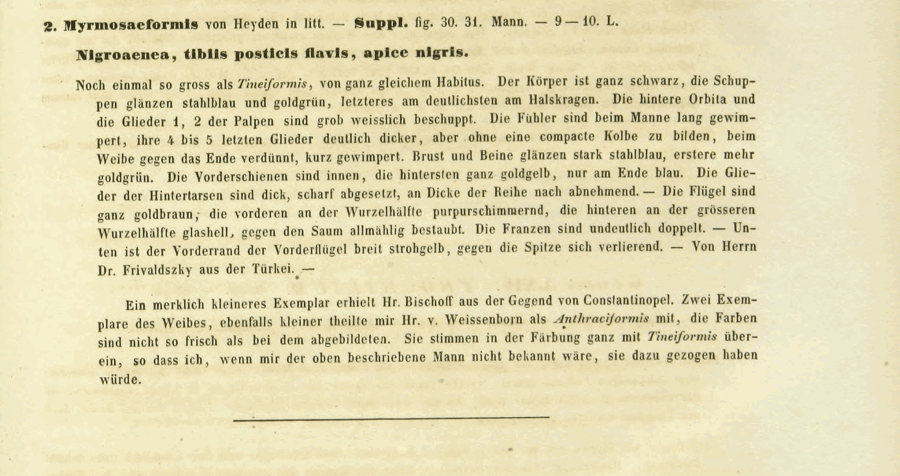
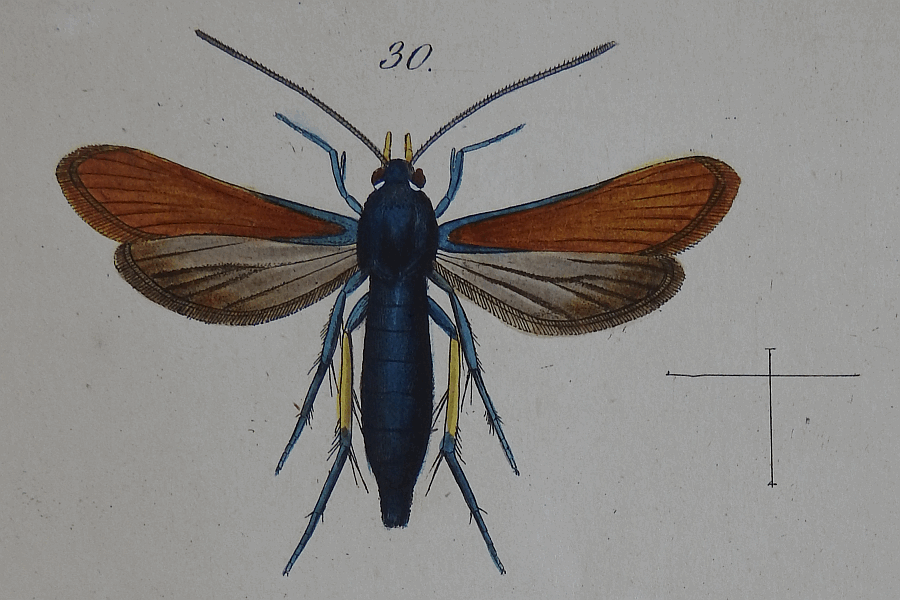
- Erstbeschreibung: Herrich-Schäffer, G. A. W. („1845“) [1843-1855]: Systematische Bearbeitung der Schmetterlinge von Europa, zugleich als Text, Revision und Supplement zu Jakob Hübner's Sammlung europäischer Schmetterlinge. Zweiter Band. Die Schwärmer, Spinner und Eulen: 1-450, Index 1-64, Hepialides pl. 1, Cossides pl. 1-2, Zygaenides pl. 1-16, Sesiides pl. 1-10, Sphingides pl. 1-4, Bombycides pl. 1-32, Noctuides pl. 1-124, Nycteolidae pl. 1. Regensburg.
- Laštůvka, Z. & A. Laštůvka (2025): Clearwing Moths of Europe Identification, Biology and Distribution (Lepidoptera: Sesiidae). — 86 pp.; (Mendel University Press) Brno. https://doi.org/10.11118/978-80-7701-064-1.