+8Kontinente:EUAS



2. Diagnose
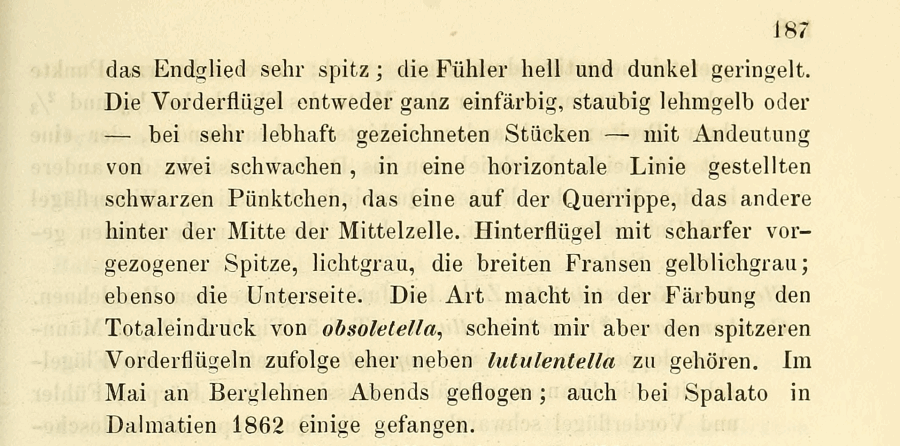
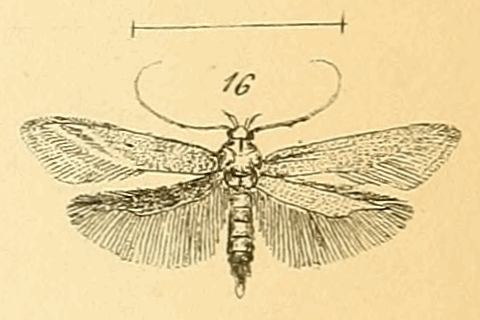
2.1. Erstbeschreibung


3. Biologie
3.1. Nahrung der Raupe
- [Asteraceae:] Pallenis maritima [= Asteriscus maritimus, Asteriscus mauretanicus] (Küstenstrandstern)
Nach Englert (1974: 390) noch unbekannt! Walsingham (1903: 263) hatte allerdings schon lange zuvor zu seiner mittlerweile als Synonym hier eingezogenen Apodia seminivora geschrieben: "Hab.: SPAIN — Cadiz — Chiclana. Larva in dry seed-heads of Asteriscus maritimus, 23.XII.1901, excl. 19.IV. 1902 ; 20. IV. 1902. [...] A very inconspicuous species, apparently difficult to breed, as I have succeeded in obtaining only two specimens from more than a hundred larvae collected in early spring at Chiclana, 1901-2, several specimens had evidently died through the thick leathery calyx hindeing their egress by contraction. I found larvae also at Tangier, but failed to rear them ; I, however, took a worn specimen on May 8th. It is quite distinct from the allied species (asterisci), which feeds in the dry seed-heads of Asteriscus mauretanicus, appearing to be confined to Asteriscus maritimus. The larva is yellowish white, with a pale brown head, devoid of colour on the thoracic and anal plates. It feeds at the base of the old seed-heads, and burrows for a short distance down the stem, apparently when preparing to pupate. The larva was extremely common near the salt-marshes at Chiclana, where a large patch of the somewhat local food-plant occurred."
(Autor: Erwin Rennwald)
4. Weitere Informationen
4.1. Andere Kombinationen
- Gelechia tenuiella Mann, 1864 [Originalkombination]
4.2. Synonyme
- Apodia seminivora Walsingham, 1903 [Nr. 03301 in Karsholt & Razowski (1996)]
- Ptocheuusa seminivora (Walsingham, 1903) [Nr. 03301 in Karsholt & Razowski (1996)]
- Metzneria insignificans Walsingham, [1908]
- Metzneria infelix Walsingham, [1908]
4.3. Faunistik
Nach der nicht mehr online zugänglichen Fauna Europaea kommt die Art in Kroatien, Frankreich, Portugal, Spanien, auf Kreta und auf den Kanarischen Inseln vor.
Mann (1864) beschrieb seine neue Art aus Split in Kroatien (Spalato in Dalmatien). Die Beschreibungen der Syonyme Metzneria insignificans und Metzneria infelix durch Walsingham ([1908]: 926) erfolgten beide von Teneriffa. Das erst später als solches erkannte Synonym Apodia seminivora wurde von Walsingham (1903: 263) aus Chiclana im Süden von Spanien beschrieben.
(Autor: Erwin Rennwald)
4.4. Literatur
- Englert, W. D. (1974): Revision der Gattung Metzneria Zeller (Lepid., Gelechiidae) mit Beiträgen zur Biologie der Arten. — Zeitschrift für Angewandte Entomologie 75: 381-421.
- Erstbeschreibung: Mann, J. (1864): Nachtrag zur Schmetterling-Fauna von Brussa. — Wiener Entomologische Monatschrift 8 (6): 173-190 + Taf. 4-5.
- Beschreibung als Metzneria insignificans und Metzneria infelix: Walsingham (1908): Microlepidoptera of Tenerife. — The Proceedings of the Zoological Society of London for the Year 1907: 911-1034 + pl. LI-LIII.
- Beschreibung als Apodia seminivora: Walsingham (1903): Spanish and Moorish Micro-Lepidoptera. — The Entomologist's Monthly Magazine 39: 179-187, 209-214, 262-268, 292-293.