+4Kontinente:AS




2. Diagnose
2.1. Erstbeschreibung

3. Weitere Informationen
3.1. Andere Kombinationen
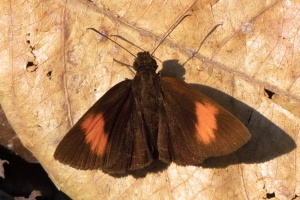
- Astictopterus gemmifer Butler, 1879 [Originalkombination]
3.2. Unterarten
- Kerana gemmifer dombya (Fruhstorfer, 1911) [Unterart nach funet.fi]
3.3. Taxonomie
Butler (1879: 555) beschrieb seine Art als "Astictopterus gemmifer" aus Malacca in Malaysia. Huang et al. (2024) - wie schon zuvor Zhang et al. (2022) - kommen zum Schluss, dass die Art in die Gattung Kerana gehört: "Our phylogenetic results showed that Ancistroides group sensu Evans (1949) or Ancistroidini sensu Chou (1994) consisted of at least two distantly related lineages (Fig. 5): (1) the traditional Ancistroides, Udaspes, and Notocrypta formed a monophyletic clade with strong support, sharing the following characters: the vein M2 is more or less decurved at origin, where it is always nearer to M3 than to M1. As in Zhang et al. (2022a), our results also indicated that the genus Ancistroides is not monophyletic, comprising three separate clades. The type species Ancistroides longicornis clustered together with Udaspes and Notocrypta with strong support. Ancistroides nigrita was recovered as an isolated clade and the other two species (A. gemmifer and A. armatus) formed a clade. Morphological evidence shows that A. gemmifer and A. nigrita are considerably different from A. longicornis in the male genitalia with bifid uncus, of which the distal 1/3 is V-shaped. On the other hand, like those in Notocrypta and Udaspes, the uncus of A. longicornis is U-shaped at more than 2/3 of the length. In addition, A. armatus and A. gemmifer (previously belonged to the genus Kerana Distant) and A. nigrita (the type species of the genus Tamela Swinhoe) differ in the characteristics of valvae and gnathos. Both the morphological and phylogenetic analyses suggest that these three genera (Ancistroides sensu strict, Notocrypta, and Udaspes) should be congeneric. Thus, we agree with Zhang et al. (2022a) to reinstate two genera Kerana and Tamela as valid, both of which were synonymized with Ancistroides by Evans (1949), and to treat Notocrypta and Udaspes as synonyms of Ancistroides based on the rule of priority."
(Autor: Erwin Rennwald)
3.4. Faunistik
Nach [Global Biodiversity Information Facility] kommt die Art in Malaysia, Thailand und Indonesien vor.
Locus typicus gemäß Erstbeschreibung: Malacca [Stadt in Malaysia].
(Autor: Michel Kettner)
3.5. Literatur
- Erstbeschreibung: Butler, A. G. (1879): The Butterflies of Malacca. — The Transactions of the Linnean Society of London. Second Series 1: 533-568, pl. LXVIII-LXIX. London (Taylor and Francis).
- Huang, Z., Chiba, H., Hu, Y., Deng, X., Fei, W., Sáfián, S., Wu, L., Wang, M. & X. Fan. (2024): Molecular phylogeny of Hesperiidae (Lepidoptera) with an emphasis on Asian and African genera. — Molecular Phylogenetics and Evolution, 198: 1-13. [zum PDF-Download auf researchgate.net]
- Zhang, J., Cong, Q., Shen, J. & N. V. Grishin (2022): Taxonomic changes suggested by the genomic analysis of Hesperiidae (Lepidoptera). — Insecta Mundi 921: 1-135. [PDF auf journals.flvc.org]