+3Kontinente:EU



2. Diagnose
2.1. Falter
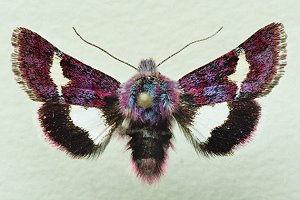
Ronkay et al. (2025: 92) sind überzeugt: "The new species is easily separable from J. friwaldszkii and J. johanna by its considerably broader hindwing white band, more purple-pinkish irrorated forewings and the strogest dark patch at place of reniform stigma; from J. divalis mostly by the white (not yellow) inner area of hindwings and the more variegated pinkish-violet colour of forewings." Dazu kommen kleinere Genitalunterschiede der Männchen und - wo bekannt - auch der Weibchen.
2.1.1. Geschlecht nicht bestimmt


4. Weitere Informationen
4.1. Etymologie
Ronkay et al. (2025: 92) erklären: "The new species is dedicated to the Forster brothers, Gerhard (Mönchhof, Austria) and Helmut (Ollersdorf, Austria), renowned explorers of the European Lepidoptera fauna, collectors of the holotype specimen."
4.2. Faunistik
Ronkay et al. (2025: 92) umreißen das bekannte, kleine Vorkommensgebiet: "The new species occurs in a small area of the Central Balkans in North Macedonia, south-western Bulgaria, Upper Thracian lowland-foothills of Central Rhodopi Mts and northern Greece." In Bulgarien und Nord-Griechenland dürfte es zum Zusammentreffen oder auch zur Arealüberschneidung mit J. friwaldszkii kommen - Details warten noch auf ihre Klärung.
4.3. Typenmaterial
Ronkay et al. (2025: 91-92) schreiben zum Holotypus: "Holotype. Male, Bulgaria, Sandanski, 17.-20.V.2004, leg. Forster (coll. Ronkay, NHMW)." Von den 141 Paratypen plus einer "large series" in der Sammlung der Forster-Brüder stammen die meisten von wenigen Fundorten in Bulgarien (zumeist Sandanski) und Nordmazedonien, nur wenige aus dem Norden Griechenlands.
(Autor: Erwin Rennwald)
4.4. Literatur
- Erstbeschreibung: Ronkay, G., Ronkay, L. & S. Beshkov (2025): Two new species of the genus Janthinea Guenée, 1852 (Noctuidae, Acontiinae, Hypercalymniini). — p. 87-98. In: Fibigeriana Supplement. Book series of Taxonomy and Faunistics. Volume 5: 266 pp.; (Heterocera Press) Budapest.