+2Kontinente:AS



2. Diagnose
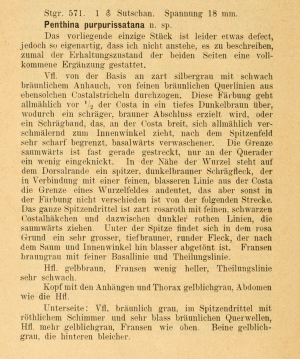
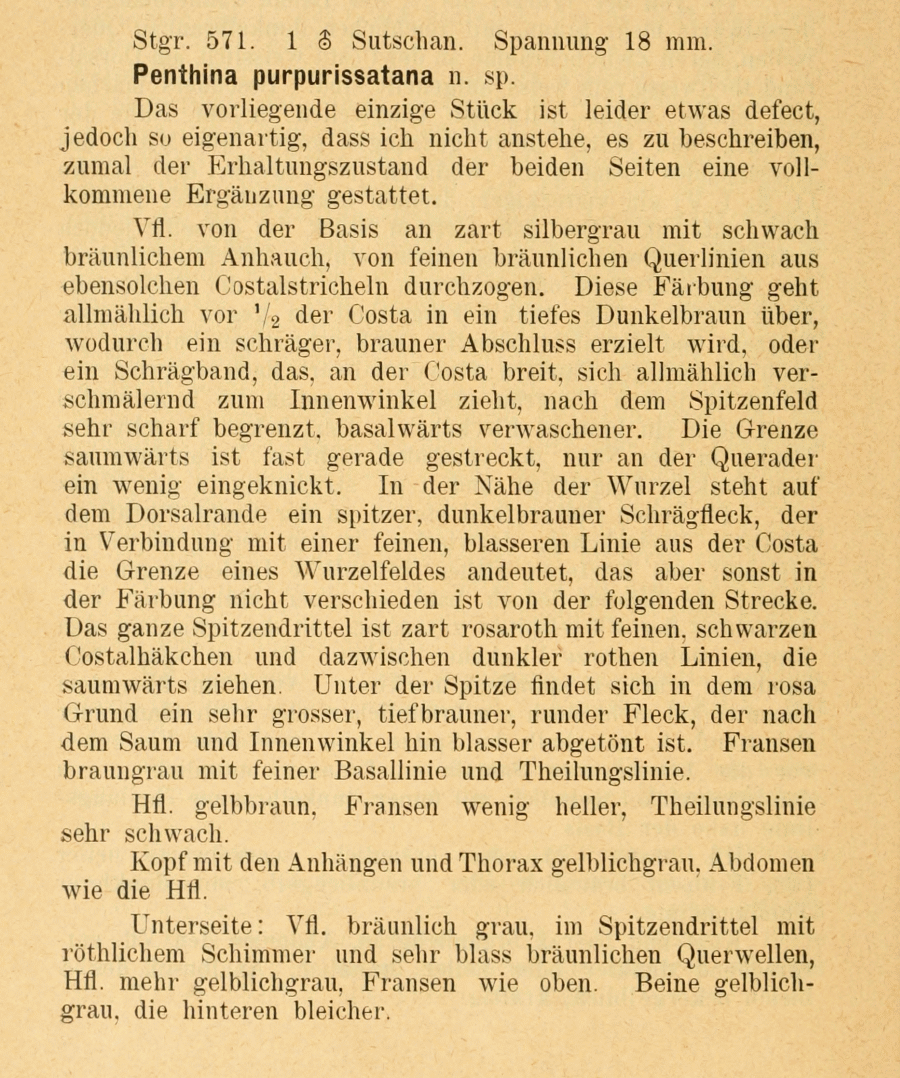
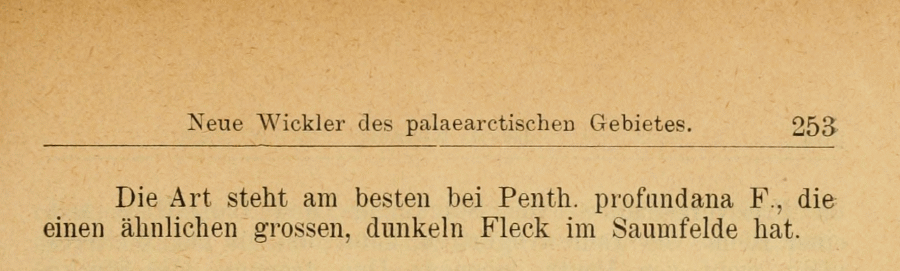
2.1. Erstbeschreibung
3. Biologie
3.1. Nahrung der Raupe
- [Schisandraceae:] Schisandra chinensis [= Schizandra chinensis] (Chinesisches Spaltkörbchen)
Diakonoff (1973: 100) meldete: "Food plants. Bred from rolledleaves of Schizandra chinensis (Turcz.) Boill. (Magnoliaceae)." Und weiter: "Far East, Maritime District, 1 ♂, "Prim. Krai, 14.vii.1961, env. Vladivostok"; 1 ♀, "Rear. no. 19, Schizandra chinensis (Turcz.) Boill., larv. 22.V., pup. 2.vi, im. 28.vi. 1963 (Sukhareva, Falkovitch), env. Vladivostok, Okeanskaia Biol. Station, mixed woods" (both specimens in Akad. Petrop.)."
(Autor: Erwin Rennwald)
4. Weitere Informationen
4.1. Andere Kombinationen
- Penthina purpurissatana Kennel, 1901 [Originalkombination]
- Olethreutes purpurissatana (Kennel, 1901)
- Semasia purpurissatana (Kennel, 1901)
4.2. Taxonomie und Faunistik
Kennel (1901: 252-253) beschrieb seine Penthina purpurissatana aus "Sutschan" (jetzt Partisansk) in der Primorje Region ganz im Südosten des Fernen Osten Russlands. Äußere Ähnlichkeit des Falters brachte Clarke (1958: 540) dazu, das Tier mit der südostasiatischen Argyroploce archimedias Meyrick, 1912 zu synonymisieren, so dass Letztere zum jüngeren Synonym wurde: "Olethreutes purpurissatana (Kennel), new combination - Plate 269, Figures 4-4a - Penthina purpurissatana Kennel, 1901, Iris, 13: 252 - Argyroploce archimedias Meyrick, 1912, Exotic Microlepidoptera, 1: 63." Das war grob falsch und Eudemopsis purpurissatana und Sorolopha archimedias stehen heute in verschiedenen Gattungen. Diakonoff (1973: 54) hatte bei Sorolopha archimedias aber zugestanden: "The species has the "classical" colouring and markings of the Palaearctic species Eudemopsis purpurissatana (Kennel)."
(Autor: Erwin Rennwald)
4.3. Literatur
- Clarke, J. F.G. (1958): Catalogue of the Type Specimens of Microlepidoptera in the British Museum (Natural History) described by Edward Meyrick 3: 1-600. London. [S. 540, Digitalisat auf biobiversitylibrary.org]
- Diakonoff, A. (1973) The South Asiatic Olethreutini (Lepidoptera, Tortricidae). — Zoölogische Monographieën van het Rijksmuseum van Natuurlijke Historie, 1: [i–xxii] 1–700.
- Erstbeschreibung: Kennel, J. (1901): Neue Wickler des palaearctischen Gebietes aus den Sammlungen der Herren O. Staudinger und A. Bang-Haas. — Deutsche Entomologische Zeitschrift Iris 13 (2): 205-305. [S. 252, Digitalisat auf biodiversitylibrary.org]