+10Kontinente:EU


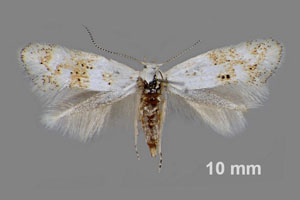
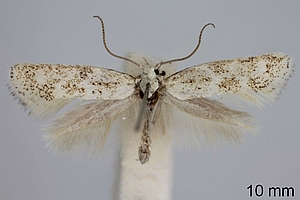

2. Diagnose
2.1. Männchen
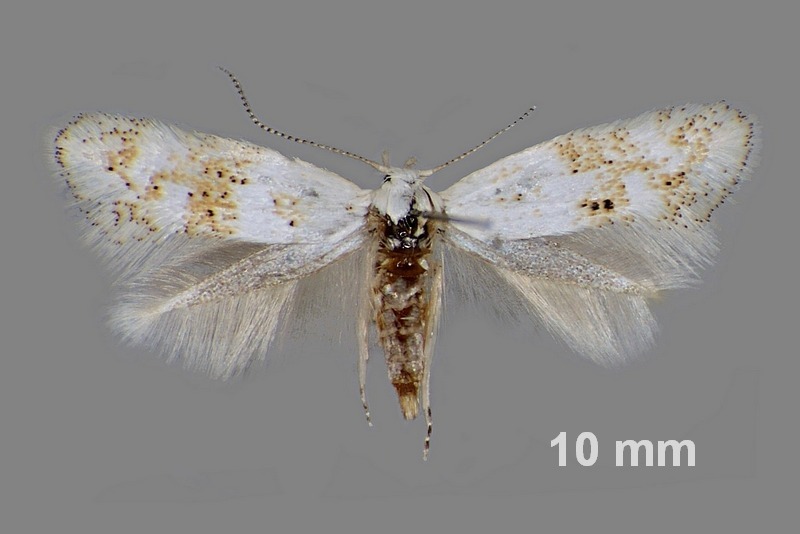
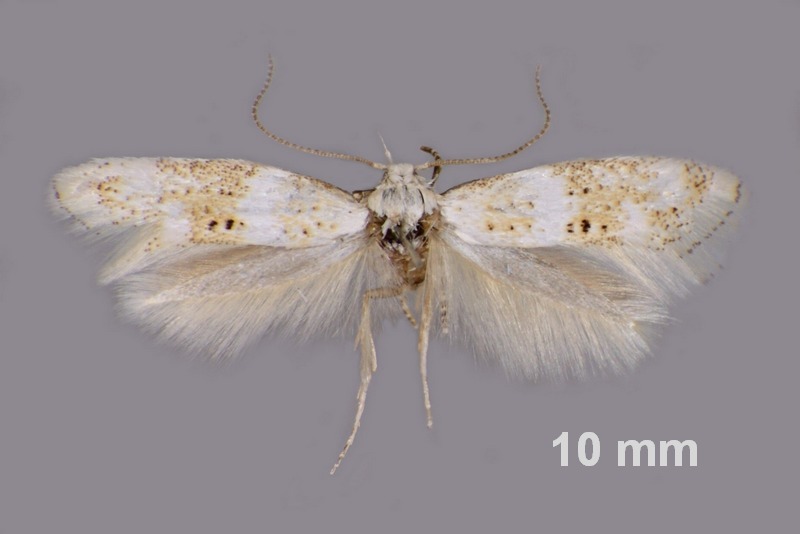
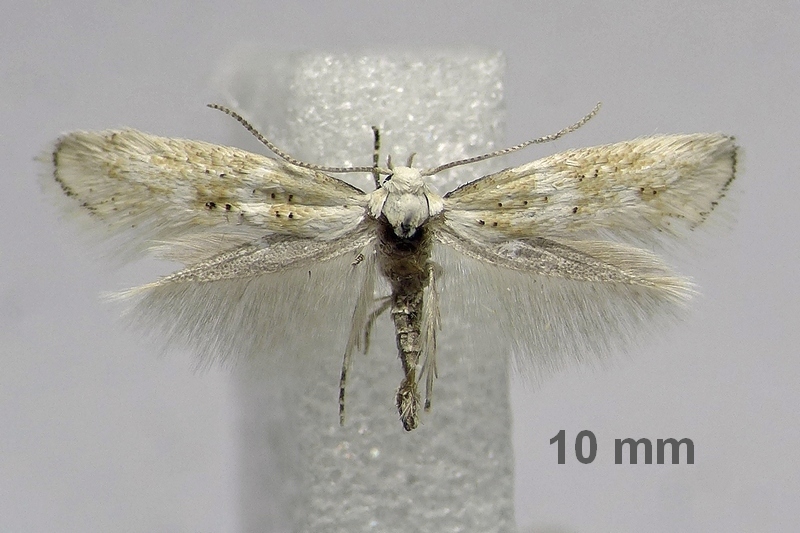
Hinweis: Am 11. Januar 2024 wurden 2 Falterbilder aus der Slowakei zur neu beschriebenen Elachista mariae verschoben.
2.2. Geschlecht nicht bestimmt
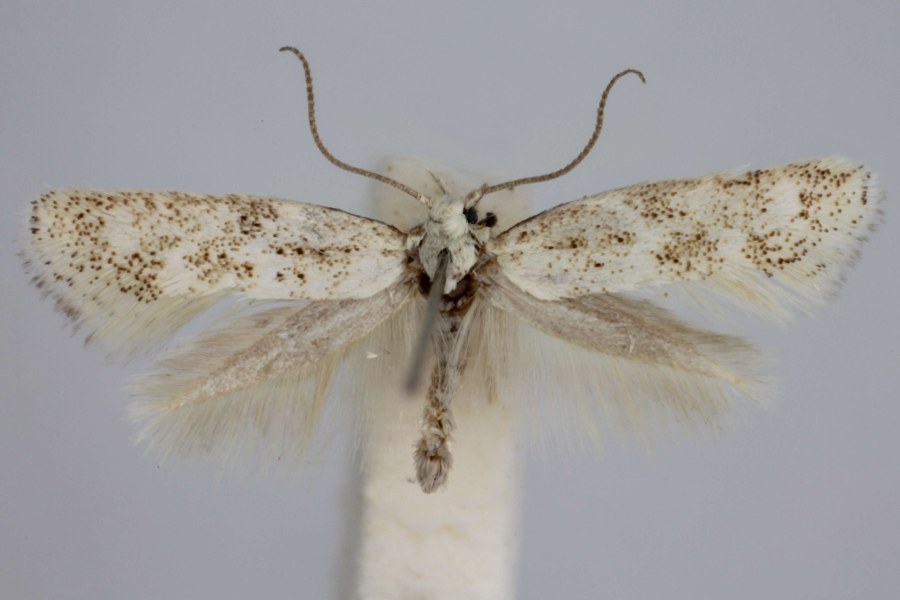

2.3. Genitalien
2.3.1. Männchen
Hinweis: Am 11. Januar 2024 wurden die bisher hier abgelegten Genitalfotos aus der Slowakei zur neu beschriebenen Elachista mariae verschoben.
3. Biologie
3.1. Nahrung der Raupe
- [Poaceae:] Phleum phleoides [= Phleum boehmeri] (Steppen-Lieschgras)
Bei Kaila et al. (2025: 133-134) heißt es knapp: "Larval host plant(s): Phleum phleoides (Baran 2002)." und "Baran (2002) gave a detailed account of identification, immature stages and ecology of E. nolckeni." Bei Baran (2002: 103-105) ist nach einer sehr detaillierten Beschreibung von Raupe und Puppe Näheres zur Lebensweise an den wenigen Fundorten in Polen zu erfahren: "Eggs are laid at the basal part of a leaf of Phleum phleoides (L.) Karsten, in the middle or near a margin of the blade. Initially the larva mines in a narrow gallery (Stigmella-like), towards the leaf-tip; than it turns at or near the tip and mines downwards making a pale greenish Phyllonorycter-like blister, 4.5-6 mm in length (n = 12) (Fig. 19). The proximal part of the blotch is rounded, irregular or divided usually into two short parts (galleries). The blister mine occupies an apical part or (rarely) a central one of the leaf. The frass is concentrated in the distal part of the mine. Because of the colour and twisted margins of the blade, the mine is relatively difficult to detect. During development (in captivity), the larvae sometimes change leaves. Pupation takes place on the ground; in the breeding containers on the bottom among leaf litter. The pupa is anchored to the substrate by a terminal segment and a silken girdle. In the laboratory, the pupal stage lasts 13-15 days. The larvae start feeding about mid-April and occur until the second half of May. Mines with mature larvae were found in large numbers in early May. Adults are univoltine and fly from the middle of May to the beginning of July, most abundantly in the first half of June."
Wenn die Bestimmungen zutreffen, nutzt E. nolckeni also die gleiche Raupennahrungspflanze wie Elachista rudectella.
(Autor: Erwin Rennwald)
4. Weitere Informationen
4.1. Etymologie (Namenserklärung)
Šulcs (1992: 105): „Die [sic] Name der neuen Art leitet sich vom Erstfinder Baron J. H. W. Nolcken her.“
4.2. Taxonomie
Kaila et al. (2025) besprechen die Art in der "Elachista bedellella group (Gelechioidea, Elachistidae, Elachistinae) similar with E. rudectella Stainton, 1851 and E. graeca Parenti, 2002". Kaila et al. (2025: 134) erklären zum Barcoding: "Maximum intraspecific divergence distance (n = 23) 1.43 % (sample id’s: BC ZSM Lep94917; DNA voucher FinBOL 2021 http://tun.fi/NH.467, 467; DNA samples KLM Lep15568; DNA sample 25479 Lepid. Phyl.; TLMF 11086, 12301, 12316, 12333, 14952, 16592, 19472, 15331, 15381, 15466, 16809, 18122, 18123, 18446, 18556, 23717, 26223, 27725, 27797, 33418). Nearest neighbour is E. rosselloensis Nel & Varenne, 2019 with 5.08 % divergence."Sie merken in der Diagnos an: "E. nolckeni is a silky white species with yellow bands in the middle and near apex of the forewing. The wing is variably scattered with raised, black scales. As such, it is more reminiscent of species such as E. pollinariella Zeller, 1839, E. heringi Rebel, 1899 and E. szocsi Parenti, 1978 in the E. argentella group rather than species of the E. bedellella group dealt with here. The male genitalia of E. nolckeni have elongate, pointed uncus lobes, resembling those of E. graeca and E. rudectella. E. nolckeni is readily distinguished from these species by its much smaller and curved cornutus. The male genitalia of Elachista ohridella and E. laurikailai closely resemble E. nolckeni."
4.3. Faunistik
Die Art wurde aus Lettland beschrieben, mit Paratypen aus Estland und Polen. Nach Sauter & Whitebread (2005) kommt sie auch in der Schweiz vor. Kaila et al. (2025: 123-125) bestätigten Exemplare aus Russland (Süd-Ural), Georgien, Estland, Österreich, Italien und Spanien. Zur Gesamtverbreitung notierte sie (S. 133): "Austria, Czech Republic, Estonia, France, Germany, Georgia, Italy, Latvia, Poland, Russia (European part, southern Ural, Caucasus), Slovakia, Spain, Switzerland, Ukraine (Kaila 2019)."
(Autor: Erwin Rennwald)
4.4. Typenmaterial
Šulcs (1992: 105): „♂, Holotypus, Lettland, Rīteri, 27.06.1990, leg. I. Šulcs. — Paratypen: 1 ♂, 1 ♀, Lettland, Jumprava, 20.06.1989 leg. I. Šulcs, Männliches Genitalpräparat 311X/B. Å. Bengtsson, Weibliches Genitalpräparat 314X/B. Å. Bengtsson; 8 ♂♂, 2 ♀♀, Lettland, Saulkalne, 6.07.1989 leg. N. Savenkov, Männliches Genitalpräparat 313X/B. Å. Bengtsson; 2 ♂♂, Lettland, Rīteri, 27.06.1990, leg. I. Šulcs: 1 ♂, Lettland, Jumprava, 11.07.1990, leg. I. Šulcs; 1 ♀, Polen, Torun, 24.06.1980, leg. J. Buszko, Genitalpräparat 315X/B. Å. Bengtsson; 4 ♂♂, Estland, Pichtendahl, mit Etiketten 10.6.1868, Paë. W, 8.06.1868 P. disertella HS, 1018 d. Picht., 15.07.1864, Picht., leg. W. Nolcken, Männliche Genitalpräparate 164, 165, 166, 167/I. Šulcs.
Die Exemplare befinden sich in den Privatsammlungen von I. Šulcs und N. Savenkow und in der Sammlung von W. Nolcken im Zoologischen Museum der Universität in Riga.“
(Autor: Jürgen Rodeland)
4.5. Literatur
- Baran, T. (2002): Elachista nolckeni Šulcs, 1992: morphology and bionomics of immature stages (Gelechioidea: Elachistidae). — Nota Lepidopterologica, 25: 97–107. [PDF auf zobodat.at]
- Hollingworth, T., Nel, J. & R. Mazel (2002): A propos de deux Microlépidoptères méconnus en France, Oxypteron politum (Walsingham, 1907) et Elachista nolckeni Sulcs, 1992, correctif et compléments (Lepidoptera, Tortricidae et Elachistidae). — Bulletin de la Société entomologique de France 107 (4): 427-428. [PDF auf persee.fr]
- Kaila, L., Nupponen, K. & V. Sruoga (2025): On species of the Elachista bedellella group (Gelechioidea, Elachistidae, Elachistinae) similar with E. rudectella Stainton, 1851 and E. graeca Parenti, 2002, with descriptions of five new species. — Nota Lepidopterologica, 48: 103–136. DOI 10.3897/nl.48.142483. [zum open-access-Artikel auf nl.pensoft.net]
- Sauter, W. & S. Whitebread (2005): Die Schmetterlinge der Schweiz (Lepidoptera). 9. Nachtrag. — Mitteilungen der Schweizerischen Entomologischen Gesellschaft, Bulletin de la Société Entomologique Suisse, 78 (1/2): 59-115. [Digitalisat auf e-periodica.ch]
- Erstbeschreibung: Šulcs, I. (1992): Elachista nolckeni sp. n. aus Lettland (Lepidoptera, Elachistidae). — Entomologica Fennica 3 (2): 105-108. [PDF auf journal.fi]