+1Kontinente:EU



2. Diagnose
2.1. Männchen

2.2. Weibchen

3. Genitalien
3.1. Männchen

3.2. Weibchen


4. Biologie
4.1. Habitat
4.2. Nahrung der Raupe
- [Cupressaceae:] Juniperus communis (Gemeiner Wacholder)
- [Cupressaceae:] Juniperus nana (Zwerg-Wacholder)
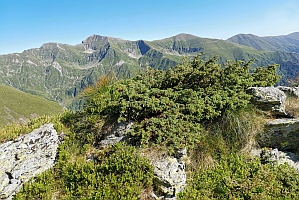
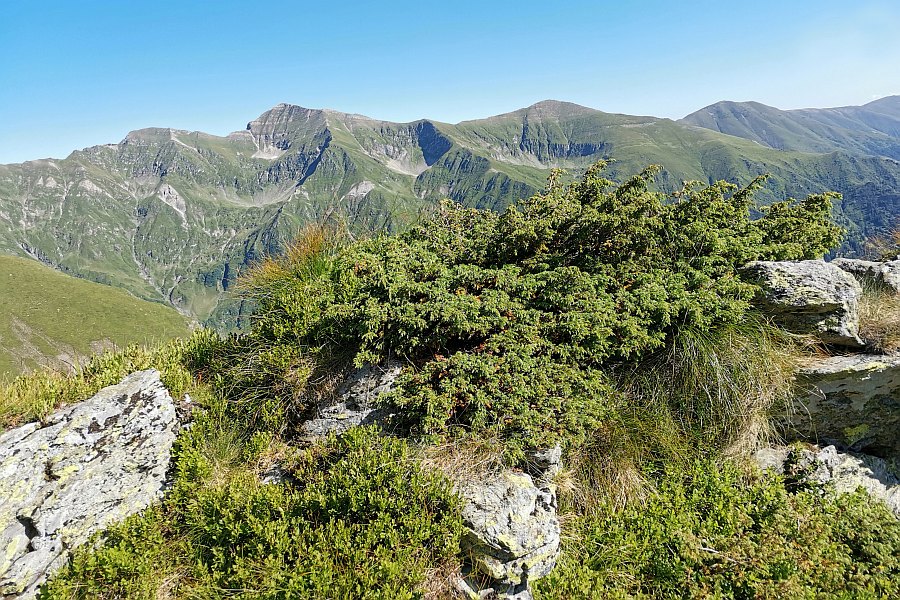
Kovács et al. (2026) teilen in ihrer Erstbeschreibung mit: "The host-plant is Juniperus communis L. Current knowledge of immature stages is limited: the larva lives among needles in silken, slightly elongate, indistinct spinnings on the end of the twigs in sheltered south-facing situations; it may hibernate once or twice; it pupates in the spring within the spinning. Spinnings are indistinct, but the needles of the old spinnings wither and become clearly visible and may indicate the presence of putative new spinnings on the new growth at the end of the twig. The larva resembles that of D. marginella and D. juniperella, but was not examined in detail. The habitats are exposed alpine scree with junipers."
Doch ganz zum Schluss ihrer Arbeit geben Kovács et al. (2026) noch einen versteckten Hinweis auf eine weitere Pflanze: "The single old record of D. juniperella from Transylvania (Romania) is that of Czekelius (1901), which, considering the label data of the D. carpatiella sp. nov. paratypes from the HNHM, certainly refers to the latter species and not to D. juniperella: “Ypsolophus juniperellus L. Zibinsgebirge 24. Juli 1900. Das Vorkommen ist an Juniperus nana gebunden. Die Raupe spinnt die Zweigspitzen fest zusammen zu walnussgrossen Knollen, die aussen grün bleiben; innerhalb derselben verpuppt sie sich und giebt nach acht bis zehn Tagen den Schmetterling.”" Juniperus nana ist damit eine weitere, vielleicht sogar die wichtigere Nahrungspflanze der Raupe von D. carpatiella.
Da diese beiden Vergleichsarten auch genetisch ähnlich sind, verwundern die äußere Ähnlichkeit und die Ähnlichkeit in der Biologie nicht.
(Autor: Erwin Rennwald)
5. Weitere Informationen
5.1. Etymologie (Namenserklärung)
Die Namenswahl ist fast selbsterklärend. Kovács et al. (2026) erläutern: "The specific name is a feminine adjective derived from the name of the Carpathians, the mountain range where the new Dichomeris species was discovered."
5.2. Taxonomie
Die Art ist äußerlich und auch von der Biologie her nächstverwandt mit D. juniperella, D. marginella und der neu beschriebenen Dichomeris dolomiella. Dazu passen dann auch die Barcodes dieser 4 Arten. Kovács et al. (2026) teilen dazu mit: "Three successfully barcoded specimens of D. carpatiella sp. nov. (one with a shorter sequence of 407 bp) from two localities, resulted in 0% intraspecific divergence and clustered in a unique BIN (see Ratnasingham and Hebert 2013) BOLD:AFZ7686. The nearest neighbour is D. dolomiella sp. nov. (BIN BOLD:AAU1435) at 3.69% minimum p-distance. The related taxa, D. marginella (BIN BOLD:AAC4900) and D. juniperella (BIN BOLD:AAF5665), differ by a minimum 4.01% and 4.49% p-distance respectively."
5.3. Faunistik
Kovács et al. (2026) kennen die Art nur von den vier Fundorten ihrer Typusserie aus den Hochlagen der Südlichen Karpaten von Rumänien: "So far only known from four localities in the Southern Carpathians, the alpine regions of the Făgăraș, Cibin, Parâng and Retezat Mountains (Romania)."
5.4. Typenmaterial
Kovács et al. (2026) listen ihre 7 Typusexempare: "Holotype: ROMANIA • ♂; Southern Carpathians, Făgăraș Mountains, Iezerul Caprei; alt. 2100 m; 14 Jul. 2023; ex pupa, pupa 12 Jul. 2023, Juniperus [communis L.]; [DNA sample] TLMF_Lep_38534; genitalia slide Buchner m3915; S. & Z. Kovács leg. & coll. (Miercurea Ciuc). Paratypes: ROMANIA • 1 ♂, 5 ♀; Southern Carpathians, Parâng Mountains, Cărbunele; alt. 2100 m; 13 Jul. 2016; genitalia prep. 2466/♂/ Kovács [= genitalia slide Buchner m3910] and 2877/♀/ Kovács [= genitalia slide Buchner w3911]; [DNA sample ♀] TLMF_Lep_38518, [DNA sample ♀] TLMF_Lep_47439; S. & Z. Kovács leg. & coll., 1 ♀ TLMF. • 1 ♂; Southern Carpathians, Făgăraș Mountains, Iezerul Caprei; alt. 2000 m; 28 Jul. 1994; S. & Z. Kovács leg. & coll. • 2 ♂, 2 ♀; same locality; alt. 2100 m; 3 Jul. 2022; S. & Z. Kovács leg. & coll. • 1 ♂; same locality; alt. 2100 m; 18 Jun. 2024; ex pupa, pupa 12 Jun. 2024, Juniperus [communis L.]; S. & Z. Kovács leg. & coll. • 1 ♂; same locality; alt. 2100 m; 20 Jun. 2024; ex pupa, pupa 12 jun. 2024, Juniperus [communis L.]; S. & Z. Kovács leg. & coll. • 1 ♀; same locality; alt. 2100 m; 22 Jun. 2024; ex pupa, pupa 12 Jun. 2024, Juniperus [communis L.]); genitalia slide Buchner w3914; S. & Z. Kovács leg. & coll. • 1 ♂; same locality; alt. 2100 m; 23 Jun. 2024; ex pupa, pupa 12 Jun. 2024, Juniperus [communis L.]; S. & Z. Kovács leg. & coll. • 1 ♂; Southern Carpathians, Retezat Mountains; alt. 2300 m; 14 Aug. 1992; L. Rákosy leg.; TLMF. • 1 ♂; same locality; alt. 2000 m; 15 Jul. [1]928; genitalia slide B. Tóth 2454m; [L.] Diószeghy leg.; HNHM. • 2 ♂; [Southern Carpathians,] Berinen [= Cibin Mountains]; 20/7 [= 20 Jul. 1900]; e.l. [= ex larva]; genitalia slide B. Tóth 2455m; [D.] Czekelius leg.; [ex] coll. Uhryk; HNHM."
(Autor: Erwin Rennwald)
5.5. Literatur
- Erstbeschreibung: Kovács, Z., Huemer, P., Buchner, P. & S. Kovács (2026): Two new species of the Dichomeris juniperella (Linnaeus, 1761) complex from the Carpathians and the Alps (Lepidoptera, Gelechiidae). — Nota Lepidopterologica, 49: 75–96. DOI 10.3897/nl.49.187783. [zum open access-Artikel auf nl.pensoft.net]