+16Kontinente:EUASAF


1. Lebendfotos
1.1. Falter
2. Diagnose
2.1. Falter

3. Biologie
3.1. Nahrung der Raupe
Noch unbekannt! Nunes et al. (2026: 5) vermerken zu ihrem Erstnachweis im Süden Portugals: "The host plant is unknown; however, it is noteworthy that the only specimen detected in this study, in October at Trafal, was obtained beneath a carob tree (Ceratonia siliqua L.), just a few centimetres below the lower canopy."
(Autor: Erwin Rennwald)
4. Weitere Informationen
4.1. Andere Kombinationen
- Leucospilapteryx dorsilineella Amsel, 1935 [Originalkombination]
4.2. Faunistik
Die Art wurde aus Israel, „Jordanbrücke“ nahe Jericho beschrieben. In Europa ist sie aus Spanien, Italien (inkl. Sardinien), Malta und Griechenland bekannt. Barton (2015) wies sie erstmals für Zypern nach. Nel & Varenne (2015) melden den Erstnachweis für Frankreich: 1 Männchen am 15. Juli 1993 am Strand von Canet-en-Roussillon (Pyrénées-Orientales). Barton (2015: 159) meldet die Art erstmals für Zypern: "Nikokleia: 04.x.2013 specimen IB1290 (Plate 6); 10.x.2013 specimen IB1419. Det. Jaroslaw Buszko."
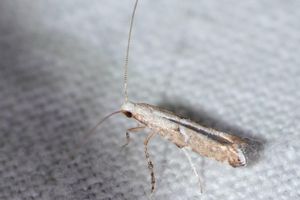
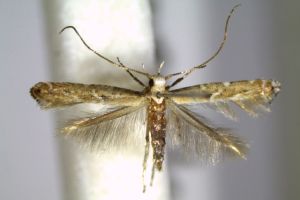
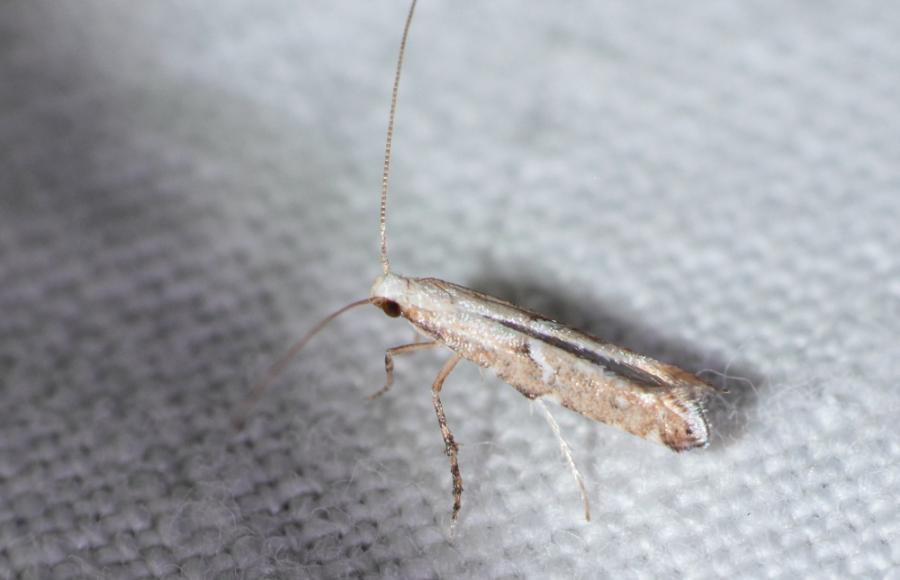
Falck (2025: 697) notierte die Art als neu für die Kanarischen Inseln: "Gran Canaria, El Sao, 110 m, 1 ♂, 1 ♀, 17-30-IX-2018, leg. P. Falck, DNA sample Lepid Phyl 0006PF/CILEP6-19; same data but 1 ♂, 4-23-III-2019, leg. P. Falck; Puntilla de la Caleta, 10 m, 1 ♂, 4-23-III-2019, leg. P. Falck; Pie de la Cuesta, 500 m, 3 ♂, 1 &, 21-VIII-4-IX-2020, leg. P. Falck; Barranco Moya, 80 m, 1 ♀, 8-20-VIII-2020, leg. P. Falck. La Gomera, Valle Gran Rey, 150 m, 1 ♂, 24-X-12-XI-2021, leg. P. Falck (PF). New to the Canary Islands, Spain." Er fasste zur Gesamtverbreitung zusammen: "D. dorsilineella is known from North Africa (Morocco, Tunisia), South Europe (Spain, France, Italy, Malta, Cyprus, Greece), Israel, Turkmenistan and China (De Prins & De Prins, 2024; Pathpiva, 2024)." Unser oben gezeigter Falter stammt aus der Türkei (asiatischer Teil).
(Autor: Erwin Rennwald)
4.3. Typenmaterial
Amsel (1935: 308): „FO: Jordanbrücke 10., 29. 4., nicht häufig.“
4.4. Literatur
- Erstbeschreibung: Amsel, H. G. (1935): Neue palästinensische Lepidopteren. — Mitteilungen aus dem Zoologischen Museum in Berlin 20 (2): 271-319, pl. 9-18.
- Barton, I. (2015): A contribution to the microlepidopteran fauna of Cyprus. — The Entomologist's Record and Journal of Variation 127 (4): 157-167.
- Falck, P. (2025): New data on Gracillariidae from the Canary Islands, Spain. Part 1. Gracillariinae, Oecophyllembiinae(Insecta: Lepidoptera). — SHILAP Revista de lepidopterología, 53 (212): 693-705. https://doi.org/10.57065/shilap.1102. [zur Arbeit mit PDF-Download auf shilap.org]
- Nel, J. & T. Varenne (2015): Atlas des Lépidoptères – Gracillariidae – Gracillariinae (s.l.) - Phyllocnistinae de France. — R.A.R.E. (Revue de l’Association Roussillionnaise d’Entomologie), Supplement au Tome XXIV: 1-160. Perpignan.
- Nunes, J., Corley, M.F.V., Fabião, J.L., Lemos, P. & J. Rosete (2025): New and interesting Portuguese Lepidoptera records from 2024 (Insecta: Lepidoptera). — SHILAP Revista de lepidopterología 53 (212): 799-824. [PDF auf shilap.org]
- Nunes, J., Valkenburg, T. & P. Ramalho (2026): A faunistic survey of Loulé (Algarve, Portugal) moths reveals new additions to the Portuguese fauna (Insecta: Lepidoptera) - Estudio faunístico de las polillas de Loulé (Algarve, Portugal) revela nuevas incorporaciones para la fauna portuguesa (Insecta: Lepidoptera). — Suplemento del Boletín de la Asociación española de Entomología 8: 1-53. [PDF auf entomologica.es]