+16Kontinente:ASAF


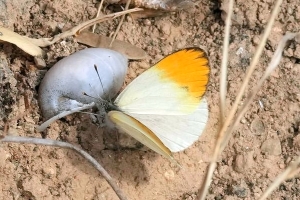
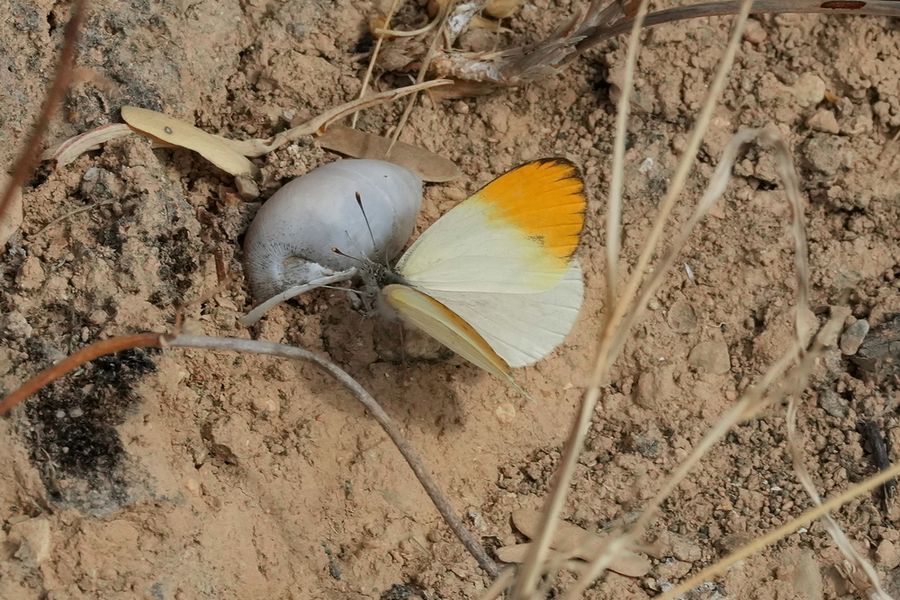
1. Lebendfotos
1.1. Falter
1.1.1. Männchen
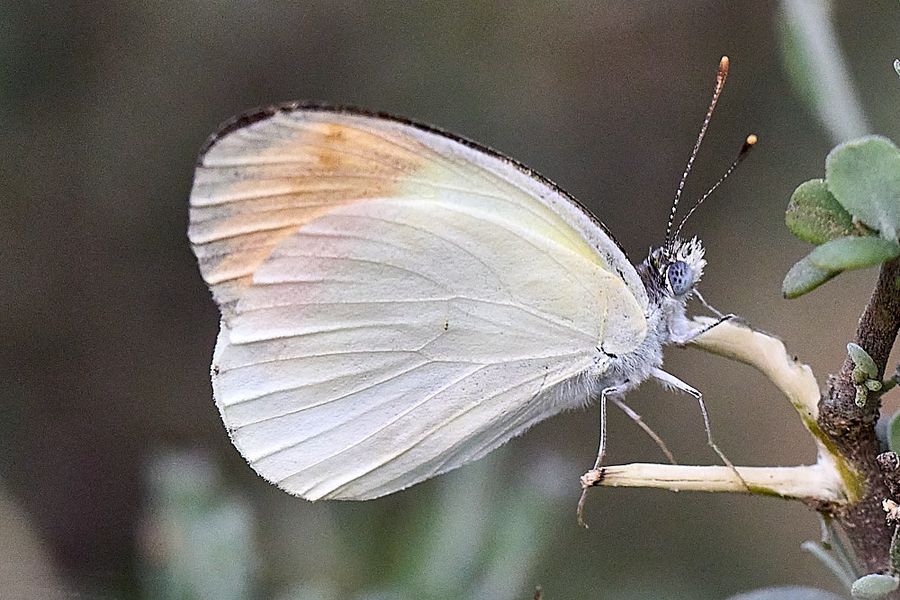
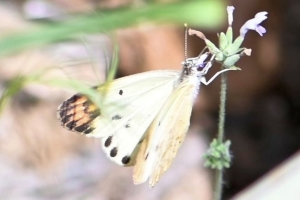
1.1.2. Weibchen


2. Weitere Informationen
2.1. Andere Kombinationen
- Pontia evarne Klug, 1829 [Originalkombination]
- Colotis aurora evarne (Klug, 1829) [bis Nazari et al. (2011) übliche Kombination]
2.2. Taxonomie und Faunistik
Colotis aurora wurde aus Indien beschrieben. Tiere aus Afrika wurden später als ssp. evarne davon abgetrennt. Nazari et al. (2011: 214) kamen im Rahmen ihrer Barcode-Studie zum Schluss, dass es sich dabei um eine nicht nur räumlich getrennte Art handelt: "The correct name for the Indian species (Papilio) eucharis (Fabricius 1775) (junior primary homonym of Delias eucharis Drury 1773) is Colotis aurora (Cramer 1780; Larsen 2005). Considering the large gap between the Indian and the African C. aurora (5.34 ± 0.03%), we recognize the African population as a separate species, C. evarne (Klug 1829) (stat. rev.)." S. 209 hatten sie schon gemeldet: "Both Indian endemic species, C. aurora (group I) and C. etrida (group II), seem to have common ancestors with African species (C. evarne and C. ephyia, respectively) which range as far north as Sudan, Chad, Saudi Arabia and Yemen (Fig. 2). The shallow divergence between these species and their presence in the Arabian Peninsula rejects the possibility of an old vicariance speciation resulting from the severance of the Indian plate from Africa or Madagascar and instead suggests a more recent vicariance or dispersal event in the Near East that resulted in isolation of C. etrida and C. aurora in the Indian subcontinent." Nicht nur alle "Colotis aurora" Afrikas gehören demnach zu C. evarne, sondern auch die des Jemen (und angrenzender Teile des Omans (Dhofar)). Bis Indien wäre in der Tat ein großer Abstand, doch Rajaei et al. (2023: 204) vermerkten zum dazwischen liegenden Iran: "Iranian populations belong to the nominotypical subspecies". Die Art wurde dort nur in Sistan-o-Baluchestan nachgewiesen, also am Rande zum Golf von Oman. Aktuelle Trennlinie - so es sie überhaupt gibt - wäre demnach der Golf von Oman - eigentlich kein unüberwindliches Hindernis. Der genetische Teil der Studie von Nazari et al. (2011) beruhte ausschließlich auf dem Barcoding mitochondrialer DNA. Doch das Barcoding hat auch Grenzen bezüglich der Art-Trennungen. Vielleicht muss hier mit Kern-DNA nachjustiert werden.
(Autor: Erwin Rennwald)
2.3. Literatur
- Erstbeschreibung: Klug, F. (1829): Symbolae physicae seu icones et descriptiones insectorum quae ex itinere per Africam borealem et Asiam occidentalem Friderici Guilelmi Hemprich et Christiani Godofredi Ehrenberg medicinae et chirurgiae doctorum studio novae aut illustratae redierunt. Decas prima: [1]-[34], pl. I-X. Berolini (Officina academica).
- Nazari, V., Larsen, T.B., Lees, D.C., Brattström, O., Bouyer, T., Van de Poel, G. & P.D.N. Hebert (2011): Phylogenetic systematics of Colotis and associated genera (Lepidoptera: Pieridae): evolutionary and taxonomic implications. - Journal of Zoological Systematics and Evolutionary Research, 49 (3): 204–215. doi: 10.1111/j.1439-0469.2011.00620.x. [zum PDF-Download auf researchgate.net]
- Rajaei, H. & O. Karsholt (eds.) (2023): Catalogue of the Lepidoptera of Iran. — In: Rajaei, H. & O. Karsholt (eds.) (2023): Lepidoptera Iranica. — Integrative Systematics 6 (Special Issue): 121–459. [Zum PDF auf bioone.org]