+15Kontinente:AF


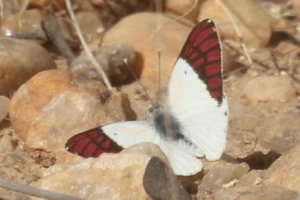
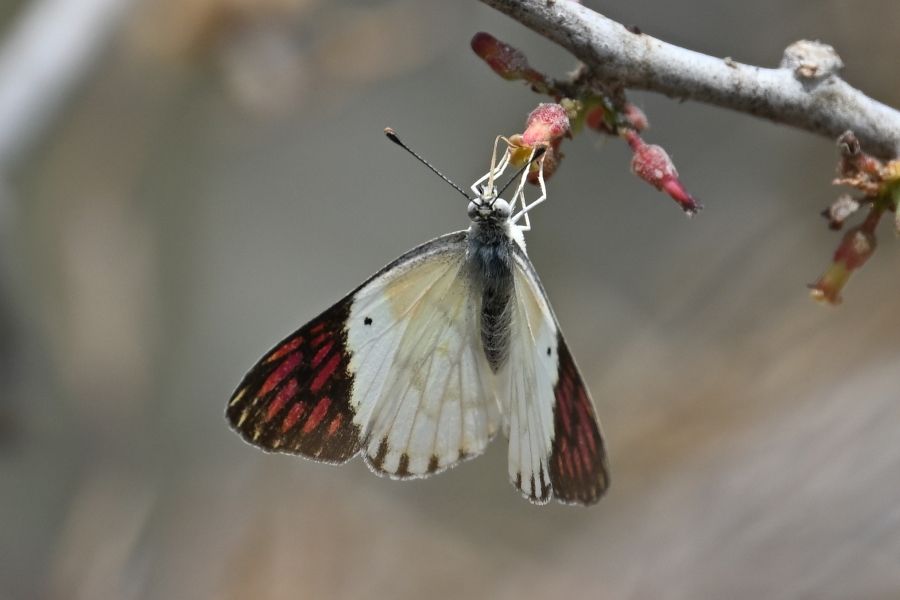
1. Lebendfotos
1.1. Falter

2. Weitere Informationen
2.1. Andere Kombinationen
- Anthocharis celimene Lucas, 1852 [Originalkombination]
2.2. Synonyme
- Anthocharis amina Hewitson, 1866 [Synonym nach funet.fi]
2.3. Unterarten
- Colotis celimene pholoe (Wallengren, 1860) [Unterart nach funet.fi]
- Colotis celimene amina (Hewitson, 1866) [Unterart nach funet.fi]
- Colotis celimene sudanicus (Aurivillius, 1905) [Unterart nach funet.fi]
- Colotis celimene angusi Rothschild, 1921 [Unterart nach funet.fi]
2.4. Taxonomie und Faunistik
Locus typicus gemäß der Erstbeschreibung von Lucas (1852: 426) ist "Abyssinie" [Abessinien], also wahrscheinlich Äthiopien (oder Eriträa?).
Nach [Global Biodiversity Information Facility] kommt die Art in Südafrika, Namibia, Kenia, Malawi, Niger, Tansania, Demokratische Republik Kongo, Mosambik, Uganda, Simbabwe, Eritrea, Nigeria, Gambia, Sudan, Somalia und Sambia vor. Davon wurden die Tiere aus Somalia, die bisher als Colotis celimene praeclarus geführt wurden, neuerdings wieder als eigene Art abgetrennt (Nazari et al. (2011: 211)): "Within C. celimene, individuals from Nigeria (ssp. sudanicus), Niger, Congo and Kenya show only minor variation in their barcodes (0.3 ± 0.1%). Several subspecies currently recognized under C. celimene (e.g. sudanicus, amina, angusi, etc.) may be redundant; however, the Namibian ssp. pholoe is divergent (2.5 ± 0.2%). The Somali ssp. praeclarus has been recently proposed as a distinct species (Bouyer 2010)."
(Autoren: Michel Kettner & Erwin Rennwald)
2.5. Literatur
- Erstbeschreibung: Lucas, H. (1852): Description de nouvelles espèces de Lépidoptères appartenant aux collections entomologiques du Musée de Paris. — Revue et magasin de zoologie pure et appliquée. 2e série 4 (9): 324-345. [Digitalisat auf biodiversitylibrary.org]
- Nazari, V., Larsen, T.B., Lees, D.C., Brattström, O., Bouyer, T., Van de Poel, G. & P.D.N. Hebert (2011): Phylogenetic systematics of Colotis and associated genera (Lepidoptera: Pieridae): evolutionary and taxonomic implications. - Journal of Zoological Systematics and Evolutionary Research, 49 (3): 204–215. doi: 10.1111/j.1439-0469.2011.00620.x. [zum PDF-Download auf researchgate.net]