+3Kontinente:AS


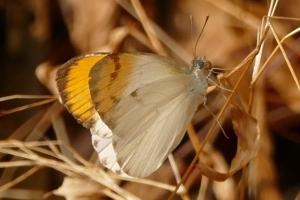
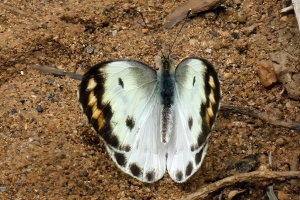
1. Lebendfotos
1.1. Falter
1.1.1. Männchen

1.1.2. Weibchen

2. Biologie
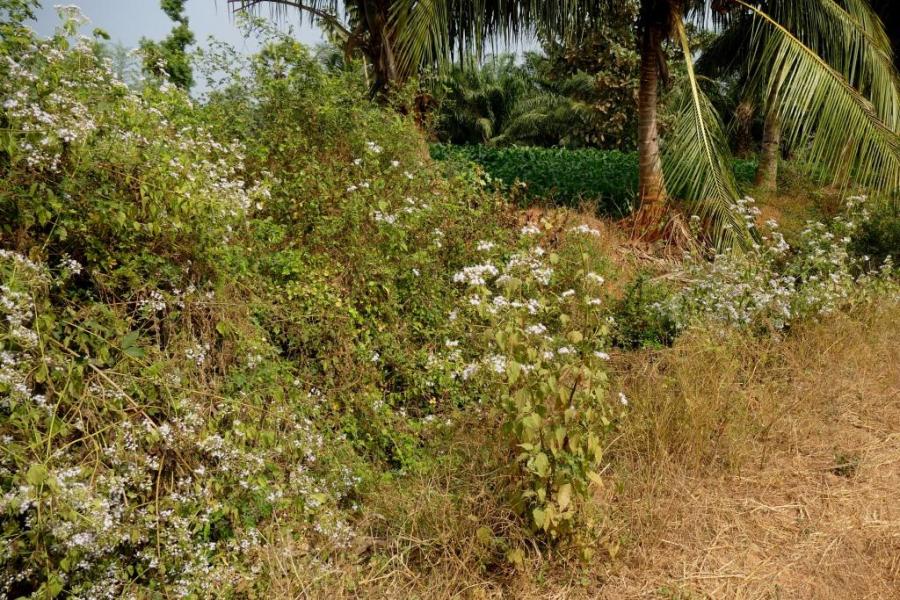
2.1. Habitat
3. Weitere Informationen
3.1. Andere Kombinationen
- Papilio aurora Stoll, [1782] [Originalkombination]
3.2. Synonyme
- Papilio eucharis Fabricius, 1775 [jüngeres primäres Homonym zu Papilio eucharis Drury 1773 [jetzt Delias eucharis (Drury, 1773)]
- Euchloe coeneos Hübner, [1819]
- Pieris titea Godart, 1819
- Teracolus pseudevanthe Butler, 1876
- Teracolus pallens Moore, 1877
3.3. Taxonomie und Faunistik
"Papilio eucharis Fabricius, 1775" wurde von Fabricius (1775: 472) aus dem östlichen Indien ("India orientalis") beschrieben, erwies sich dann aber als jüngeres primäres Homonym zu Papilio eucharis Drury 1773 - jetzt Delias eucharis (Drury, 1773), so dass dieser älteste Name nicht zur Verfügung steht und durch den nächst jüngeren ersetzt werden muss: Colotis aurora mit locus typicus: Côte de Coromandel [Koromandelküste, südöstliche Küste des Indischen Subkontinents]. Hübner ([1819]: 94) gibt keine geographische Auskunft zu seiner "Euchloe coeneos", setzt sie aber mit Colotis aurora von Cramer gleich. Ebenso schuf Godart (1819: 124) mit Pieris titea einen unnötigen Ersatznamen, ebenfalls von der Côte de Coromandel. Butler (1876: 164) beschrieb Teracolus pseudevanthe von Indien und konkreter Bombay. Moore (1877: 49) nannte für seine "Teracolus pallens" Bombay und "N. Canara" als Fundorte.
Nach [Global Biodiversity Information Facility] kommt die Art in Indien, Äthiopien, Tansania, Kenia, Eritrea, Oman, Somalia, Südsudan, Malawi, Uganga, Südafrika, Mosambik, Sudan, Jemen, Kamerun und Sri Lanka vor. Das gilt aber nur, wenn man das Taxon evarne als "Colotis aurora evarne (Klug, 1829)", also als Unterart vob C. aurora führt. Nazari et al. (2011) trennten dieses afrikanische Taxon aber als eigene Art ab, so dass nach ihnen C. aurora nur noch in Indien vorkommt. Sie schreiben (S. 209): "Both Indian endemic species, C. aurora (group I) and C. etrida (group II), seem to have common ancestors with African species (C. evarne and C. ephyia, respectively) which range as far north as Sudan, Chad, Saudi Arabia and Yemen (Fig. 2). The shallow divergence between these species and their presence in the Arabian Peninsula rejects the possibility of an old vicariance speciation resulting from the severance of the Indian plate from Africa or Madagascar and instead suggests a more recent vicariance or dispersal event in the Near East that resulted in isolation of C. etrida and C. aurora in the Indian subcontinent." Nicht nur alle "Colotis aurora" Afrikas gehören demnach zu C. evarne, sondern auch die des Jemen (und angrenzender Teile des Omans (Dhofar)). Bis Indien wäre in der Tat ein großer Abstand, doch Rajaei et al. (2023: 204) vermerkten zum dazwischen liegenden Iran: "Iranian populations belong to the nominotypical subspecies". Die Art wurde dort nur in Sistan-o-Baluchestan nachgewiesen, also am Rande zum Golf von Oman. Aktuelle Trennlinie - so es sie überhaupt gibt - wäre demnach der Golf von Oman - eigentlich kein unüberwindliches Hindernis. Der genetische Teil der Studie von Nazari et al. (2011) beruhte ausschließlich auf dem Barcoding mitochondrialer DNA. Doch das Barcoding hat auch Grenzen bezüglich der Art-Trennungen. Vielleicht muss hier mit Kern-DNA nachjustiert werden.
Für das Synonym "Colotis eucharis Fabricius, 1775" werden bei [[Global Biodiversity Information Facility]] Kenia, Südafrika, Indien, Malawi, Mosambik, Uganda, Tansania, Zentralafrikanische Republik, Sri Lanka, Sudan und Oman aufgelistet. Auch hier bezieht sich der größere Teil der Angaben auf Colotis evarne.
(Autoren: Erwin Rennwald & Michel Kettner)
3.4. Literatur
- Beschreibung als Teracolus pseudevanthe: Butler, A.G. (1876): Revision of the Lepidopterous Genus Teracolus, with Descriptions of the new Species. — Proceedings of the Zoological Society of London, 1876: 126-165, pl. VI-VII. [Digitalisat auf archive.org]
- Beschreibung als Papilio eucharis: Fabricius, J.C. (1775): Systema entomologiae, sistens insectorum classes, ordines, genera, species, adiectis synonymis, locis, descriptionibus, observationibus. 1-832. Flensburgi et Lipsiae (Officina Libraria Kortii). [Digitalisat auf archive.org]
- Beschreibung als Euchloe coeneos: Hübner, J. [1816-1826] („1816“): Verzeichniß bekannter Schmettlinge [sic]: 1-431, 1-72. Augsburg. [Digitalisat auf archive.org]
- Beschreibung als Pieris titea: Latreille & Godart (1819): Encyclopédie méthodique. Histoire naturelle. Entomologie, ou histoire naturelle des crustacés, des arachnides et des insectes 9 (1): 1-328. Paris (Agasse). [Digitalisat auf archive.org]
- Beschreibung als Teracolus pallens: Moore, F. (1877): Descriptions of Asiatic Diurnal Lepidoptera. — The Annals and Magazine of Natural History, Including Zoology, Botany, and Geology. Fourth Series 20 (115): 43-52: 43-52. [Digitalisat auf archive.org]
- Nazari, V., Larsen, T.B., Lees, D.C., Brattström, O., Bouyer, T., Van de Poel, G. & P.D.N. Hebert (2011): Phylogenetic systematics of Colotis and associated genera (Lepidoptera: Pieridae): evolutionary and taxonomic implications. - Journal of Zoological Systematics and Evolutionary Research, 49 (3): 204–215. doi: 10.1111/j.1439-0469.2011.00620.x. [zum PDF-Download auf researchgate.net]
- Rajaei, H. & O. Karsholt (eds.) (2023): Catalogue of the Lepidoptera of Iran. — In: Rajaei, H. & O. Karsholt (eds.) (2023): Lepidoptera Iranica. — Integrative Systematics 6 (Special Issue): 121–459. [Zum PDF auf bioone.org]