+6Kontinente:AF


1. Lebendfotos
1.1. Falter

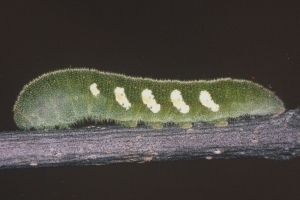
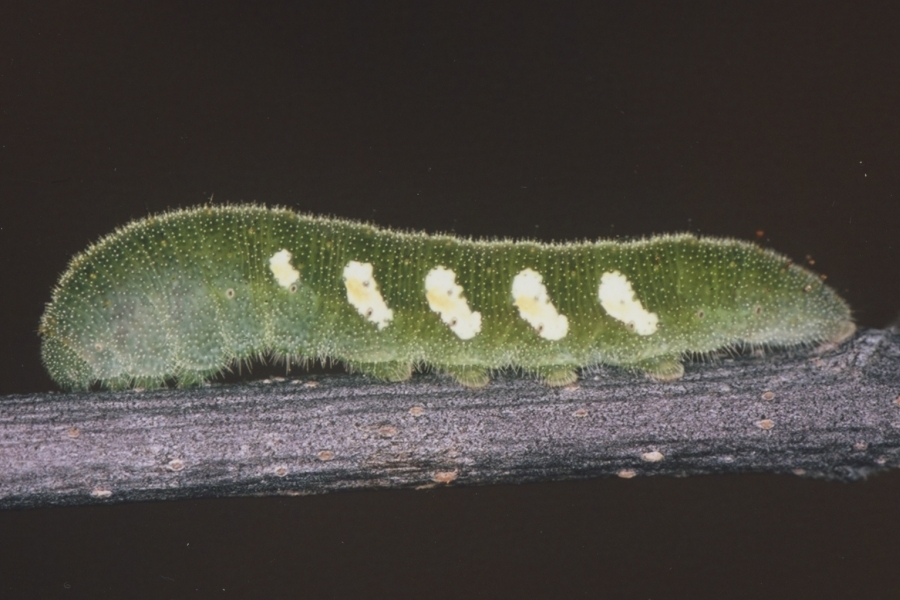
1.2. Raupe
2. Weitere Informationen
2.1. Andere Kombinationen
- Thestias annae Wallengren, 1857 [Originalkombination]
- Colotis danae annae (Wallengren, 1857)
2.2. Synonyme
- Callosune hildebrandti Staudinger, 1885 [jetzt Subspecies von C. annae]
- Teracolus hildebrandti (Staudinger, 1885) [jetzt Subspecies von C. annae]
- Colotis hildebrandti (Staudinger, 1885) [jetzt Subspecies von C. annae]
- Teracolus callidia Grose Smith, 1886 [Synonym zu ssp. hildebrandti]
2.3. Unterarten
- Colotis annae hildebrandti (Staudinger, 1884)
2.4. Taxonomie und Faunistik
Wallengren (1857: 16) beschrieb seine "Thestias annae" aus "Caffraria", also dem Osten Südafrikas. Später wurde sie meist als Unterart zu Colotis danae gestellt. Dagegen galt die von Staudinger (1885: 44) aus Kitui in Kenia beschriebene Colotis hildebrandti meist als gute Art. Nazari et al. (2011: 214) kommen zu einer anderen Gliederung: "Colotis danae from India (ssp. danae) and Iran (ssp. dulcis) are divergent from African populations (3.7 ± 0.9% and 3.9 ± 0.3% respectively) and from one another (3.4 ± 0.2%), while only minor variation exists within the African C. danae (0.5 ± 0.2%). We recognize the subspecies C. danae danae, C. danae dulcis and C. danae eupompe (= pseudocaste syn. nov.). The larger taxon annae Wallengren, 1857 flies in dry parts of South Africa, from Natal to Namibia and north to Zambia and Botswana. Colotis hildebrandti Staudinger (1884) is similarly large and ranges from southern Kenya to central Zambia. Their barcodes were similar (0.38 ± 0.05%). We reinstate C. annae (stat. rev.) as a good species, with ssp. hildebrandti as its northern subspecies (stat. nov.)."
Nazari et al. (2011) führen die Art innerhalb der Gattung Colotis - zusammen mit Colotis guenei und Colotis danae - in ihrer "Group V".
(Autor: Erwin Rennwald)
2.5. Literatur
- Beschreibung als Teracolus callidia: Grose Smith, H. (1886): Description of two new species of Pieridae from Zanzibar. — The Entomologist's monthly magazine, 23: 32. [Digitalisat auf archive.org]
- Nazari, V., Larsen, T.B., Lees, D.C., Brattström, O., Bouyer, T., Poel, G. van de & P.D.N. Hebert (2011): Phylogenetic systematics of Colotis and associated genera (Lepidoptera: Pieridae): evolutionary and taxonomic implications. — Journal of Zoological Systematics and Evolutionary Research, 49 (3): 204–215. doi: 10.1111/j.1439-0469.2011.00620.x. [zum PDF-Download auf researchgate.net]
- Beschreibung als Callosune hildebrandti: Staudinger, O. (1885): Exotische Tagfalter in systematischer Reihenfolge mit Berücksichtigung neuer Arten 1 (7): 39-46, (5) pl. 23. Fürth (G. Löwensohn). [Digitalisat auf archive.org]
- Erstbeschreibung: Wallengren, H. D. J. (1857): Lepidoptera Rhopalocera, in terra Caffrorum annis 1838—1845 collecta a J. A. Wahlberg. — K. Svenska vetenskaps akademiens handlingar 2 (4): 1-55. Stockholm. [Digitalisat auf biodiversitylibrary.org]