+3Kontinente:NAMA



2. Diagnose
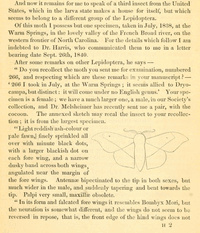
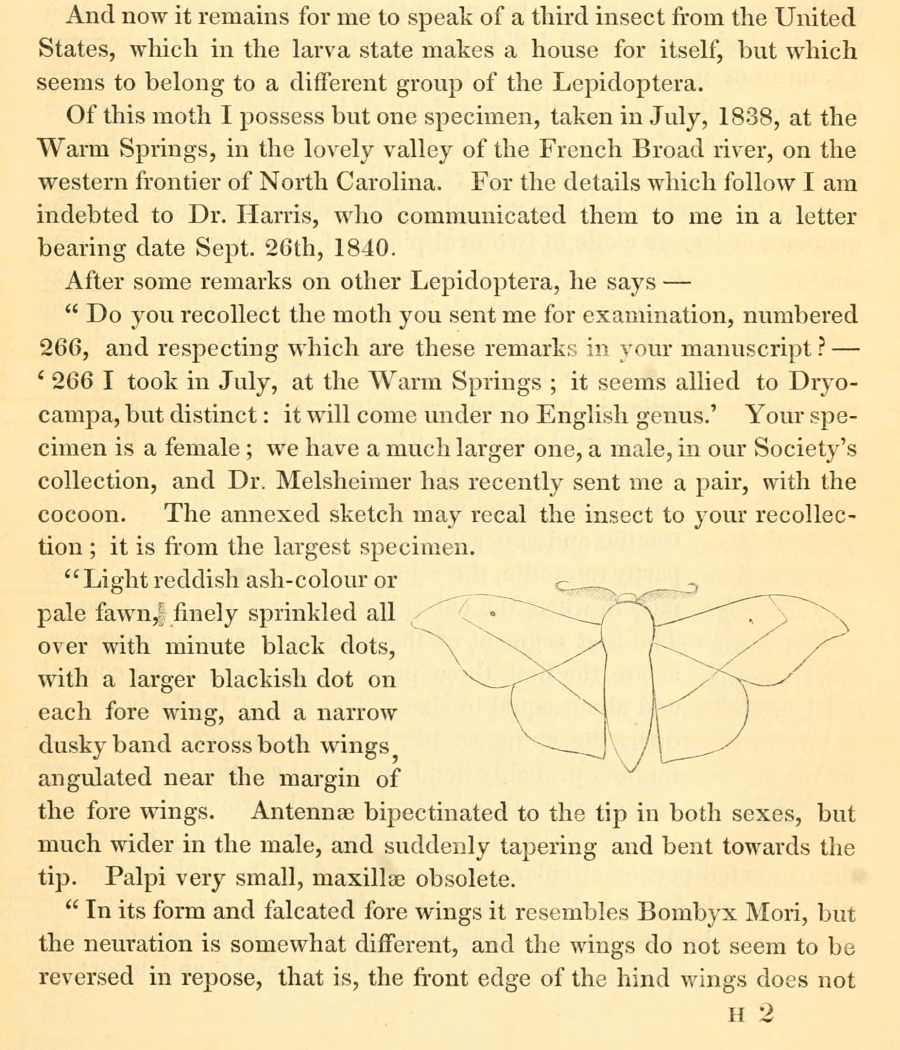
2.1. Erstbeschreibung
3. Biologie
3.1. Nahrung der Raupe
- [Fagaceae:] Quercus sp. (Eiche)
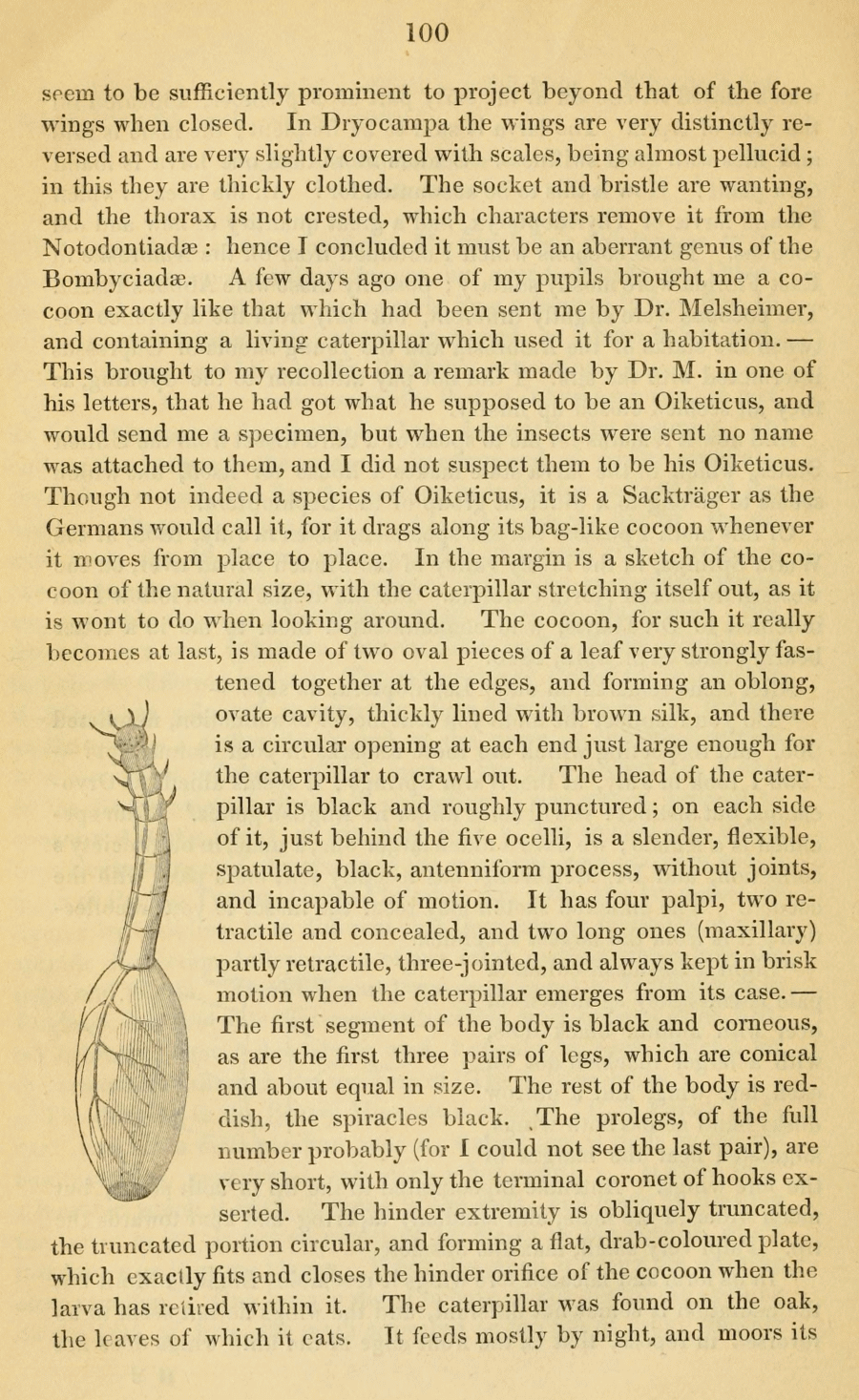
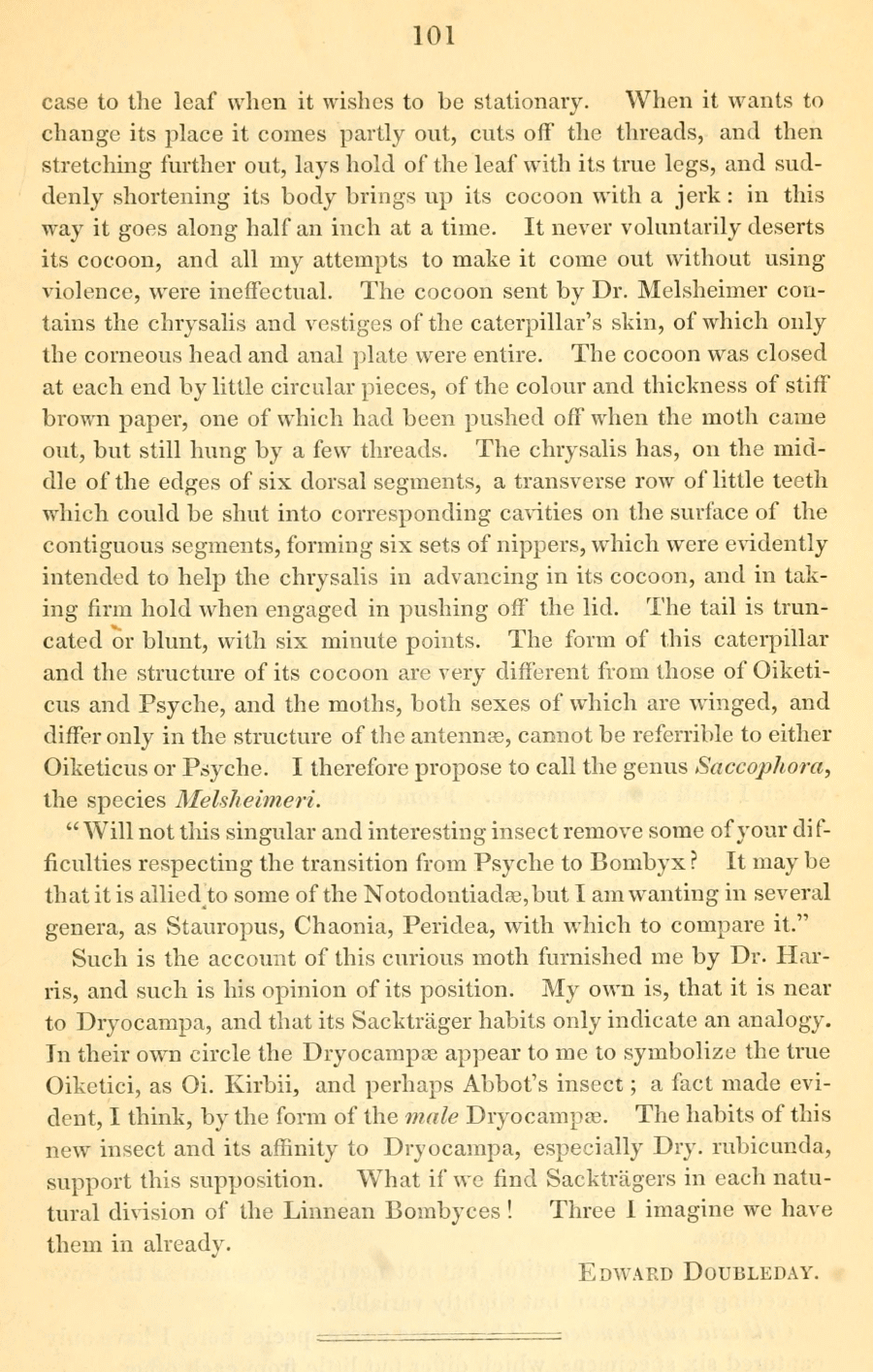
Harris in Doubleday (1841: 99-101) beschrieb nicht nur den Falter, sondern auch seine Raupe: "A few days ago one of my pupils brought me a cocoon exactly like that which had been sent me by Dr. Melsheimer, and containing a living caterpillar which used it for a habitation. — This brought to my recollection a remark made by Dr. M. in one of his letters, that he had got what he supposed to be an Oiketicus, and would send me a specimen, but when the insects were sent no name was attached to them, and I did not suspect them to be his Oiketicus. Though not indeed a species of Oiketicus, it is a Sackträger as the Germans would call it, for it drags along its bag-like cocoon whenever it moves from place to place. In the margin is a sketch of the cocoon of the natural size, with the caterpillar stretching itself out, as it is wont to do when looking around. The cocoon, for such it really becomes at last, is made of two oval pieces of a leaf very strongly fastened together at the edges, and forming an oblong, ovate cavity, thickly lined with brown silk, and there is a circular opening at each end just large enough for the caterpillar to crawl out. The head of the caterpillar is black and roughly punctured; on each side of it, just behind the five ocelli, is a slender, flexible, spatulate, black, antenniform process, without joints, and incapable of motion. It has four palpi, two retractile and concealed, and two long ones (maxillary) partly retractile, three-jointed, and always kept in brisk motion when the caterpillar emerges from its case. — The first segment of the body is black and corneous, as are the first three pairs of legs, which are conical and about equal in size. The rest of the body is reddish, the spiracles black. The prolegs, of the full number probably (for I could not see the last pair), are very short, with only the terminal coronet of hooks exserted. The hinder extremity is obliquely truncated, the truncated portion circular, and forming a flat, drab-coloured plate, which exacily fits and closes the hinder orifice of the cocoon when the larva has retired within it. The caterpillar was found on the oak, the leaves of which it cats. It feeds mostly by night, and moors its case to the leaf when it wishes to be stationary. When it wants to change its place it comes partly out, cuts off the threads, and then stretching further out, lays hold of the leaf with its true legs, and suddenly shortening its body brings up its cocoon with a jerk: in this way it goes along half an inch at atime. It never voluntarily deserts its cocoon, and all my attempts to make it come out without using violence, were ineffectual. The cocoon sent by Dr. Melsheimer contains the chrysalis and vestiges of the caterpillar's skin, of which only the corneous head and anal plate were entire."
St Laurent et al. (2026: 296) erklärten zu ihrer neuen, von C. melsheimeri abgetrennten C. albarenicolus: "Nothing is definitively known about the life history of this new species except that it flies exclusively during the spring (March-May) and its inferred habitat is Florida Scrub (see Distribution below). Presumably, C. albarenicolus feeds on oaks like other North American Mimallonidae, but this must be confirmed. The range of this new species overlaps the ranges and habitats of characteristic oaks of scrub habitats: Myrtle Oak (Quercus myrtifolia Willd.) and Florida Scrub Oak (Quercus inopina Ashe); but C. albarenicolus ranges farther north than Q. inopina and is absent from the northerly part of the range of Q. myrtifolia."
Insgesamt werden die C. melsmeimeri-Raupen anscheinend sehr selten gefunden und wenn, dann werden keine konkreten Eichen-Arten benannt.
(Autor: Erwin Rennwald)
4. Weitere Informationen
4.1. Etymologie (Namenserklärung)
Harris in Doubleday (1841: 99-101) benannte die Art nach Herrn Melsheimer, von dem er Raupenbeschreibung und Falter erhalten hatte.
4.2. Taxonomie und Faunistik
Die Art wurde von Pennsylvania beschrieben. Sie ist in der Osthälfte der USA weit verbreitet und erreich im Norden auch Kanada, im Süden Mexiko. St Laurent et al. (2026) trennten Cicinnus albarenicolus davon ab, eine Art, die in Florida gemeinsam mit C. melsheimeri fliegt, aber sehr viel seltener ist.
(Autor: Erwin Rennwald)
4.3. Literatur
- Erstbeschreibung: Doubleday, E. (1841): Remarks on some North American Lepidoptera. — The Entomologist, 1 (7): 97-101. [Digitalisat auf archive.org]
- St Laurent, R.A., Wehrly, S. & J. Slotten (2026): A new species of sack-bearer moth (Lepidoptera, Mimallonidae) from Florida. — Zookeys, 1273: 287–306. DOI: 10.3897/zookeys.1273.181781. [zum open-access-Artikel auf zookeys.pensoft.net]