+12Kontinente:EUAS


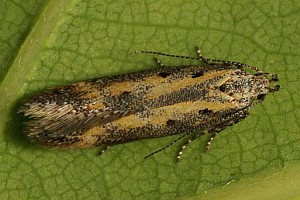
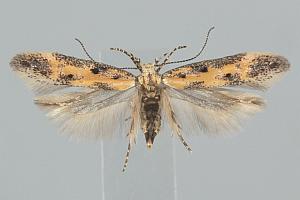
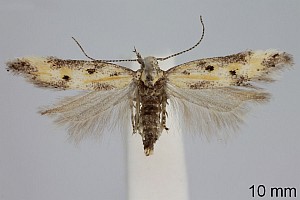

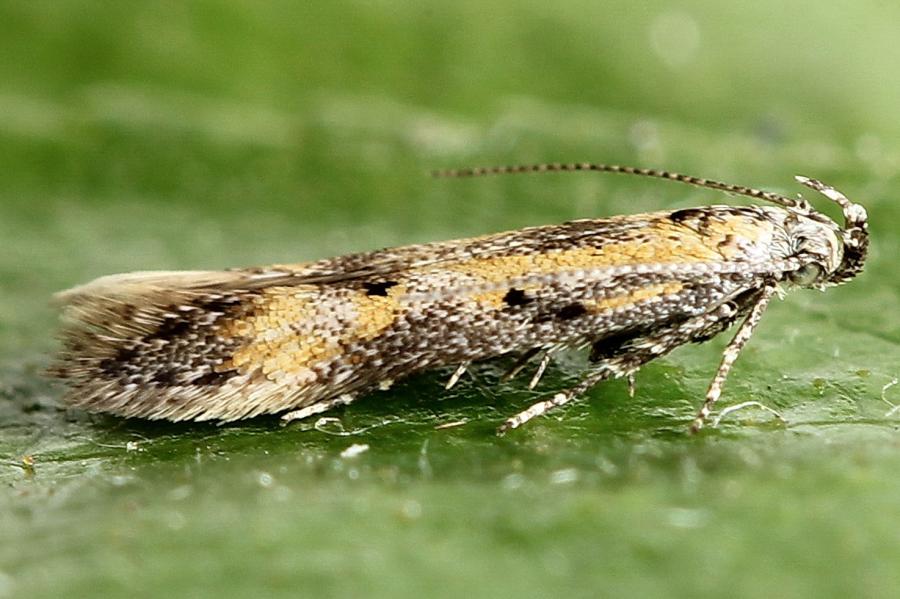

2. Diagnose
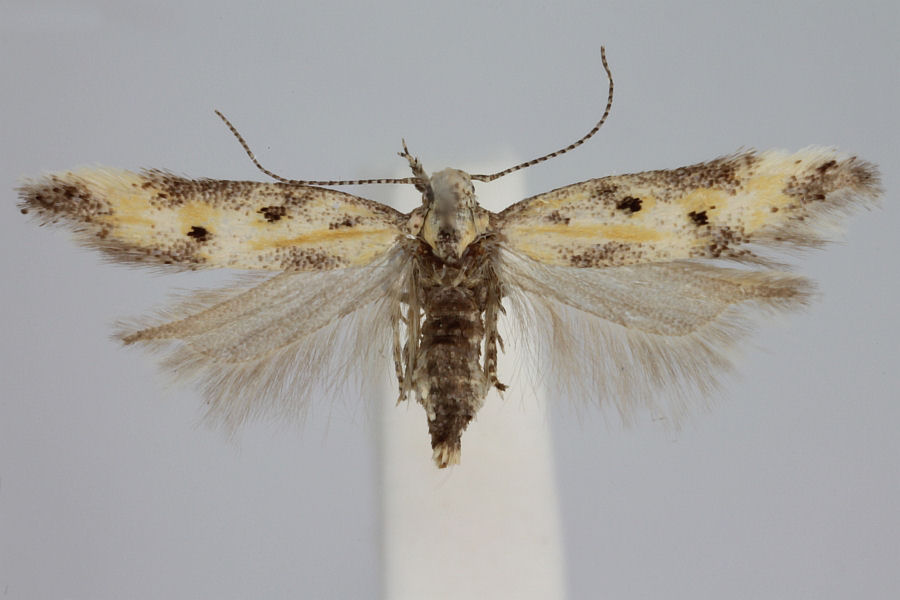
2.1. Weibchen
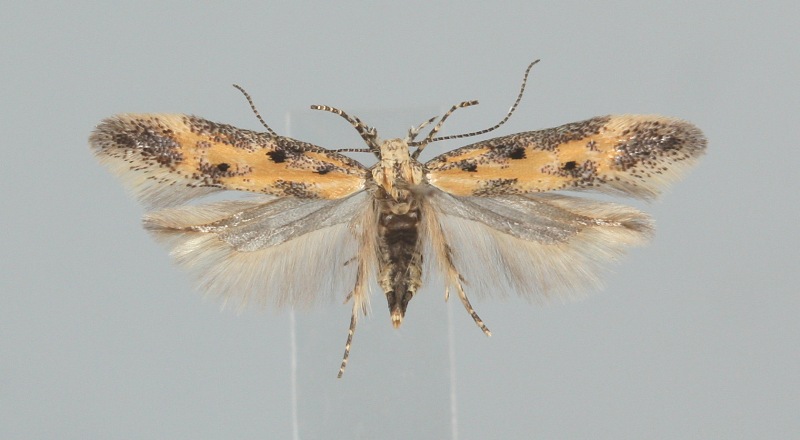
2.2. Geschlecht nicht bestimmt

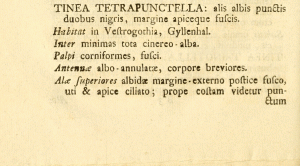
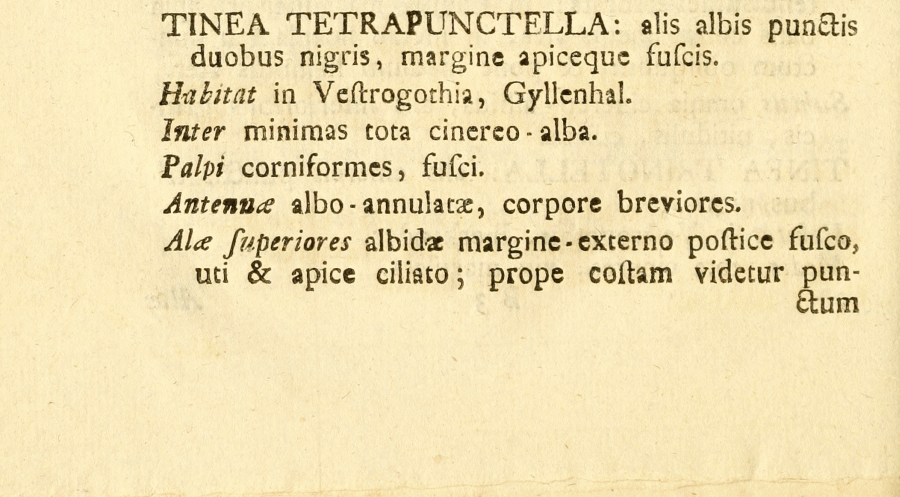
2.3. Erstbeschreibung
3. Biologie
3.1. Nahrung der Raupe
- [Fabaceae:] Lathyrus palustris (Sumpf-Platterbse)
- [Fabaceae:] Lathyrus linifolius (Berg-Platterbse)
- [Fabaceae:] Vicia cracca (Vogel-Wicke)
Stainton (1865: 130-131) meldete zu seiner "Gelechia lathyri": In September, 1863, I received from Mr. T. Brown, of Cambridge, some larvae new to me, feeding on the leaves of Lathyrus palustris; these larvae were evidently referable to some species of Gelechia, but at the time I had not the most remote suspicion of the species they would produce. On the 25th May last, I heard from Mr. T. Brown that he had bred specimens from these larvae, some of which he sent for my opinion : on looking at these specimens, it was quite evident that it was the insect described in my volume of the "Insecta Britannica," under the name of Gelechia Nigricostella : the larva I knew was quite distinct from the larva of Nigricostella and there was, in the perfect insects, sufficient difference to attract my attention. Mr. Brown very kindly offered to send me a supply of pupae if I should like to breed the insect myself; this offer I instantly accepted, and within a week I was setting out fresh specimens of a Gelechia which was very manifestly not Nigricostella, though hitherto known in this country by that name. At the July meeting of the Entomological Society of London I exhibited specimens of this insect, and then proposed for it the name of Gelechia Lathyri. [...] The larva is 4 lines long ; dark dull green ; head black ; second segment black above, with its fiont edge whitish ; anal segment and space between second and third segments paler green ; spots very minute, dark grey in pale blotches. An older larva was greener, not so grey ; but the head and second segment were equally black. This larva makes a white web along the stalk of Lathyrus palustris, and gnaws the stalk and adjoining leaves half through."
Stainton (1867: 229-231) griff das nochmals auf und erklärte zur Raupensuche: "Wenn man in einer Gegend, die diese Art hervorbringt, im August und September die Sumpfplatterbse (Lathyrus palustris) untersucht, so wird man wahrscheinlich manche Blätter gegen den Blattstiel hin benagt und nahe demselben ein schwaches, weisses Gewebe längs des Stengels bemerken. Enthält dieses Gewebe eine schmutzig grünliche Raupe mit schwarzem Kopf und schwarzem Schilde auf dem zweiten Segment, so darf man sie als die der Gelechia lathyri ansehen. [...] Die Raupe nährt sich vom Lathyrus palustris. Sie verfertigt ein schwaches, weisses Gewebe, in dem sie sich aufhält, und das gewöhnlich längs des Stengels der Pflanze angelegt ist. Von da aus frisst sie die benachbarten Blätter und Blattstiele halb durch. Das weissliche Gespinnst befindet sich gewöhnlich an den unteren Theilen des Gewächses. Das Wachsthum der Raupe geht sehr langsam vor sich, da sie sich schon zu Ende Juli vorfindet und erst zu Anfang September erwachsen ist."
Durch Larsen (1927: 195) kam Vicia cracca in die Diskussion: "Denne smukke Art, der meget ligner nigricostella Dup., tog Gudmann i Antal i Aasedamsmosen Bornholm først i August saa han i samme Mose talrige Planter af Vicia cracca overspundne fra Rod til Top med hvidligt Silkespind, og efter grundigt Eftersyn viste det sig, at der forskellige Steder i det spundne fandtes smaa mørkgrønlige Larver med sort agtigt Hoved, gemte i tætte Silkespind. Gudmann er ikke i Tvivl om, at Larverne tilhører Epithectis lathyri Stt., og at Imagines i Juli, som jeg antog var nigricostella Dup., ogsaa er lathyri Stt., hvilket Resultat jeg ogsaa er kommet til efter nærmere Under søgelse. Prof. Rebel har forøvrigt senere bekræftet Bestemmelsens Rigtighed. Larven af lathyri Stt. angives ellers at leve i Spind langs Stænglen af Lathyrus palustris."
Die wurde von späteren Autoren unterschiedlich interpretiert. So schrieben Huemer & Karsholt (1999: 183) recht skeptisch: "It is also suspected to feed on Vicia cracca (Larsen 1927: 195)." Bei Gregersen & Karsholt (2022: 366) heißt es hingegen einfach: "Host-plant. Lathyrus palustris and Lathyrus linifolius (Stainton et al. op. cit..; Bland 2002: 125) and Vicia cracca (Larsen 1927a: 195)". Ist es berechtigt, dass die Zweifel hier einfach gestrichen wurden ? Ja, denn die Autoren können zu Dänemark schreiben: "First recorded as A. nigricostella from Bornholm (B) in 1922 (Gudmann) (Larsen 1927a: 86); subsequently published as Epithectis lathyri (Larsen 1927a: 195). Currently the species is present in two separate areas; one covering most of N and W Jutland where the species is local on heaths (e.g. numerous larvae on V. cracca L. in NEJ: [...]". Dass es sich bei den Tieren an Vicia cracca in Dänemark um A. tetrapunctella handelt, hat sich also bestätigt. Und wie der weibliche Diagnosefalter von Jukka Tabell aus Finnland zeigt, wird die Vogel-Wicke nicht nur ganz regional genutzt.
(Autor: Erwin Rennwald)
4. Weitere Informationen
4.1. Andere Kombinationen
- Tinea tetrapunctella Thunberg, 1794 [Originalkombination]
4.2. Synonyme
- Gelechia lathyri Stainton, 1865
- Gelechia lathyrella Doubleday, 1866
4.3. Faunistik
Nach der nicht mehr online verfügbaren Fauna Europaea kommt die Art in Großbritannien, Irland, Finnland, Norwegen, Schweden, Dänemark, Estland, Lettland und Frankreich vor.
4.4. Literatur
- Gregersen, K. & O. Karsholt (2022): The Gelechiidae of North-West Europe. — 939 pp., Oslo, Norway (Norwegian Entomological Society).
- Huemer, P. & O. Karsholt (2010): Gelechiidae II (Gelechiinae: Gnorimoschemini). — In: Huemer, P., Karsholt, O. & M. Nuss (Hrsg.): Microlepidoptera of Europe 6. 1-586. Stenstrup (Apollo Books).
- Larsen, C.S. (1927): Tillæg til Fortegnelse over Danmark Microlepidoptera. — Entomologiske Meddelelser, 17: 7-211.
- SCHÜTZE (1931): 131
- Beschreibung als Gelechia lathyri: Stainton, H. T. (1865): New British Tinea. — The Entomologist's Annual for MDCCCLXV: 128-131, pl. 1. London (John van Voorst). [Digitalisat auf biodiversitylibrary.org] und [pl. 1, fig. 1]
- Stainton, H. T. (1867): The natural history of the Tineina 10: I-XI, 1-304, Gelechia pl. IX-XVI. London (John van Voorst) – Paris (Deyrolle) – Berlin (E. S. Mittler und Sohn). — Digitalisat auf archive.org: [228-237], [pl. XIV fig. 3] (unter dem Namen Gelechia lathyri).
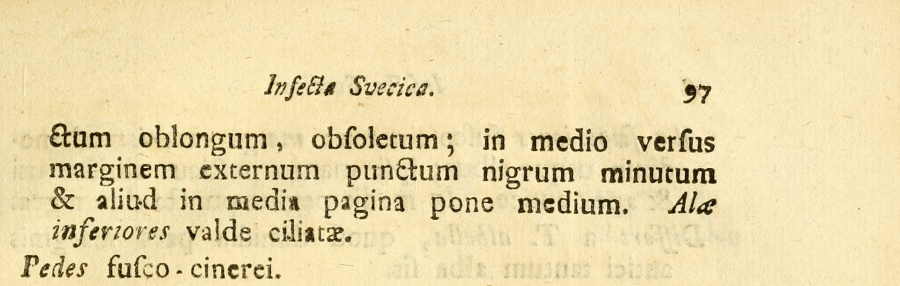
- Erstbeschreibung: Thunberg, C. P. (1794): D. D. dissertatio entomologica sistens insecta svecica 7: 83-98 + pl. Upsala (Johan. Erdman).
4.5. Informationen auf anderen Websites (externe Links)
- [BOLD Systems]
- [svenska_fjarilar]
- [insects.fi] dort unter Athrips tetrapunctellus zu finden.