+3Kontinente:EUAS



2. Diagnose
2.1. Geschlecht nicht bestimmt

3. Biologie
3.1. Nahrung der Raupe
- [Rosaceae:] Spiraea sp. (Spierstrauch)
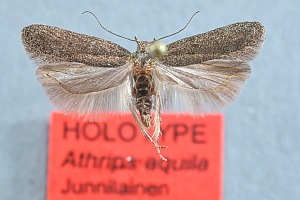
Junnilainen & Nupponen (2010: 23) teilten in ihrer Erstbeschreibung mit: "The species occurs in steppe habitats with dominant shrubs such as Spiraea crenata, Spiraea hypericifolia, Caragana frutex and Cotoneaster melanocarpus (see also Remarks). [...] Remarks. Systematically Athrips aquila should be placed near A. patockai. In the collection of ZISP there are two specimens of A. aquila from Kazakhstan: a male labeled “Dzhungarskiy Ala-Tau, Chatyrdag, 4 km NE Topolevka, Sarkand district, larva on Spiraea from 28.IV, imago 03.VII.1957 (V. I. Kuznetzov) (gen. prep. No 34/02); a female bearing a similar label, imago 29.VII.1957 (V. I. Kuznetzov) (gen. prep. No 37/02) (Bidzilya pers. comm.)." Da Athrips patockai als Raupe an Spiraea media lebt, ist es nicht verwunderlich, dass auch die nahe verwandte Art A. aquila an Spiraea gefunden wurde - die genauen Arten sind noch zu ermitteln.
(Autor: Erwin Rennwald)
4. Weitere Informationen
4.1. Etymologie
Junnilainen & Nupponen (2010: 23) erklärten: "Etymology. Latin aquilus = dark color. The species name is derived from the dark colour of the forewings."
4.2. Faunistik
Die Art wurde aus dem Südural (Russland) beschrieben und ansonsten aus dem Südosten Kasachstans erwähnt. Kovács & Kovács (2022: 36) überraschten mit ersten Nachweisen aus Rumänien: "First record for the Romanian fauna: Dobrogea, Măcin Mountains, Greci, 250 m, 26.V.2007, genitalia prep. 1775/♂/ Kovács, 1 ♂; 22.VIII.2009, genitalia prep. 1772/♂ and 1773/♀/ Kovács, TLMF Lep 27426, 24 ♂, 1 ♀, legit S. & Z. Kovács, coll. TLMF, coll. ZMUC, coll. S. & Z. Kovács. All were attracted to light. A recently barcoded specimen clustered into the BIN BOLD:ADO3593 to 0.32 % p-distance to a specimen from the southern Ural Mountains (BOLD Systems, accessed 1 December 2020)."
(Autor: Erwin Rennwald)
4.3. Literatur
- Erstbeschreibung: Junnilainen, J. & K. Nupponen (2010): The gelechiid fauna of the Southern Ural Mountains, part I. descriptions of seventeen new species (Lepidoptera: Gelechiidae). — Zootaxa 2366: 1-34 [PDF auf researchgate.net].
- Kovács, Z. & S. Kovács (2022): An overview of the Romanian Gelechiidae (Lepidoptera) summarizing the current knowledge in an updated and annotated checklist. — Entomologica romanica 26: 1-76. [PDF auf entomologica-romanica.reviste.ubbcluj.ro]