+22Kontinente:EUAS


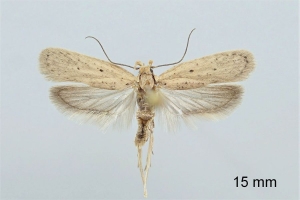



1. Lebendfotos
1.1. Falter

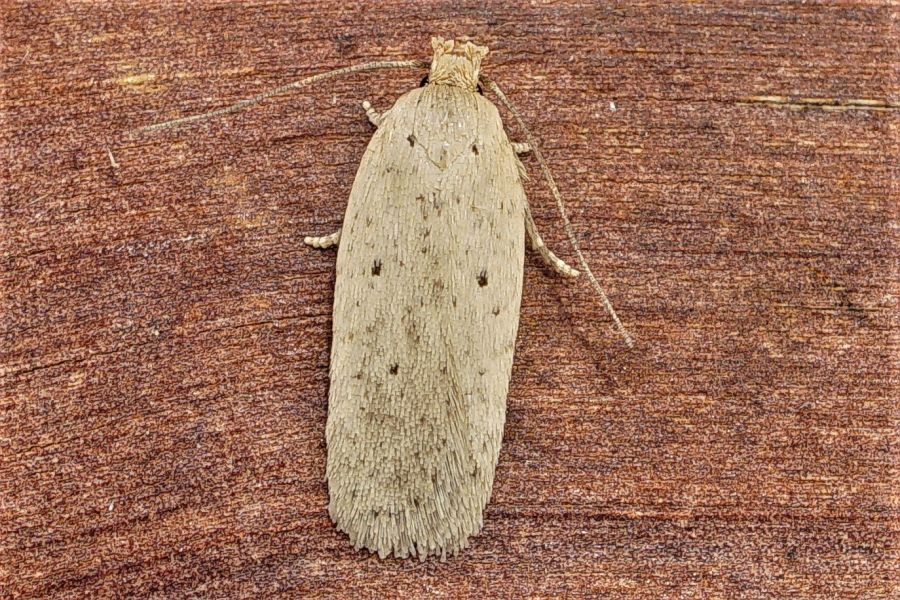
1.2. Raupe


1.3. Befalls-Spuren

2. Diagnose
2.1. Weibchen
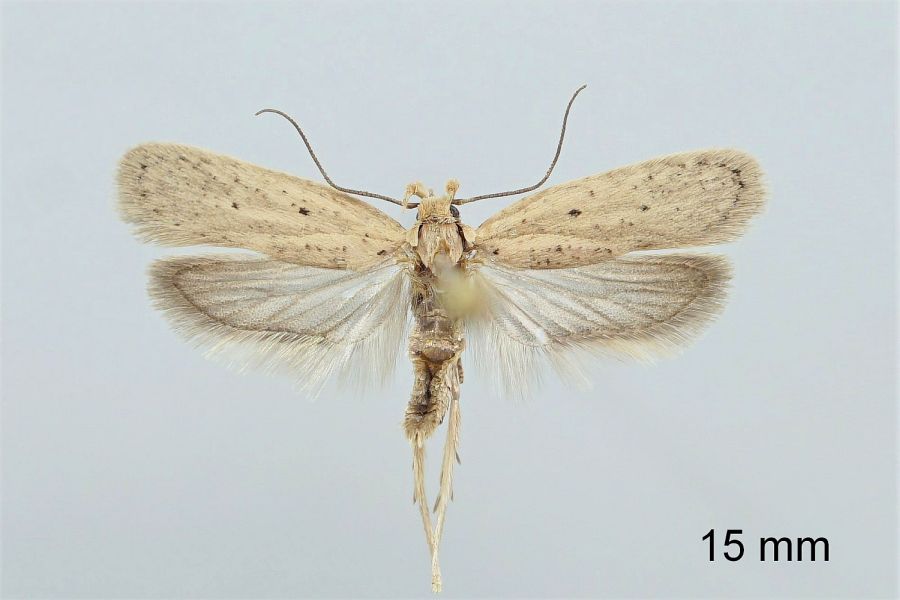
2.2. Geschlecht nicht bestimmt

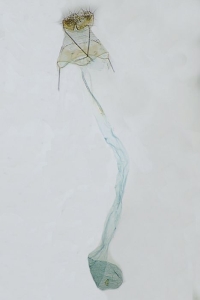
2.3. Genitalien
2.3.1. Weibchen
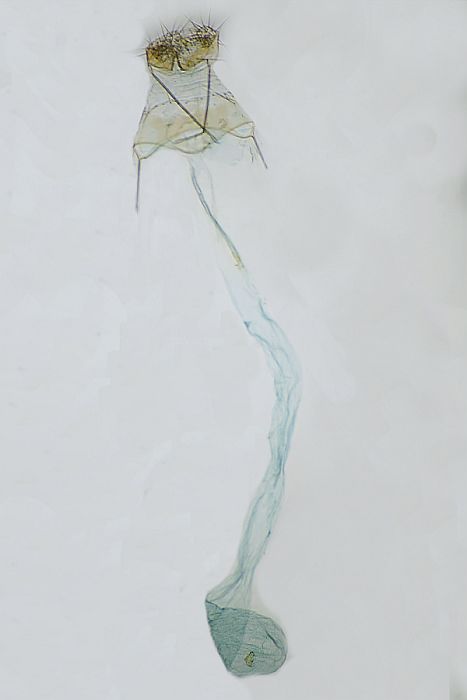

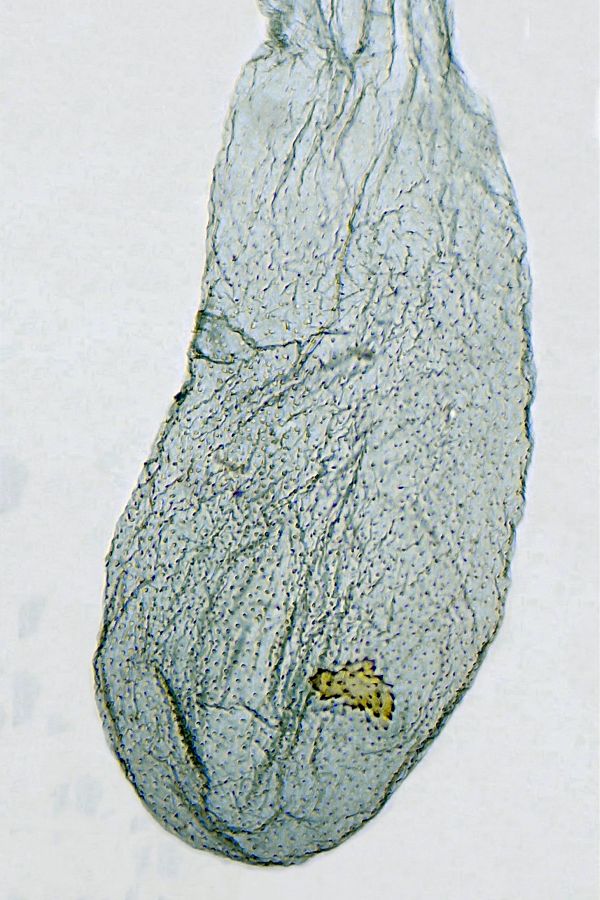
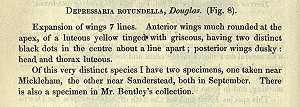
2.4. Erstbeschreibung
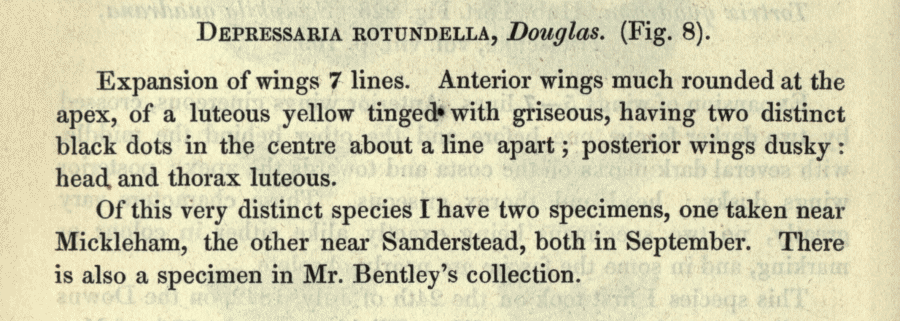

3. Biologie
3.1. Habitat

3.2. Raupennahrungspflanzen

3.3. Nahrung der Raupe
- [Apiaceae:] Daucus carota (Wilde Möhre, Speise-Möhre)
- [Apiaceae:] Distichoselinum tenuifolium
- [Apiaceae:] Orlaya grandiflora (Strahlen-Breitsame)
Die Art scheint weitestgehend an die Wilde Möhre (Daucus carota gebunden zu sein. Buchner & Corley ([2024]: 41) können ergänzen: "Larva on Daucus carota L. (Hannemann, 1953), with single records from Distichoselinum tenuifolium (Lag.) Garcia-Martin & Silvestre (Corley, 2005) and Orlaya grandiflora (L.) Hoffm. (R. Heckford and S. Beavan, pers. comm.)."
(Autor: Erwin Rennwald)
4. Weitere Informationen
4.1. Andere Kombinationen
- Depressaria rotundella Douglas, 1846 [Originalkombination]
4.2. Synonyme
- Depressaria peloritanella Zeller, 1847
4.3. Faunistik
Nach Gaedike & Heinicke (1999) in Deutschland nur mit Angaben von vor 1980 aus Baden-Württemberg und Thüringen bekannt.
Šumpich (2013: 21) meldete die Art als neu für Kroatien: "Krk island, Baščanska Draga, 21.–22.viii.1994, 1 ♂; Turanj near Biograd, 22.–27. viii.2004, 1 ♂; Pirovac env., Tisno, 15.–17.vii.2003, 1 ♂, 13.–20.viii.2007, 1 ♂; Pelješac penin., Žuljana, 1.–13.vii.2005, 1 ♂. Widely distributed in southern and western Europe (locus typicus: United Kingdom), locally recorded also in central Europe. In the Balkans known only from Romania and Greece. First record for Croatia."
Im Moment fällt in unserer Karte die Lücke in Tschechien auf. Dabei gibt es von dort durchaus Daten unter diesem Namen. Šumpich & Liška (2018: 50) stellten aber fest, dass sie allesamt zur neu beschriebenen D. medelichensis gehören: "On the basis of this taxonomic change we report it as new species for the Czech Republic and at the same time we remove A. rotundella from the Czech checklist." Das könnte durchaus noch für weite Nachbarländer gelten, eben gerade für die hier zitierten Meldungen aus Kroatien und Griechenland.
Huemer et al. (2025) meldeten die Art mit BIN BOLD:ADC0980 als neu für Zypern.
(Autor: Erwin Rennwald)
4.4. Literatur
- Corley, M. F. V. (2005): Further additions to the Lepidoptera of Algarve, Portugal. II (Insecta: Lepidoptera). — SHILAP Revista de lepidopterología 33: 347-364. [zum PDF-Download auf researchgate.net]
- Erstbeschreibung: Douglas, J. W. (1846): Descriptions of Ten New British Moths. — The Zoologist: A Popular Miscellany of Natural History 4: 1266-1270. London (John van Voorst).
- Gaedike, R. & W. Heinicke (1999): Verzeichnis der Schmetterlinge Deutschlands (Entomofauna Germanica 3). — Entomologische Nachrichten und Berichte, Beiheft 5: 1-216.
- Hannemann, H. J. (1953): Natürliche Gruppierung der europäischen Arten der Gattung Depressaria s. l. (Lep. Oecoph.) (begründet auf die Bildung der männlichen Kopulationsorgane und in Beziehung gesetzt zur Verwandtschaft der Wirtspflanzen ihrer Larven). — Mitteilungen aus dem Zoologischen Museum in Berlin 29 (2): 269-373.
- Huemer, P., Özden, Ö., Rennwald, E., Barton, I., Junnilainen, J., Hausmann, A., Nieukerken, E.J. van & P.D.N. Hebert (2025): Well-Known, Misidentified, or Unnamed? A DNA Barcode-Based Reassessment of the Lepidoptera Fauna of Cyprus Supported by Morphology. — Insects, 17 (4): 1-27. https://doi.org/10.3390/insects17010004. [zum Artikel mit PDF-Download + Supplementary material auf mdpi.com]
- SCHÜTZE (1931): 151
- Šumpich, J. (2013): Faunistic records of some Microlepidoptera from Croatia. — Entomologia Croatica, 17 (1–4): 13–33. [PDF auf hrcak.srce.hr] bzw. [PDF auf entomologicalservice.com]